
🤩 Bible Stories to Marvel At
Where God’s miracles become great – for little and big children
💎 Job Chapter 28 – Job Searches for True Wisdom
🔦 When Wisdom Lies Deeper Than Gold
🌅 Introduction
In the previous chapter, Job had spoken with great firmness. He did not want to give up his integrity. Even though his friends repeatedly accused him, he refused to lie or confess guilt that was not his. To Job, truth was more precious than quickly making peace with people.
Now the tone changes. Job does not speak first about his friends, nor does he speak directly about his illness. He opens a wide window into the world of human activity and shows how far people will go when they search for treasures.
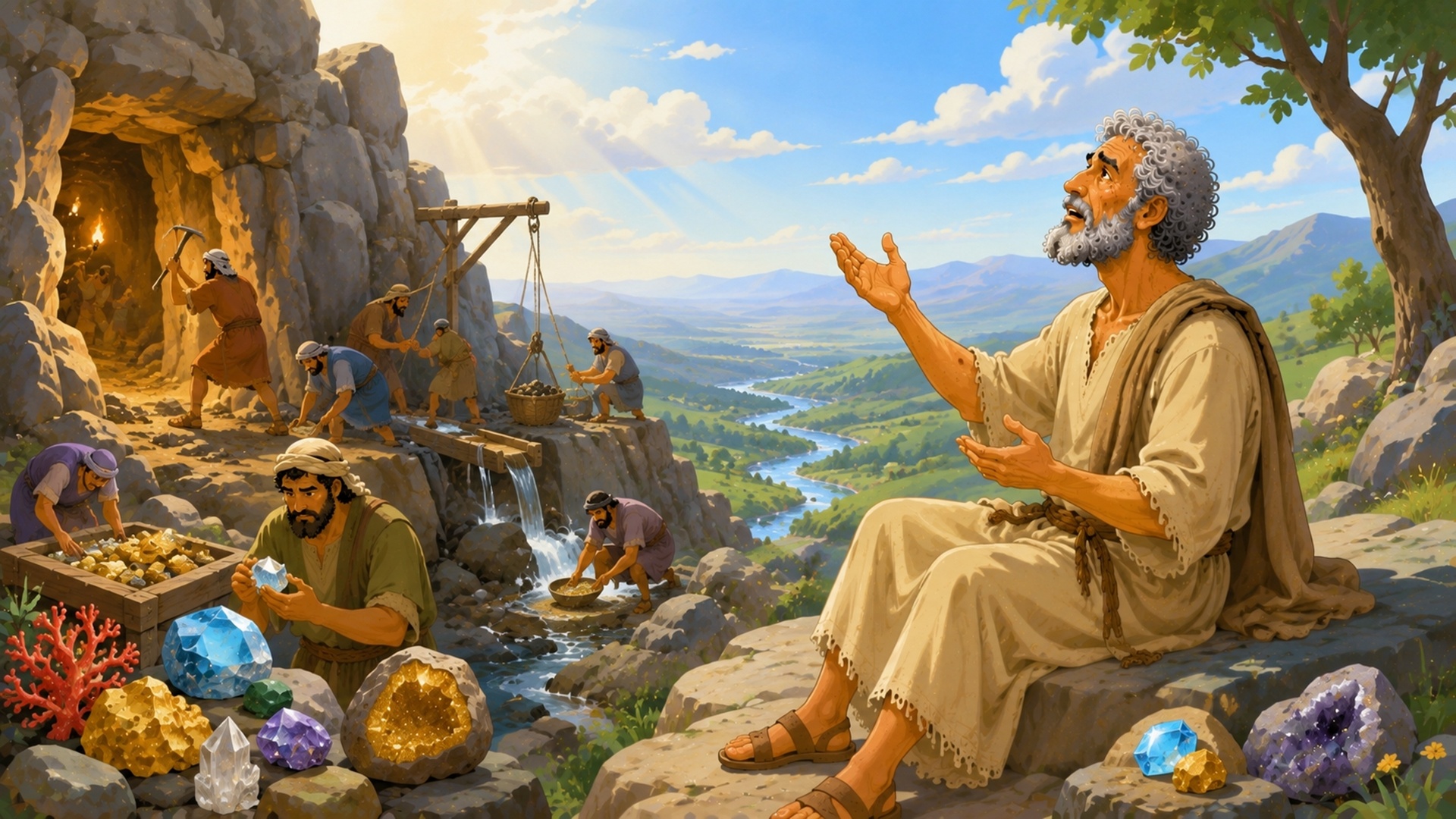
People dig deep into the earth. They search for silver, gold, copper, iron, and precious stones. They enter places no bird sees and no wild animal walks. They bring light into dark tunnels and draw hidden treasures out of the depths.
But then Job asks a far greater question: If people can find so many hidden things, why can they not discover wisdom by themselves? Where does wisdom dwell? Where is the place of understanding?
This chapter tells us that wisdom is more valuable than gold, silver, pearls, and precious stones. It cannot be bought, dug out of the ground, or conquered by human strength. True wisdom comes from God. In the end, Job shows that the beginning of true wisdom is reverence for the Lord and turning away from evil.
📖 The Biblical Story
⛏️ People Search Deeply for Treasures
Job begins with a picture from the world of miners. He speaks of places where silver is found and locations where gold is refined. Iron is taken from the earth, and copper is smelted from stone.
This is an exciting picture. People do not look only at what lies on the surface of the earth. They dig deeper. They discover that hidden treasures lie beneath their feet—treasures that cannot be seen immediately.
Children can imagine it as a great treasure hunt. Above ground, everything looks ordinary: stones, earth, dust, and rocks. Yet deep beneath the surface, shining treasures may be hidden. It takes work, patience, courage, and light to find them.
In this way, Job shows how intelligent and inventive people can be. They learn how to open the earth and make hidden things visible. But this human ability has a limit.
🕯️ Light Enters the Darkness
Job describes how people bring an end to darkness. They descend deep underground, where it is dark, and search into the most hidden corners. They bring light into places where no one lives.
The picture is powerful. Beneath the earth, it is dark, narrow, and dangerous. No ray of sunlight simply reaches those depths. Yet people find ways to work even there. They carry light with them and continue searching.
We can imagine a miner descending into a deep shaft with a lamp. Above him, the bright world is left behind. Beneath him lie darkness, rocks, and unknown passages. Yet he continues because he hopes to find something precious.
Job marvels at this human ability. People can be courageous. They can investigate, build, dig, and discover. They can reach places that were once hidden.
🏞️ Hidden Paths That Almost No One Knows
Job tells of paths far away from other people. Deep below the surface, there are routes that no ordinary traveler knows. Miners hang in shafts, far from inhabited places, moving through areas where no one else goes.
Above ground, food grows. Fields produce grain. People see plants, animals, and roads. But deep beneath the surface, the earth is turned over as though another world existed below.
This makes Job’s picture so vivid. Above is everyday life. Below is mystery. Above, people walk along roads. Below, others search in the depths for treasure.
Job shows that people can enter places that are hidden and dangerous. They can accomplish much. Yet the most important question remains unanswered: Can they also find wisdom?
🦅 Places No Eagle Can See
Job says that there are paths no bird of prey knows and no eagle’s eye has seen. The eagle has exceptionally sharp vision. It flies high in the sky and sees things that people can hardly recognize.
Yet even the eagle cannot see the hidden paths beneath the earth. Proud, wild, and powerful animals do not walk there either. The hidden treasures lie in places even the animals do not know.
For children, this is a beautiful picture: Imagine an eagle flying high above mountains and valleys. It sees rivers, trees, animals, and fields. But it cannot see what is hidden deep inside the earth.
In this way, Job makes clear that people can discover certain hidden things that even animals cannot reach. Yet true wisdom remains hidden even more deeply.
🪨 People Move Rocks and Mountains
Job describes how people lay their hands upon hard rock and overturn mountains from their foundations. They cut tunnels through stone and see precious things hidden there.
This shows strength and perseverance. Rocks are hard. Mountains appear immovable. Yet people work day after day, piece by piece, until pathways open and treasures become visible.
Sometimes great patience is needed to find something valuable. A miner cannot simply reach into the ground once and immediately pull out gold. He must search, dig, examine, and persevere.
Job uses these images so that his listeners will understand: People make great efforts to obtain earthly treasures. Yet there is one treasure far more valuable that cannot be found in the same way.
💧 People Stop Water and Bring Hidden Things to Light
Job also speaks of people blocking underground streams and bringing hidden things into the light. Water can be powerful. It flows, seeps in, and can block pathways. Yet people find ways to hold it back and continue searching.
In this way, things that were previously hidden become visible. Precious stones, metals, and shining objects emerge from the darkness. What lay within the rock for a long time is suddenly seen.
This image fits Job’s great question. People can bring hidden things into the light. But can they also uncover the deepest truth of life? Can they explain why suffering happens? Can they fully understand God’s ways?
Job knows the answer is no. Human intelligence can discover many things, but it cannot explain everything. There is a wisdom that lies deeper than any mine shaft.
❓ Where Can Wisdom Be Found?
Then Job asks the great question of the chapter: Where can wisdom be found? Where is the place of understanding? This question suddenly stands like a bright light in the middle of the story.
People know where to search for silver. They know how to refine gold. They know where iron and copper are found. But where can wisdom be found?
Wisdom is more than possessing a great deal of information. A person may know many things and still act foolishly. Someone may calculate, build, write, and read, yet fail to understand what is good, just, and true.
Job is asking about the wisdom that sees life correctly—the wisdom that honors God, knows when to speak and when to remain silent, and does not judge hastily in times of suffering.
👣 People Do Not Know Its Way by Themselves
Job says that human beings do not know the way to wisdom. It is not found in the land of the living as though someone could simply travel there and collect it.
This is a serious thought. People can be highly intelligent and still fail to discover the deepest wisdom by themselves. They can build cities, gather treasures, and explore many things. But the wisdom of God does not simply lie within human reach.
For children, we might say: A person can have a room full of books and still not automatically possess a wise heart. Wisdom does not mean only knowing many words. Wisdom means respecting God and doing what is right.
Job shows that we need God in order to become truly wise. Without Him, we see only part of the picture.
🌊 The Deep and the Sea Say: It Is Not with Us
Job allows the deep and the sea to speak. The deep says, “Wisdom is not in me.” The sea says, “It is not with me.” Even the vast and mysterious waters cannot produce wisdom.
The sea appears immense and unfathomable. It contains hidden depths, powerful waves, and countless mysteries. Yet wisdom cannot simply be found there either.
Job makes the search increasingly vast. It is not only the earth that cannot simply provide wisdom. The deep and the sea cannot supply it either. Wisdom is not like a stone that can be lifted or a shell found along the shore.
Wisdom is a gift that is higher and deeper than the visible world.
💰 Wisdom Cannot Be Bought
Then Job speaks of gold, silver, and precious objects. He says that wisdom cannot be purchased with gold, nor can its price be weighed out in silver.
This is an important message. Some people think that enough money can obtain anything. Houses, clothing, tools, books, and beautiful objects can be purchased. But wisdom cannot be bought like an item at a market.
Children can imagine a rich man arriving with a large bag filled with gold and saying, “I would like to buy wisdom.” But no one can sell him true wisdom. It has no price tag.
Wisdom is more precious than money because it guides the heart. Gold may shine, but it cannot teach someone how to live justly, mercifully, and reverently before God.
💎 Wisdom Is More Precious Than Gemstones
Job names many precious things: gold, onyx, sapphire, coral, crystal, pearls, topaz, and other treasures. Everything people consider beautiful and valuable cannot compare with wisdom.
Gemstones can sparkle. They can be set in crowns, rings, or precious vessels. People admire their colors and brilliance. Yet wisdom is even more valuable.
Why? Because gemstones shine only on the outside. Wisdom brings light into the heart. It helps a person choose the right path, speak kindly, honor God, and avoid evil.
Job shows that the greatest treasure is not something that can be placed inside a chest. The greatest treasure is a heart that reveres God and loves what is good.
🕊️ Even the Animals Do Not Know the Way to Wisdom
Job says that wisdom is hidden from the eyes of every living creature and concealed even from the birds of the sky. Animals that fly far or see deeply do not know its location.
The eagle finds prey. The lion finds pathways through the wilderness. Birds know the air, fish know the water, and animals know their paths. But they do not find true wisdom.
Once again, Job shows that wisdom is not simply part of nature, as though it could be picked up somewhere. Nature can teach us much about God’s greatness, but true wisdom comes from God Himself.
People can learn from creation. But they must look beyond creation to the Creator.
🕳️ Destruction and Death Have Only Heard of It
Job even speaks of destruction and death. They say, “We have heard only a report of it with our ears.” This means that even the most mysterious realms do not truly know wisdom.
This makes wisdom even more mysterious. It cannot be found in the mountains, the sea, among the birds, in the depths, or in death.
Job takes us on a great journey. We descend into the earth, look upon precious stones, rise in our thoughts toward the sky, gaze into the sea, and even approach the boundary of death. Everywhere the answer is the same: It is not here.
This makes the suspense even greater: If no one within creation possesses wisdom, who then knows its way?
👑 God Knows the Way to Wisdom
Now comes the great answer: God understands the way to wisdom, and He knows its place. What human beings cannot discover is known to God.
God sees to the ends of the earth. He looks upon everything beneath the heavens. No place is hidden from Him. No thought is too deep for Him. No pathway is too dark.
God does not know only the treasures of the earth. He knows the order of the world. He understands how wind, water, rain, and storms fit together. He sees how everything in His creation has its proper place.
Therefore, anyone who desires to know true wisdom must look to God. Neither gold, the depths, the sea, nor human pride can provide it. God alone knows its origin.
🌦️ God Orders the Wind, Water, and Rain
Job describes how God gives weight to the wind and measures the waters. He establishes a law for the rain and a pathway for lightning and thunder.
These are beautiful images from nature. The wind cannot be held in one’s hand, yet it is not disordered before God. Water flows and falls, but God knows its measure. Storms appear wild, yet even they are not beyond His power.
Children can be told: When rain taps against the windows and thunder rolls in the distance, we may marvel. Nature is vast and powerful, but God is greater. He knows the pathways of wind and water.
Job shows that God does not merely possess wisdom. He has also placed wisdom within His creation. Everything has weight, measure, and direction before Him.
📖 God Saw Wisdom and Revealed It
Job says that God saw wisdom, declared it, established it, and examined it. These words show that wisdom does not lie hidden in darkness from God. He knows it perfectly.
Human beings cannot grasp it by their own strength, but God can reveal it. God can teach people what truly matters. He can show them a way that is good and true.
This is comforting. Wisdom cannot be bought, but neither is it hopelessly unreachable. God does not keep it to Himself in order to confuse people. He reveals to them the beginning of a wise life.
Now comes the most important sentence of the chapter. After the long search through gold, silver, the depths, the sea, and precious stones, Job explains where true wisdom begins.
🙏 Reverence for God Is Wisdom
At the end, Job says: “Behold, the fear of the Lord, that is wisdom, and to depart from evil is understanding.” The “fear of the Lord” does not mean that we should merely run away from God in terror. It means reverence, wonder, respect, and a heart that takes God seriously.
A wise person knows: God is greater than I am. God’s Word is more important than my pride. God’s way is better than gaining a quick advantage. Therefore, the wise person desires to honor God and not live against Him.
Wisdom is also revealed by turning away from evil. Not everything that appears attractive is good. Not every easy path is right. A wise person says no to lies, cruelty, greed, and injustice.
For hearts young and old, this is a clear message: The beginning of wisdom is not found in a treasure cave, but in a heart that respects God and chooses what is good.
🌟 The Greatest Treasure Is Found with God
This chapter ends with a bright and profound thought. People can discover astonishing things. They can dig deeply, recover treasures, and uncover hidden pathways. But they cannot find the most important wisdom without God.
Job had lost many things. Gold, possessions, health, honor, and joy had been taken from him. Yet in the middle of his suffering, he speaks about a treasure greater than anything visible.
Wisdom means honoring God even when we do not understand everything. Wisdom means turning away from evil even when it appears attractive. Wisdom means remaining humble before God and taking His ways more seriously than human pride.
Job shows us that the most valuable treasure does not shine like gold in our hands. It shines in the heart when a person reveres God and desires to remain on His path.
🌅 What This Chapter Shows
This chapter shows how far people will go to find treasures. They dig deep into the earth, bring light into dark places, and draw out silver, gold, and precious stones.
It also shows that true wisdom is far more valuable than all the treasures of the earth. It cannot be bought or dug out of the ground. God alone knows its way. The beginning of wisdom is reverence for God and turning away from evil.
🟣 Summary
In Job chapter 28, Job speaks about the search for wisdom. He describes how people dig deeply into the earth for silver, gold, copper, iron, and precious stones. They bring light into dark places and discover treasures even animals do not know. But then Job asks where wisdom can be found. It is not in the depths, not in the sea, not among the birds, and it cannot be purchased with gold or gemstones. Only God knows the way to wisdom because He sees everything and orders His creation. In the end, Job shows that true wisdom means fearing the Lord and turning away from evil.
💚 Message for Children Today
Many things can appear valuable: money, beautiful possessions, success, or special treasures. But the most important thing is a wise heart that takes God seriously and loves what is good.
Job shows us that true wisdom does not come primarily from owning many things or knowing everything. It begins when we respect God, listen to Him, and stay away from evil.
💭 Questions for Reflection
🔸 Why is wisdom more valuable than gold and precious stones?
🔸 Why can people not simply dig up or purchase wisdom?
🔸 What does it mean today to honor God and turn away from evil?
🧒 👧 👦
💌 Invitation to Job Chapter 29
🌅 Job Remembers Earlier Days
Job has spoken about true wisdom. He has shown that it is more precious than gold and that it begins with reverence for God.
Now Job looks back. He remembers earlier times when his life was still bright, when people honored him, and when he was able to help others.
What does it feel like when someone remembers past days that were filled with light?
Come along and discover the next chapter!
🔔 Preview of Job Chapter 29
🕯️ When Memories Shine Like Warm Light
Job remembers a time when he clearly sensed God’s presence, was respected, and helped the poor, the fatherless, and the weak.
👉 Why does Job long for his earlier days?
👉 How did Job help other people?
👉 And why can beautiful memories bring both comfort and sadness?
✨ In the next chapter, we will hear Job’s reflection on his brighter days and understand even more deeply how much he has lost.