

🌅 Back to the Source of Life
Sabbath reflections for silence, renewal, and encountering God
🙏 The Prayer That Changes the Heart
🤲 1.Our Father in Heaven
🌿 Introduction to the New Series
After the Beatitudes, in which Jesus describes the inner path of the heart, He leads His listeners further to a prayer that makes this path concrete.
The Lord’s Prayer is more than a familiar wording. It is an invitation to grow step by step into a relationship with God. Each petition opens a new space in which the heart learns to trust, to let go, and to realign itself.
This series does not only seek to explain what the words mean, but to help us understand them inwardly and experience them personally.
“Our Father in heaven…”
Matthew 6:9 – first part
🕊️ A Story – An Unexpected Beginning
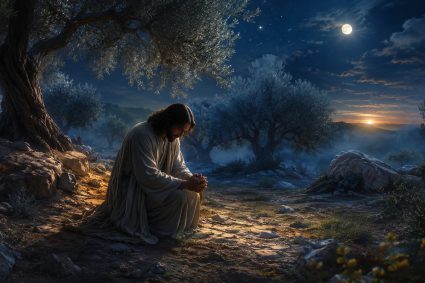
It was a simple moment, and yet there was something unusual about it. The disciples had often seen Jesus pray. They had watched how He withdrew, how He spoke in stillness, and how afterward He returned with a peace and clarity they could not explain.
They knew prayers. They had grown up with them. Fixed phrases, familiar words, spoken at certain times. But with Jesus it was different. His prayer was not a duty, not a ritual, but a living connection.
One day they came to Him and asked Him: “Lord, teach us to pray.”
It was not a request for more words. It was the longing to understand what they had seen in Him.
Jesus did not answer with a long explanation. He began with a simple sentence:
“Our Father…”
For those who listened, this was more than an opening. It was an invitation to see God differently. Not only as the Most High, not only as the Holy One, but as Father.
A word that expresses closeness. Trust. Relationship.
And yet Jesus added: “in heaven.”
In this way, both remain: closeness and reverence. Familiarity and greatness.
In this first sentence, everything that follows is already present.
🌿 A God Who Seeks Relationship
When Jesus calls God Father, He opens a space that goes far beyond religious ideas. A father is not distant. He is not impersonal. He knows, He sees, He cares.
At the same time, God is not reduced to our standards. “In heaven” reminds us that He is greater than anything we can understand. His nearness does not diminish His holiness, and His greatness does not diminish His nearness.
Ellen G. White describes this tension in this way:
“In the first words of the Lord’s Prayer, we are invited to address God as our Father. This shows us that we may approach Him with confidence. Yet at the same time, we become aware that He is in heaven, stands above all things, and still knows each individual.”
(Ellen G. White, Thoughts from the Mount of Blessing, chapter “The Lord’s Prayer”)
And she further writes:
“Whoever recognizes God as Father is not guided by fear, but by trust. This relationship changes the way a person prays, lives, and thinks.”
(Thoughts from the Mount of Blessing, chapter “The Lord’s Prayer”)
🔥 The Obstacle in the Heart
For many people, this very thought is difficult. Seeing God as Father does not come easily to everyone. Sometimes this is because of experiences, images that have shaped us, or a feeling of distance.
One can know God and yet feel far away. One can speak about Him and yet not speak with Him.
Jesus begins the prayer exactly here, because everything else depends on this. Without relationship, prayer remains external. Without trust, it remains distant.
But this sentence is not a demand. It is an invitation.
🌙 A New Access to God
“Our Father” does not only mean that we may come to God individually. It also reminds us that we are not alone. It is a shared prayer, an expression of a relationship that reaches beyond the individual.
Ellen G. White writes:
“When we say ‘our Father,’ we acknowledge that we belong to a larger family. God is not only the Father of the individual, but of all who seek Him. This awareness changes our view of other people.”
(Thoughts from the Mount of Blessing, chapter “The Lord’s Prayer”)
Thus a simple sentence becomes a new access: to God and to people.
🌾 The Sabbath as a Space of Nearness
The Sabbath is far more than a day of rest. It is God’s special invitation to encounter Him. In a world full of appointments, obligations, and constant distractions, God creates a holy space in which human beings may come to rest and experience His nearness anew.
Already at Creation we see that God blessed and sanctified the Sabbath (Genesis 2:3). Even before there was sin, stress, or exhaustion, God gave this day as a time of fellowship. The Sabbath therefore reminds us that our worth does not depend on our performance, but on our relationship with our Creator.
When Jesus teaches us to pray, “Our Father in heaven,” this thought finds a special expression in the Sabbath. On no other day are we so consciously invited to lay aside everything that demands our attention in order to realign ourselves with the Father. The Sabbath gives us the opportunity to perceive God’s voice again, which is often unheard in the noise of everyday life.
Ellen G. White writes:
“The Sabbath was given so that human beings might better know God. It directs our thoughts away from earthly things toward the works of God and His love.”
(From the Treasury of Testimonies, Volume 3)
In the rest of the Sabbath we discover anew that God is not only the Lord of the universe, but also our Father. He knows our worries, our struggles, and our longings. During the week we often come to Him with requests; on the Sabbath He invites us simply to be with Him.
Precisely for this reason, the Sabbath is a space of nearness. It reminds us that God’s presence does not have to be earned. We may come before Him just as we are – with open questions, with joy, or even with weariness. The Father does not wait for perfect people, but for open hearts.
This nearness also changes the way we look at others. If we are together God’s children and together pray “Our Father,” then we are reminded that we are part of a larger family. The Sabbath connects not only human beings with God, but also people with one another. It creates space for reconciliation, fellowship, and mutual encouragement.
Perhaps the greatest gift of the Sabbath is that each week it reminds us again who we truly are: not people driven by everyday life, not only workers, parents, students, or those carrying responsibilities, but beloved children of God.
When we come to rest on the Sabbath, we may hear anew the invitation of our heavenly Father: “Be still, and know that I am God” (Psalm 46:10).
Thus the Sabbath becomes a place of encounter – a holy space in which knowledge becomes trust, distance becomes nearness, and duty becomes living fellowship with God.
🤲 Invitation
Take a moment and speak these words slowly: “Our Father in heaven.” Not as a habit, but consciously.
Let them speak to you before you continue speaking yourself.
✨ Prayer
Father,
I come to You just as I am.
Help me understand what it means that You are my Father.
Take away the distance I often feel,
and give me trust.
Teach me not only to know You,
but to encounter You.
And open my heart to Your nearness.
Amen.