

🌅 Back to the Source of Life
Sabbath reflections for silence, renewal, and encountering God
🌿 Beatitudes
🤲 7.And Forgive Us Our Debts
“And forgive us our debts, as we also have forgiven our debtors.”
Matthew 6:12
🕊️ A Story – Tears in the House
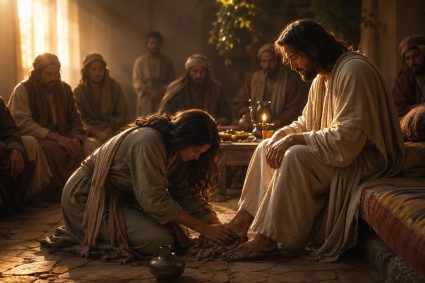
The house was filled with voices. People were sitting together, conversations were flowing, everything seemed orderly and controlled. It was a place where people knew how to behave and what was better left unspoken.
Then the door opened.
A woman entered. Her steps were careful, almost hesitant, and yet there was a determination in them stronger than all the eyes in the room. She knew she was not welcome here. She knew what people thought about her. But she had not come because of the people.
Jesus was there.
Without many words, she came closer. She knelt down, and then something happened that no one had expected. Her tears began to flow — not held back, not controlled, but honest and deep. They fell on Jesus’ feet and became an expression of her entire inner condition.
She had brought nothing with which she could explain herself. No justification, no defense. Only her heart.
The people in the room saw her — and judged her. But Jesus saw more. He saw not only her past, but what was happening within her in that very moment.
And then He spoke the words that changed everything:
“Your sins are forgiven.”
🌿 Forgiveness Begins with Honesty
With the request “forgive us our debts,” the prayer becomes deeply personal. It brings us to a point where we can no longer avoid the truth. It is not about general thoughts, but about what we ourselves know — our guilt, our mistakes, our hidden sides.
This prayer invites us to become honest. It challenges us not to explain away or minimize our guilt, but to bring it before God.
Ellen G. White describes it this way:
“When we ask for forgiveness, we acknowledge our guilt before God. We stop justifying ourselves and come honestly before Him. This openness is the beginning of healing, because only what is brought into the light can be forgiven.”
(Ellen G. White, Thoughts from the Mount of Blessing, chapter “The Lord’s Prayer”)
And she continues:
“God does not forgive reluctantly. His forgiveness is an expression of His love. Whoever comes to Him will not be rejected, but accepted and cleansed.”
(Thoughts from the Mount of Blessing, chapter “The Lord’s Prayer”)
🌙 The Depth of Forgiveness
The woman came with empty hands — and left transformed. Not because she had achieved something, but because she had received something.
Forgiveness is not earned. It is received.
Ellen G. White describes this experience as follows:
“God’s forgiveness does not only mean that guilt is no longer counted against us. It also means that the heart is renewed. A person is not only acquitted, but transformed.”
(Thoughts from the Mount of Blessing, chapter “The Lord’s Prayer”)
And further:
“Whoever experiences forgiveness becomes free. The burden of the past loses its power, and a new life begins.”
(Thoughts from the Mount of Blessing, chapter “The Lord’s Prayer”)
🌾 The Sabbath as a Place of Forgiveness
The Sabbath is a sacred space in which God not only calls people to rest, but also to freedom. During the week, many people carry burdens that no one sees. Words they regret. Thoughts that weigh heavily on the heart. Decisions that echo within them. Guilt they suppress. Wounds that were never truly spoken about.
People often try to keep going, appear strong, or distract themselves. But the soul does not forget.
The Sabbath interrupts this constant running.
In the stillness of the Sabbath, space is created to become honest. Not before other people, but before God. Without a mask. Without religious performance. Without needing to explain oneself.
Precisely in this silence, God often reveals to people not only their guilt, but also His love.
For God’s goal is not shame, but healing.
Many people are afraid to truly face their guilt. They fear condemnation, rejection, or the memory of their own failure. But Jesus never met people with cold harshness when they came honestly to Him. The woman in the Pharisee’s house came with tears — and left with peace.
The Sabbath reminds us:
With God, a person may stop trying to save themselves.
Ellen G. White writes:
“The Sabbath points people to God’s love and grace. It invites them to lay down the burden of sin and find peace in Christ.”
(cf. Thoughts from the Mount of Blessing)
In God’s presence, guilt loses its power when it is brought into the light. What remains hidden continues to burden the heart. But what is honestly confessed before God can be healed.
That is why the Sabbath is also a place of inner cleansing.
Not through human effort,
not through self-punishment,
not through the feeling that one must first become better —
but through encountering the grace of God.
Perhaps on the Sabbath, God shows you memories or areas of your life that you have long suppressed. Not to reopen old wounds, but so they can finally heal.
Forgiveness means more than the removal of guilt. It means restoration. Peace. Freedom. A new beginning.
And often this transformation begins very quietly —
in an honest prayer,
in a moment of brokenness,
in the confession:
“Lord, I need Your grace.”
The Sabbath invites us to remain right there.
Not to run away.
Not to defend ourselves.
But to accept God’s forgiveness.
For whoever receives forgiveness no longer has to be defined by their past.
🌿 Thus the Sabbath becomes a place
where the burdened heart finds rest,
the soul breathes again,
and the person experiences:
Grace is greater than guilt.
🤲 Invitation
Come honestly before God today. Not prepared, not organized, but just as you are.
✨ Prayer
Father,
You know my heart and everything within it.
I come to You without excuses.
I ask You: Forgive me.
Take from me the burden that I cannot carry by myself.
Cleanse my heart and give me a new beginning.
And help me to truly accept Your forgiveness.
Amen.