
Lesson 4.The Plagues | 4.5 Hail, Locusts, and Darkness | EXODUS | LIVING FAITH

⛪ Lesson 4: The Plagues
📘 4.5 Hail, Locusts, and Darkness
✨ God’s Power Breaks Through All Darkness
………………………………………………………………….
🟦 Introduction
At the heart of the confrontation between Moses and Pharaoh lies more than the liberation of a people: it is about God’s honor, the conflict between truth and lies, light and darkness, life and death. The plagues are divine instruments—on the one hand to execute justice, on the other to call for repentance. But what happens when the heart remains hardened? And what do these ancient events mean for us today?
………………………………………………………………….
📖 Bible Study
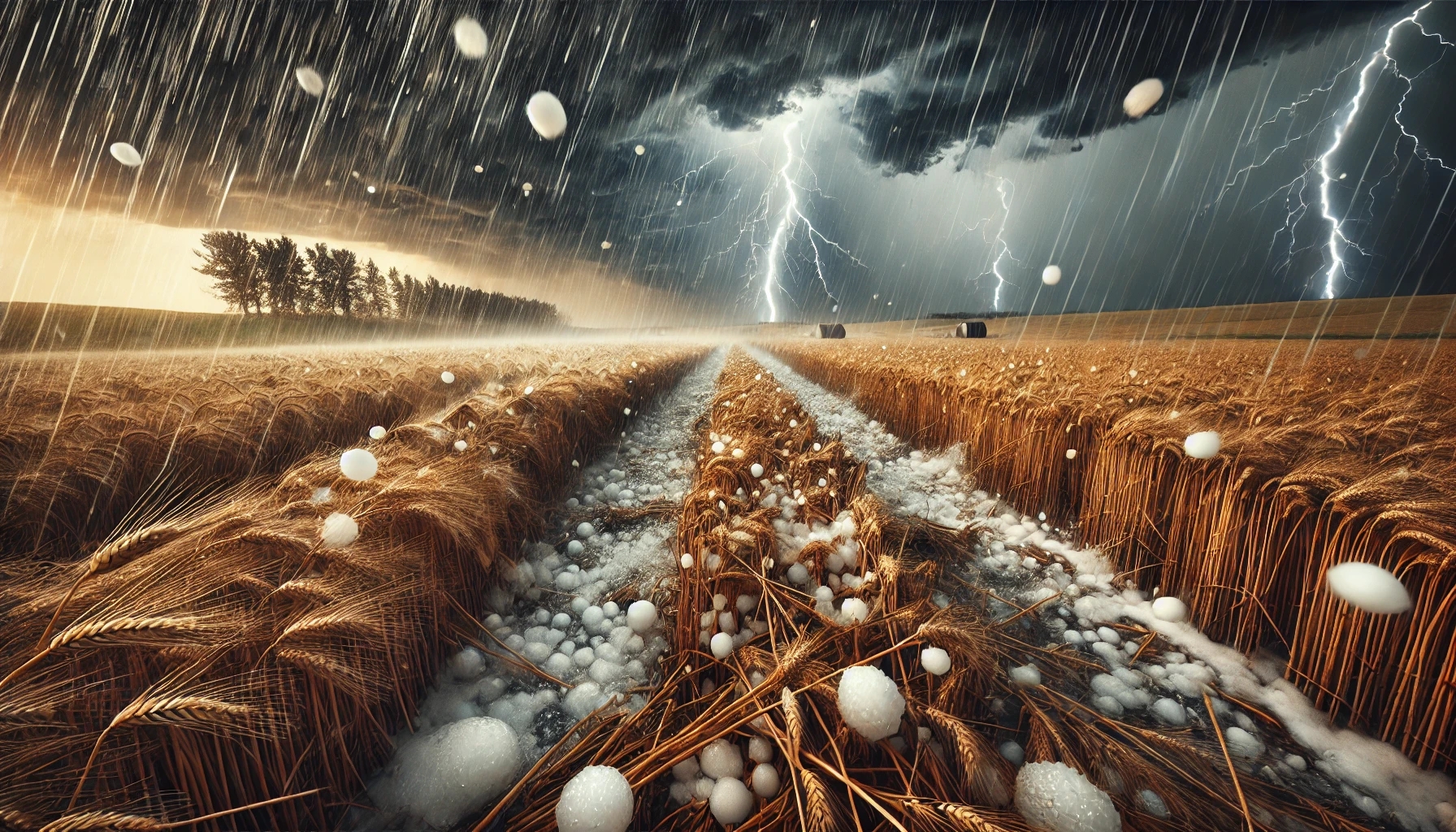
Plague 7 – Hail (Exodus 9:13–35)
Core Observation:
God not only announces the next plague but also explains its purpose: “so that you may know that there is no one on earth like me” (v. 14). For the first time, God calls for a decision—even among the Egyptians. Those who take God’s word seriously bring their livestock to safety. The judgment is not blind—it is a test of faith.
Exposed False Securities:
This plague strikes the sky, the weather, the fields—the very foundations of life. Nut, the sky goddess; Osiris, god of growth and fertility; and Shu, lord of the atmosphere, are all powerless. Only God controls nature and the harvest.
Heart Lesson:
God’s judgment is also an invitation to repent. Pharaoh says for the first time, “I have sinned”—yet his remorse is fleeting. He seeks relief, not renewal.
Today:
Crises (e.g., climate disasters, economic shocks) reveal what we truly build our lives upon. Those who take God’s word seriously act before the catastrophe—not just afterward. True faith shows itself in obedience, not only in praying for relief.
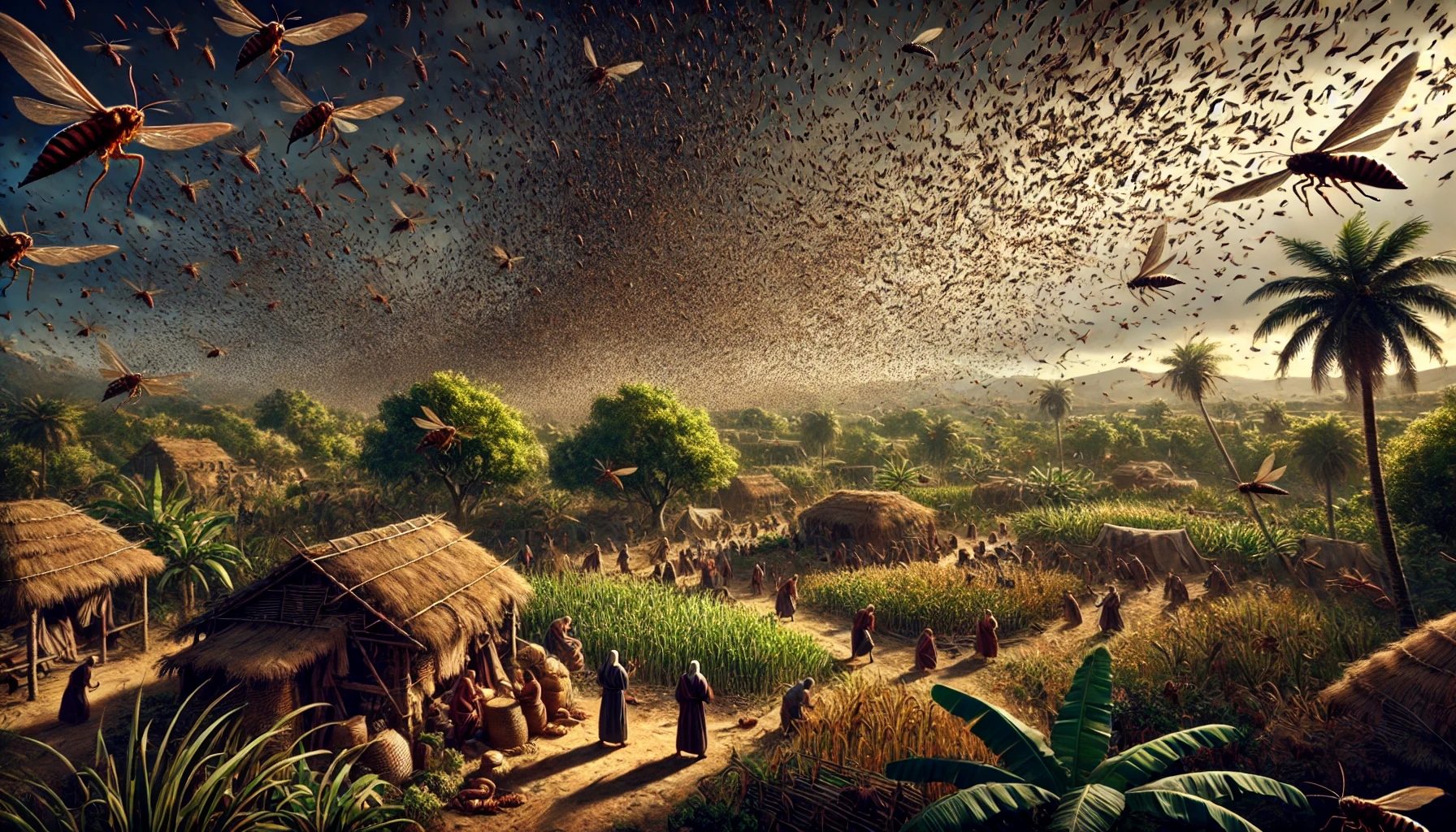
Plague 8 – Locusts (Exodus 10:1–20)
Core Observation:
God announces that He has hardened Pharaoh’s heart—to make His name known among the nations (v. 2). The locusts “ate up whatever was left to you”—total devastation.
Exposed False Securities:
Seth (god of chaos and storms), Isis (goddess of fertility), and Serapis (god of healing, harvest, and order) can neither protect nor restore. The economic destruction is complete. The elite press Pharaoh: “Egypt is ruined” (v. 7).
Heart Lesson:
Pharaoh offers another compromise: only the men may go. But Moses knows true worship includes the whole community. A compromise with God breaks the relationship.
Today:
When systems collapse, half-truths and compromises surface. God demands wholehearted devotion—not just what is convenient. Family faith is not optional.
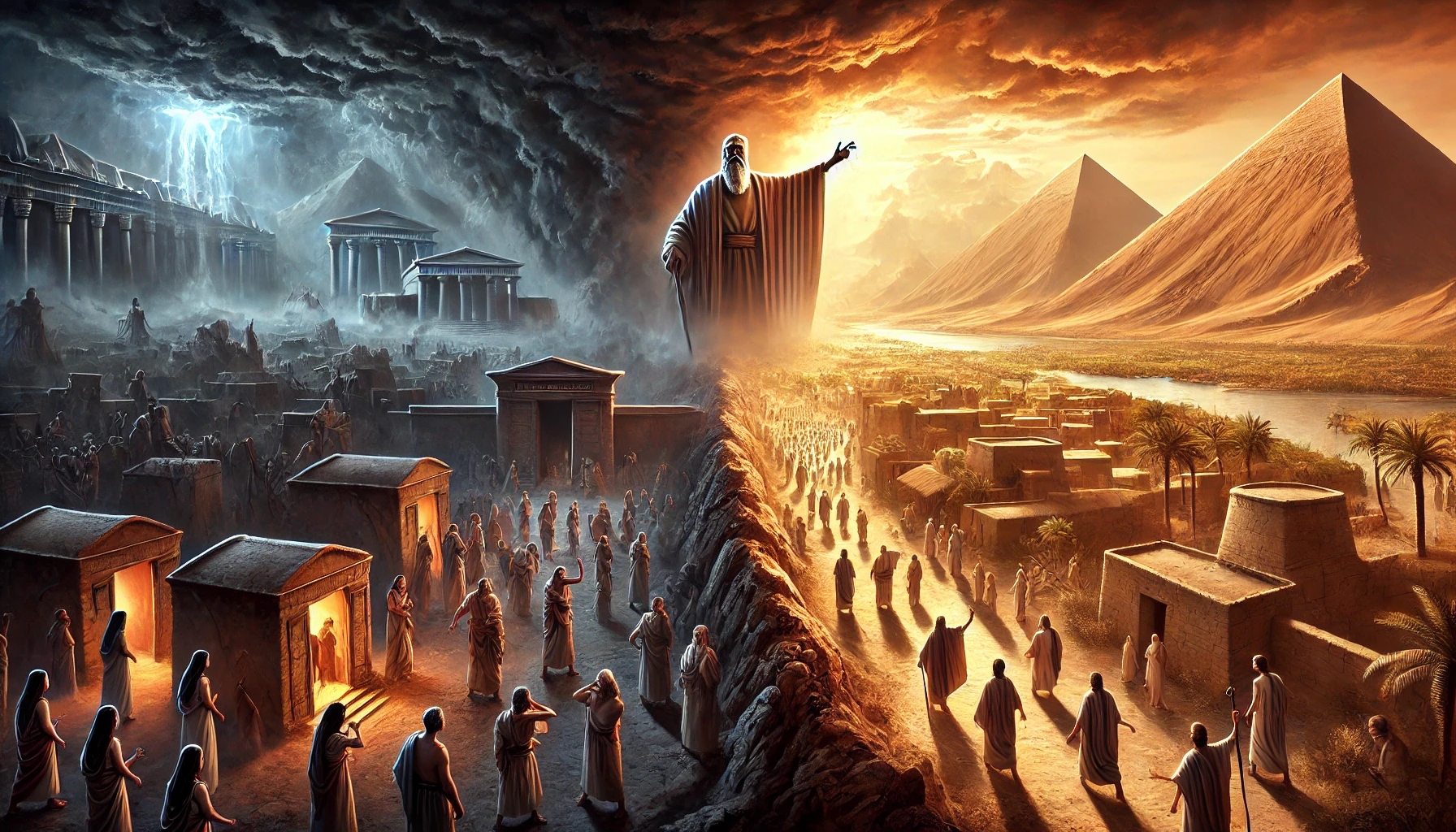
Plague 9 – Darkness (Exodus 10:21–29)
Core Observation:
Darkness—three days impenetrable. No light, no daily life, no coming or going. But in Goshen there was light.
Exposed False Securities:
Ra, the highest Egyptian god and sun deity—source of all life—is utterly dethroned. Even Thoth, the moon god, cannot help. No science, no power, no cult can create light.
Heart Lesson:
Darkness is not only external. It symbolizes a spiritual condition. Pharaoh can no longer see or hear—he never wants to see Moses again. Rejecting God’s truth ends in isolation.
Today:
Those who consistently shut themselves off from God’s truth will sooner or later experience spiritual darkness. Yet where people walk in God’s way, there is light—even amid chaos. Ask yourself: do you live in the light—or merely close enough to avoid notice?
Summary of Plagues 7–9
The final plagues before the decisive act reveal:
-
God’s judgment is not arbitrary, but a warning.
-
Idols fail where life, future, light, and truth are at stake.
-
Repentance without genuine turning is dangerous.
-
God protects His people—but expects trust, obedience, and full surrender.
………………………………………………………………….
📖 Answers to the Questions
📌 Question 1: Read Exodus 9:13–10:29. How successful were the plagues in leading Pharaoh to change his mind?
The plagues exerted ever-increasing pressure—both on Egypt and on Pharaoh personally. Yet despite the rising intensity and clarity of divine intervention, Pharaoh’s change of heart was only superficial and temporary.
-
Seventh Plague (Hail): For the first time, he confesses, “I have sinned” (9:27), but retracts his remorse as soon as the danger passes. This is classic “catastrophe remorse”—fear-based, not born of genuine insight.
-
Eighth Plague (Locusts): Moses prays for Pharaoh, but Pharaoh again offers only partial obedience: “Only the men may go” (10:11). He wants to set conditions rather than submit.
-
Ninth Plague (Darkness): Pharaoh makes a final attempt to control God: Moses may not appear before him again. He thus seals off the last avenue of grace.
In summary, the plagues were intended as God’s pedagogical tool—to bring recognition, not destruction. But the stubbornness of the heart—coupled with pride, fear of losing power, and spiritual blindness—rendered Pharaoh incapable of true repentance.
Key Takeaways:
-
One can see God’s hand clearly—and yet refuse to yield.
-
External disasters can provoke temporary remorse, but only the Spirit brings inner change.
-
Power protects no one from spiritual blindness; indeed, it often hinders repentance.
📌 Question 2: What a dramatic example of the words, “Pride goes before destruction, a haughty spirit before a fall” (Proverbs 16:18)?
Pharaoh is a prime example of this biblical principle. His pride is not merely personal arrogance—it symbolizes a world power that believes itself above God.
-
Despite the clear evidence—natural disasters, economic ruin, the failure of his magicians and advisers—Pharaoh refuses to question his status as “god-king.”
-
His attempts at negotiation—“Only the men may go,” “Not with the livestock”—show that he thinks he can twist God’s demands.
-
He even contradicts his own advisers, who acknowledge Egypt’s ruin (10:7). But his pride makes him prefer destruction over admitting God’s supremacy.
Why is his fall so dramatic?
-
He could have saved himself at any time.
-
He received all the warnings—personal, precise, supernatural.
-
Though not solely responsible, as ruler he bore the consequences for many.
-
He lost not only political and economic control, but ultimately his son and his people’s trust.
Spiritual Lesson:
-
Pride often hides quietly: “I know best. I can decide for myself. I don’t need any external authority.”
-
Pride rejects God’s authority—often under the guise of “freedom” or “reason.”
-
Pride is the heart’s last fortress against God—and the first step toward spiritual ruin.
Pharaoh’s story holds up a mirror: not to show how evil one can be, but how quickly we cling to our own will and block the way to grace.
………………………………………………………………….
✨ Spiritual Principles
-
God’s judgment is just and purposeful.
-
The plagues are not random—they target false securities, idols, and self-willed power.
-
God shows that all creation obeys Him, not the Egyptian gods.
-
Partial obedience is no obedience. Pharaoh’s compromises (e.g., “only the men may go”) fall short of true surrender.
-
Resistance to God ends in darkness. The ninth plague symbolizes Pharaoh’s spiritual state: rejecting God’s light yields blindness despite the truth before one’s eyes.
-
God visibly protects His own. While Egypt is engulfed in darkness, Goshen remains bright.
………………………………………………………………….
🧩 Application for Daily Life
-
What are my idols? Everyone relies on something—wealth, influence, knowledge, control. These “supports” become idols when they replace God.
-
How do I respond to God’s correction? Am I really willing to rethink, or do I soothe my conscience with half-measures?
-
Do I believe God’s word even when it conflicts with my feelings or culture? The Egyptians could have saved their livestock (9:20–21) had they believed. It was not about heritage but about trust.
-
Where do I try to negotiate with God instead of obeying? God doesn’t make deals—He seeks our devotion, not our convenience.
-
Am I light in the darkness around me? Like Goshen, God wants His people to shine where others live in darkness.
………………………………………………………………….
✅ Conclusion
Plagues 7–9 strip away the power of the Egyptian gods and show that only God reigns over nature, light, life, and death. At the same time, they test faith: those who heed God’s word are preserved. Pharaoh, despite all the signs, remains proud and hardened. He recognizes God’s power—yet refuses to bow. That is the true tragedy: choosing control over trust.
We, too, face the choice: harden our hearts or place our trust in Him? Where God rules, there is light; where pride reigns, there comes darkness.
………………………………………………………………….
💭 Thought of the Day
“True faith is shown not in catastrophe-born repentance, but in willing obedience—without any external pressure.”
………………………………………………………………….
✍️ Illustration – “The Days of Decision” (Fictional Story)
A tale of power, idols, control—and light in the darkness.
Chapter 1 – The Corporate Lord
Felix Ahrens was CEO of a global agribusiness headquartered in Berlin. For years he lived by one principle: “He who controls, wins.” His company exported genetically modified seed, pesticides, and energy worldwide, shaping markets, making farmers dependent—and shareholders happy.
Felix did not believe in God. “Religion is like nature—controllable, manipulable, useful.”
His right-hand, Nadja, was different. A quiet but strong Christian. She alone dared question his decisions.
Chapter 2 – The First Shock
It began with a sudden storm on June 13. Meteorologists called it a “climate anomaly.” Within two days, massive hail destroyed thousands of hectares of corn and soy—in the very countries where Ahrens’s company was invested. Insurers refused payout. Damage ran into billions.
Nadja whispered, “You reap what you sow.”
Felix shrugged, “Storms come. We’ll rebuild.”
But by night he dreamed—of fields burning, water turning to stone, light vanishing.
Chapter 3 – The Invasion
Four weeks later: in South America, Central Asia, and North Africa, locust swarms devoured entire harvests in hours—the worst outbreak in over a century.
Felix trembled. “Our supply chains… our crops… this can’t happen.”
Nadja offered him a Bible. “Read Exodus 10. Maybe you’ll see.”
He threw the book away.
“I’m no Moses, and God is none of my concern.”
He began to negotiate: “We’ll free smallholder farmers… with conditions.” Yet inwardly he clung to control.
Chapter 4 – Three Days of Darkness
On August 18 power grids failed across multiple countries at once. Total blackouts. No hackers. No solar storms. No explanation. Berlin went dark for 72 hours.
Felix sat alone in his high-rise office, candle in hand.
No phone. No voice. No reflection—only silence and pitch black.
He remembered Nadja’s words.
He whispered for the first time in decades: “God? If you’re real… help me. I see nothing.”
Chapter 5 – The Light
On the fourth day power returned. But something in Felix had changed. He addressed his team:
“I don’t know what comes next, but I know we never really had control. We played God—and lost.”
He launched a new initiative: “LightPoint,” promoting sustainable agriculture—fair, ecological, humane.
Nadja simply said, “Sometimes darkness is needed to recognize true light.”
Epilogue
Felix is not poor today—but he lives differently. He gives more, speaks less, sometimes prays—especially during storms.
He knows: true power lies not in control, but in humility.
Spiritual Insight from the Story:
-
Hail shattered Felix’s sense of economic security.
-
Locusts devoured what he thought he controlled.
-
Darkness revealed his inner emptiness.
-
But God’s light came not with noise, but through stillness and repentance.

More Stories