
✉️ CHRIST IN PHILIPPIANS AND COLOSSIANS
⛪ Lesson 10 : Complete in Christ
📘 10.5 Commandments of Men
✨ Freedom Instead of Burden – Christ Is Enough
🟦 Introduction
Paul ends chapter 2 with a serious warning:
“If you died with Christ to the elemental spirits of the world, why do you submit to regulations…?” (Col 2:20)
Here he touches on a timeless problem:
the temptation to gain spiritual security through outward rules.
The chapter shows a clear line:
-
10.1: Christ is the source of all wisdom.
-
10.2: We are rooted in Him.
-
10.3: The record of debt is nailed to the cross.
-
10.4: Shadows have been fulfilled.
-
10.5: Do not return to human commandments.
It is about freedom.
But not lawlessness.
It is about the gospel.
………………..✉️………………..
📖 Bible Study
Colossians 2:20 — “Dead to the elemental spirits of the world”
“Elemental spirits/principles of the world” (stoicheia tou kosmou) means:
-
basic religious structures
-
earthly regulations
-
religious foundational systems
Paul uses the same expression in Galatians 4:3, 9.
He describes religious systems that belong to the earthly order—especially the ceremonial law.
If we have died with Christ,
we are no longer subject to these things.
Verse 21 — “Do not handle, do not taste…”
That sounds like ascetic regulations.
Such rules:
-
seem especially spiritual,
-
give an impression of discipline,
-
look strict and holy.
But Paul exposes them.
Verse 22 — “…all are destined to perish with use”
These things are:
-
temporary,
-
material,
-
earthly.
Christian hope, by contrast, is heavenly (Phil 3:20).
Our citizenship is not in temple ritual,
but in heaven.
Verse 23 — “…an appearance of wisdom”
This is the key verse.
These regulations:
-
have the appearance of wisdom,
-
seem humble,
-
look strict.
But:
“…are of no value against the indulgence of the flesh.”
That means:
outward strictness does not change the heart.
You can:
-
fast,
-
abstain,
-
keep rules,
and still be proud.
Historical Context
After the cross:
-
the temple curtain was torn (Matt 27:51).
-
Daniel 9:27 pointed to the end of the sacrificial service.
-
the ceremonial system had fulfilled its purpose.
What had once been divinely ordained
became, after its fulfillment, a human-imposed duty.
The problem was not
that these things were originally wrong.
The problem was
that after their fulfillment they were still treated as necessary for salvation.
Danger of Religious Pride
Jesus criticized the Pharisees (Mark 7:1–13) because they:
-
placed human traditions
-
above God’s commandment.
This repeated itself in church history.
Again and again there arose:
-
additional regulations,
-
moral rankings,
-
spiritual evaluation systems.
The gospel was obscured by religious formalism.
………………..✉️………………..
🗣️ Answers to the Questions
❓ Question 1 – How do you understand Paul’s admonition in the context of the chapter?
Detailed Answer
Paul’s core message is:
If Christ has fulfilled everything,
why return to shadows?
His admonition includes:
1. Freedom from the ceremonial law
These regulations were temporary.
Christ is their fulfillment.
2. Warning against ascetic self-righteousness
Strict rules often produce pride.
3. Warning against spiritual performance thinking
Keeping rules can create the feeling
that God owes us something.
But salvation is a gift.
4. Warning against identifying with what is temporary
If we cling again to earthly systems,
we identify with what perishes.
But we are waiting for:
“a new heaven and a new earth” (2 Pet 3:13)
Paul urges:
Live from the new reality—not from the old system.
❓ Question 2 – How do we make sure our only foundation is Christ’s work outside of us?
Detailed Answer
The gospel has two dimensions:
-
What Christ did FOR us (objective).
-
What Christ works IN us (subjective).
Salvation is based exclusively on:
-
His perfect life
-
His substitutionary death
-
His resurrection
-
His heavenly ministry
This happened:
-
outside of us,
-
independent of our performance,
-
before our change.
Sanctification (the work in us) is important,
but it is the result, not the foundation.
How do we stay secure?
1. Keep the cross at the center
Your progress does not save you—
His sacrifice saves you.
2. Distinguish justification and sanctification
Justification: a one-time legal act.
Sanctification: a lifelong process.
3. Avoid spiritual comparison
Comparison leads either to pride or despair.
4. Remember daily:
I am saved because Christ is enough.
Not because I am enough.
………………..✉️………………..
💎 Spiritual Principles
-
What Christ has fulfilled must not become a condition for salvation again.
-
Outward discipline does not replace inner renewal.
-
Religious strictness can feed spiritual pride.
-
Our identity is heavenly, not ceremonial.
-
Christ is the foundation—not religious performance.
………………..✉️………………..
🛠️ Everyday Application
Dangers today:
-
legalism in behavior
-
spiritual comparison
-
moral superiority
-
tradition over Scripture
Practical questions:
-
Do I feel spiritually superior to others?
-
Do I secretly believe I can impress God through performance?
-
Do I rely on religious routine?
-
Do I replace relationship with rules?
Christian discipline is good—
but it is the fruit of salvation,
not the condition for salvation.
………………..✉️………………..
✅ Conclusion
Human commandments can impress—
but they do not save.
Christ saves.
Faith does not rest on:
-
asceticism
-
ritual
-
performance
-
tradition
But on:
the finished work of Jesus.
………………..✉️………………..
💭 Thought of the Day
Rules can shape behavior—
but only Christ saves the heart.
………………..✉️………………..
✍️ Illustration – The Invisible Burden
Between performance and grace
Chapter 1 — The perfect Christian
Stuttgart, 2028.
Samuel was disciplined.
-
Early prayer every day.
-
Strict diet.
-
Attended every church event.
-
No visible faults.
Everyone admired him.
But inside, he was tired.
Chapter 2 — Comparison
He began to judge others.
“They don’t take it seriously.”
“They’re half-hearted.”
Slowly, his heart grew hard.
Chapter 3 — Breakdown
One day he failed publicly.
A mistake.
A moral slip.
His perfect facade shattered.
He was desperate.
If his performance didn’t save him—
then what?
Chapter 4 — The conversation
An older brother said:
“Samuel, you trusted in your work.
Not in His work.”
Those words struck him deeply.
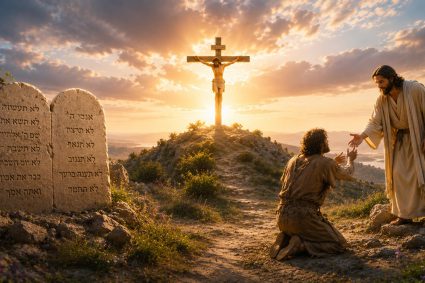
Chapter 5 — The cross
He read Colossians 2:20–23.
“An appearance of wisdom.”
He realized:
His discipline was good—
but it had become his foundation.
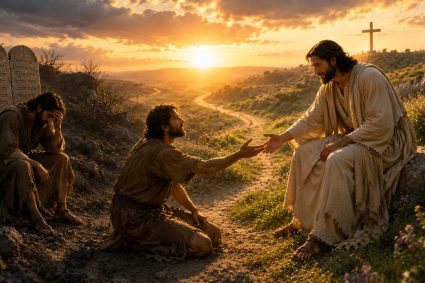
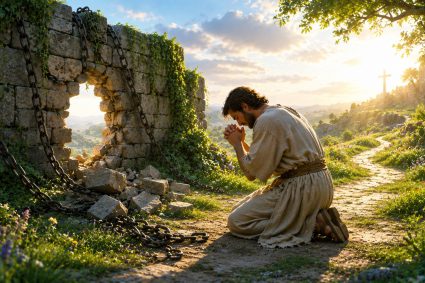
He knelt down.
Not with a list.
Not with performance.
Only with a plea for grace.
Chapter 6 — Freedom
Slowly he learned:
Discipline from gratitude.
Obedience from love.
Service without pride.
He was not less serious.
But he was free.
………………..✉️………………..
📌 Closing Thoughts on the Story
In the 21st century, many people search for spiritual structure.
But structure without grace becomes a burden.
Christ is:
-
our foundation,
-
our righteousness,
-
our hope.
Not our performance.
Not our tradition.
Not our strictness.
Only Him.
