
🤩 Bible Stories to Marvel At
Where God’s miracles become great – for little and big children
🦌 Job Chapter 39 – God Shows Job the Wild Animals
🦅 When Animals Tell of God’s Wisdom
🌅 Introduction
In the previous chapter, God had answered Job from the storm. After the many words of Job’s friends, after Job’s laments, and after Elihu’s long speeches, the Lord himself finally spoke. Yet God did not immediately explain every mystery of Job’s suffering. First, he led him to wonder.
God asked Job about the foundation of the earth, the boundaries of the sea, the morning, the depths of the ocean, light and darkness, snow, hail, rain, wind, stars, clouds, lightning, lions, and ravens. Job was to recognize that the world is filled with wonders that human beings can neither create nor control.
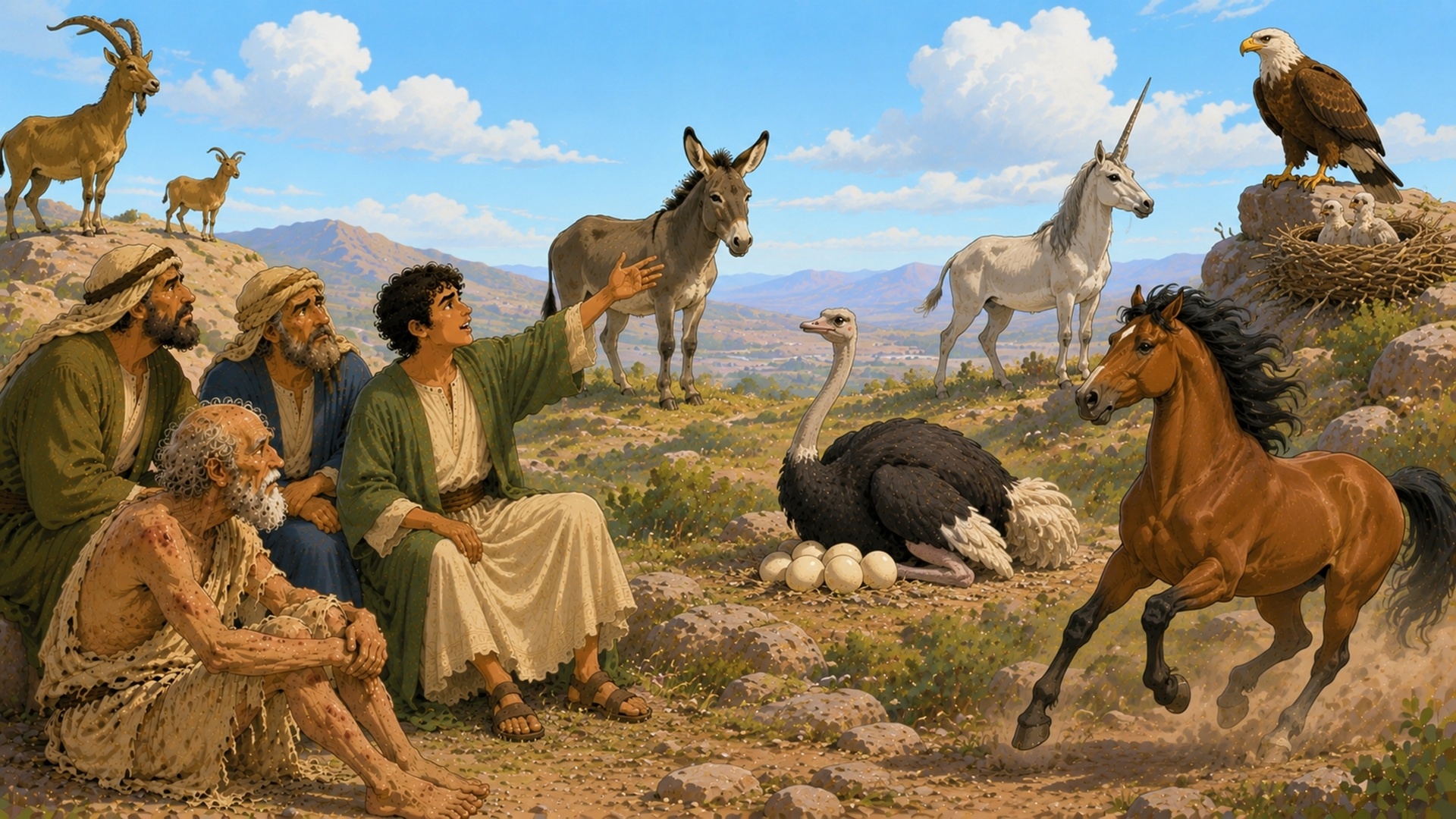
Now God’s answer continues. But God does not speak only about the heavens, the sea, and the weather. He directs Job’s attention toward the animal world. He asks about animals that are free, wild, strong, swift, mysterious, or dangerous. God speaks about mountain goats and deer, the wild donkey, the wild ox, the ostrich, the horse, the hawk, and the eagle.
Not all these animals live close to human beings. Some live in the mountains, some in the wilderness, some run across vast plains, and some soar high into the sky. Many of them cannot simply be controlled by people. Yet none of them lies beyond God’s knowledge.
This chapter shows that God knows the times when animals give birth, their paths, their strength, their freedom, their courage, and their limits. What human beings cannot direct still remains in God’s hand. The wild animals become living witnesses to God’s wisdom.
📖 The Biblical Story
🦌 God Asks About the Mountain Goats
God begins with a question from the world of the mountains. He asks Job whether he knows the time when the mountain goats give birth. These animals live in places that are difficult to reach—among rocks, heights, and steep paths.
People may occasionally see a mountain goat from a distance. But who knows the exact hidden moment when a young animal is born? Who watches over these quiet moments in the mountains?
Job cannot say, “I am there. I know every birth. I count every new breath.” But God knows. No rock is too high, no ravine too hidden, and no animal too small for his eyes.
This is comforting for young and grown-up hearts. God does not see only the great things that people admire. He also sees the quiet wonders that no one notices. Even a young animal in the mountains is not forgotten by him.
🕰️ God Knows the Time of the Deer
God then asks whether Job can observe the time when the deer give birth. Does Job know when they lie down, when their young are born, and when the pains of birth are over?
These questions are gentle and profound. Birth is a mysterious moment. New life begins, and yet much of it happens in secret. Animals do not need a human being to explain everything to them. God has given them their paths, instincts, and times.
A deer does not give birth at Job’s command. It does not need a human clock, a human calendar, or a human plan. God has ordered its time.
Job is to recognize that countless wonders take place in creation without human direction. Yet God knows every single one of them. His wisdom reaches into the hidden moments of life.
🌱 Young Animals Grow and Go Their Way
God describes how the young animals grow strong, mature in the open fields, and go away. They do not return as though they must always remain under human care. They enter the life God has given them.
This is a wonderful picture of growth. A small animal begins weak and needs protection and time. But then it becomes stronger. It stands, walks, jumps, and eventually goes its own way.
Children can imagine a young deer standing uncertainly on its slender legs at first. Then it learns to walk, jump, and follow its mother. Later, it becomes more independent.
God shows Job: I care for life that you hardly ever see. I accompany growth that you cannot control. My care is greater than human attention.
🏜️ Who Gave the Wild Donkey Its Freedom?
God then speaks about the wild donkey. He asks: Who set the wild donkey free? Who loosened its bonds? This animal does not live like a domesticated donkey in a stable. It loves the freedom of the steppe and the wilderness.
The wild donkey does not belong to human beings. It carries no burdens for them and does not wait for their commands. It runs through vast, empty landscapes and seeks its life there.
For Job, this is a powerful image. Human beings like to arrange and control things. But God has also created creatures that remain beyond human control.
The freedom of the wild donkey is not a mistake. It is part of God’s creation. God delights not only in domesticated animals close to people, but also in wild animals that live in distant solitude.
🌵 The Wilderness Is Its Home
God says that he gave the steppe to the wild donkey as its home and the salt land as its dwelling place. What seems dry, lonely, and harsh to human beings is a living space for this animal.
The wild donkey laughs at the noise of the city. It does not hear the shouts of a driver. It searches the mountains for pasture and looks for every green plant.
This reveals God’s diversity. Not every creature lives in a soft, safe, and comfortable place. Some animals are made for harsh landscapes. They find food and freedom where human beings would hardly wish to live.
This is astonishing for young and grown-up hearts: God created not only gardens, but also deserts. Not only domestic animals, but also wild creatures. Not only nearness, but also vast open spaces.
🐂 Will the Wild Ox Serve You?
God now asks about the wild ox. It is strong, powerful, and untamed. God asks Job whether this animal would be willing to serve him or remain beside his manger at night.
A domestic ox can be harnessed, led, and used for work. But the wild ox cannot simply be treated like an obedient working animal. Its strength is not subject to Job’s command.
Job cannot simply bring it into his stable and say, “Now you will work for me.” The power of this animal remains beyond human control.
God is showing that there is power in his creation that human beings cannot use however they wish. They may admire it, but they cannot rule over it.
🪢 Can Job Harness the Wild Ox to the Plow?
God continues by asking whether Job can bind the wild ox to the furrow with a rope. Will it plow the valleys behind Job? Will Job trust it because its strength is great?
This is almost like a small test. An animal may be strong, but strength alone does not mean that it will be useful to human beings. If it cannot be guided, its power cannot simply be employed for human plans.
One might say to children: A very strong animal is not automatically a good helper. If it does not listen, it cannot be given work that must be done in an orderly way.
God reminds Job that he cannot simply use the forces of creation according to his wishes. God, however, knows every animal and its place.
🌾 Can Job Entrust His Harvest to It?
God asks whether Job would entrust his harvest to the wild ox. Would he expect this powerful animal to gather the grain and bring it to the threshing floor?
Certainly not. The wild ox is strong, but it is not obedient like a domesticated working animal. Its strength is impressive, but it is not available for the work in Job’s fields.
This reveals an important difference: Not everything strong is available for human use. Not everything powerful exists to fulfill human wishes.
Creation does not belong to human beings like a box of tools. It belongs to God. Humanity may use and care for it, but humanity is not lord over everything.
🪶 The Ostrich Spreads Its Wings
God then directs Job’s attention toward a strange animal: the ostrich. Its wings flap joyfully, yet it does not fly like the stork or the hawk. It is built differently, guided differently, and astonishing in a different way.
The ostrich is an animal full of mysteries. It has wings, but it does not fly high into the sky. Instead, it can run swiftly across the ground. It appears awkward and amazing at the same time.
One might say to children: Not every animal uses its wings in the same way. One bird can fly high, while an ostrich runs with tremendous speed. God made every animal special.
God shows Job that his creation does not always correspond to human expectations. It is filled with surprises.
🥚 The Ostrich Leaves Its Eggs in the Dust
God describes how the ostrich leaves its eggs upon the ground and allows them to be warmed in the sand. It does not consider that a foot might crush them or that a wild animal might break them.
To human eyes, this appears strange and careless. A person might ask: Why does it not protect its eggs more carefully? Why does it not build a secure nest like other birds?
Yet God speaks about this to show that even such puzzling things remain within his hand. Not everything corresponds to human ideas of wisdom.
Job is to recognize that the world contains more than things he can immediately understand. Some animals appear contradictory and yet belong within God’s wise creation.
🤔 An Animal Without Human Wisdom
God says that the ostrich appears harsh toward its young, as though they were not its own. It does not care for them in the way human beings would expect. God also says that he did not endow it with wisdom or give it a share of understanding.
These words sound unusual. The ostrich does not appear as an example of special care, but as an example of how different animals can be. Some possess astonishing instincts, while others appear unwise in certain ways.
Yet this, too, belongs to God’s creation. God does not make every animal the same. Each has its own place, its own nature, and its own limitations.
For young and grown-up hearts, this is a lesson: We do not need to understand everything immediately in order to recognize that God is greater. Creation is more diverse than our own thoughts would make it.
🏃 When the Ostrich Runs, It Laughs at Horse and Rider
God then reveals the other side of the ostrich. When it rises and begins to run, it laughs at the horse and its rider. It can move with astonishing speed.
What seemed strange a moment ago now appears wonderful. The ostrich does not fly like other birds, but it runs with great power. Its strength lies somewhere human beings might not first expect.
This is a beautiful lesson. Sometimes people judge too quickly. They see what someone cannot do and overlook what God has given that person.
The ostrich reminds us that God distributes gifts differently. Not every creature is made for the same task. Yet each one reveals something of God’s creativity in its own way.
🐎 Who Gave the Horse Its Strength?
God now speaks about the horse. He asks Job whether he gave the horse its strength or clothed its neck with a flowing mane. The horse appears full of power, beauty, and movement.
A strong horse can run swiftly, jump, carry, and pull. Its mane flows, its muscles work, and its body seems made for movement.
For young and grown-up hearts, a horse is often an impressive animal. It can appear gentle, but also full of energy. When it gallops, one senses strength and freedom.
God asks Job: Did you make this? Did you form this strength? Job must recognize: No. This beauty and power come from the Creator’s hand.
🦗 The Horse Leaps Like a Locust
God asks whether Job makes the horse leap like a locust. Its powerful snorting is frightening. It paws the ground in the valley, rejoices in its strength, and charges toward the weapons.
The horse is not described here as a peaceful animal in a meadow, but as a warhorse. It is courageous, impetuous, and full of energy. It does not retreat from danger.
One can imagine the ground trembling beneath its hooves. The horse senses the battle, hears the noise, and presses forward. It is a picture of courage and power.
Job did not give this animal its courage. He did not place the fire within its heart. God alone created it this way.
⚔️ The Horse Is Not Afraid of Battle
God describes how the horse laughs at fear. It is not frightened and does not turn away from the sword. The quiver, spear, and javelin rattle, yet the horse continues forward.
The image is powerful. Human beings may use a horse in battle, but they did not create its inner strength. The courage of the horse is part of God’s mysterious creation.
One might say to children: A horse can sometimes be easily frightened, but the warhorse in this picture is full of fire. It hears the call to battle and runs forward.
God shows Job that even courage, strength, and movement in animals are wonders that Job did not create. He may see them, but he cannot bring them into existence.
🎺 The Horse Hears the Trumpet
God says that at the sound of the trumpet the horse neighs and senses the battle from far away. It hears the voices of the commanders and the battle cry.
The horse is shown as an animal in its element. Where a human being might tremble, the horse presses forward. Its nature is filled with strength and readiness.
Such images may feel unfamiliar to modern readers because war is sorrowful and destructive. Yet God is not expressing delight in suffering. He is revealing the astonishing strength of an animal that human beings did not create.
Job is not first meant to think about battle, but about the wonder of creation: Who gave this animal such power, such fire, and such boldness? God alone.
🦅 Does the Hawk Fly by Job’s Wisdom?
God then asks about the hawk. Does the hawk fly by Job’s wisdom? Does it spread its wings toward the south because Job commands it?
A hawk is swift, alert, and graceful. It glides through the air, uses currents of wind, and sees from a great height what is happening on the ground.
Human beings can admire the flight of a hawk, but they did not give it the ability to fly. They did not design its wings or place its paths within its heart.
For young and grown-up hearts, this is a beautiful thought: Birds do not fly because human beings taught them. God gave them everything they need to cross the sky.
🏔️ Does the Eagle Soar at Your Command?
God continues by asking whether the eagle rises at Job’s command and builds its nest in the heights. The eagle lives high above, far beyond human control.
It builds its nest upon rocks and high cliffs. From there, it looks far across the land. Its eyes can see prey from a great distance. Its wings carry it to heights human beings cannot reach.
Job cannot command the eagle where to live. He cannot send it upward merely by speaking. The eagle does not follow Job’s plan, but the order God placed within it.
God is showing that even the majestic creatures of the sky belong to him. They live freely, but not apart from God. They are wild, but not beyond his wisdom.
👁️ The Eagle Sees from Far Away
God describes how the eagle lives upon the rock and searches for prey from there. Its eyes look far into the distance. Where human beings can hardly recognize anything, the eagle sees clearly.
This is astonishing. God has given each animal special abilities. The eagle possesses sharp eyes, powerful wings, and a dwelling place in the heights.
One might say to children: When you can barely see something from the ground, the eagle can see much farther from above. God made it that way.
Through these questions, Job is reminded that God’s wisdom is visible not only in great stars and oceans, but also in the eyes of a bird.
🪹 The Eagle’s Young Also Live Within God’s Order
God speaks of the eagle’s young drinking blood and gathering where the slain are found. This image is harsh and difficult, but it reveals the reality of the wild natural world.
Not everything in the animal world appears gentle and friendly to human beings. There are hunters and prey, strength and danger, life and death. Creation is beautiful, but it is also awe-inspiring.
God shows Job a world much greater than human ideas of comfort. Wild animals also have their place within this world. God knows them all.
Job cannot direct every movement of these animals. He cannot explain why every creature is the way it is. But God knows.
🌟 The Wild Animals Reveal God’s Wisdom
At the end of this chapter, Job stands before an entire world filled with animals. Mountain goats, deer, wild donkeys, wild oxen, ostriches, horses, hawks, and eagles pass before his inner eye.
Each animal tells a different story. The mountain goat speaks of hidden care in the mountains. The deer tells of God’s knowledge of the times of birth. The wild donkey reveals freedom. The wild ox reveals untamed strength. The ostrich reveals surprising uniqueness. The horse reveals courage. The hawk and eagle reveal height, vision, and movement.
God is not saying, “Job, your suffering is unimportant.” Rather, God is saying: Job, you live within a creation that is far greater, deeper, and more mysterious than you can comprehend. Since you cannot even direct these animals, trust that my wisdom also reaches those places where you understand nothing.
For young and grown-up hearts, this is an invitation to wonder. Every animal God created can remind us that the Creator sees more, knows more, and cares more fully than human beings can imagine.
🌅 What This Chapter Reveals
This chapter shows that God knows and provides for the wild animals. He knows the times when mountain goats and deer give birth, the freedom of the wild donkey, the strength of the wild ox, the uniqueness of the ostrich, the courage of the horse, and the flight of the hawk and the eagle.
This chapter also shows that human beings cannot control everything. Many animals live beyond human control, but not beyond God’s wisdom. God knows their paths, their abilities, and their place within creation.
🟣 Summary
In Job chapter 39, God continues his answer from the storm and directs Job’s attention toward the animal world. He asks whether Job knows the times when mountain goats and deer give birth. He speaks about the wild donkey that lives freely in the wilderness and about the wild ox whose strength human beings cannot simply use for their work. God describes the ostrich, which appears strange yet runs swiftly; the horse with its strength and courage in battle; the hawk that spreads its wings; and the eagle that lives high upon the rock and sees from far away. The chapter shows that God’s wisdom is visible in every animal and that human beings can admire many things without being able to control them.
💚 Message for Young and Grown-up Hearts Today
We learn that God’s creation is filled with wonders. Every animal is different. Some are strong, some swift, some free, and some mysterious. God knows them all and has given each one its place.
We also learn that we do not need to control everything in order to trust God. If God knows and provides for the wild animals, then he also knows our lives. His wisdom reaches beyond our understanding.
💭 Thoughts for Reflection
🔸 Why does God show Job so many different animals?
🔸 What do the wild donkey, the wild ox, the horse, and the eagle reveal about God’s creation?
🔸 Why can wonder at animals strengthen our trust in God?
🧒 👧 👦
💌 Invitation to Job Chapter 40
🤲 Job Becomes Silent Before God
God has led Job through the wonders of creation. He has shown him the earth, the sea, the stars, the weather, and the wild animals. Job has seen that God’s wisdom is greater than human understanding.
Now God will ask Job directly whether a human being can contend with the Almighty. Job will answer, but not with many explanations. He will become silent and place his hand over his mouth.
What happens when a person realizes that God is greater than all his questions?
Come along and discover the next chapter!
🔔 Teaser for Job Chapter 40
🐉 When God Speaks About Strength and Humility
Job will become small and silent before God. Yet God’s answer is not finished. The Lord will continue speaking and ask Job whether he wishes to discredit God’s justice. Then God will show him a mighty creature: Behemoth.
👉 Why does Job place his hand over his mouth?
👉 Why does God ask about justice, power, and humility?
👉 And what does Behemoth reveal about God’s creative power?
✨ In the next chapter, Job will become silent before the Lord—and God will lead him even deeper into wonder at his power.
