
🤩 Bible Stories to Marvel At
Where God’s miracles become great – for little and big children
🌪️ Job Chapter 38 – God Answers from the Storm
🌌 When God Leads Humanity to Wonder
🌅 Introduction
For many chapters, human beings had spoken. Job had lamented, asked questions, wept, and defended his integrity. His friends Eliphaz, Bildad, and Zophar had tried to explain his suffering, but their words had often wounded Job even more. Later, Elihu had spoken and directed Job’s attention to God’s greatness, justice, and power in nature.
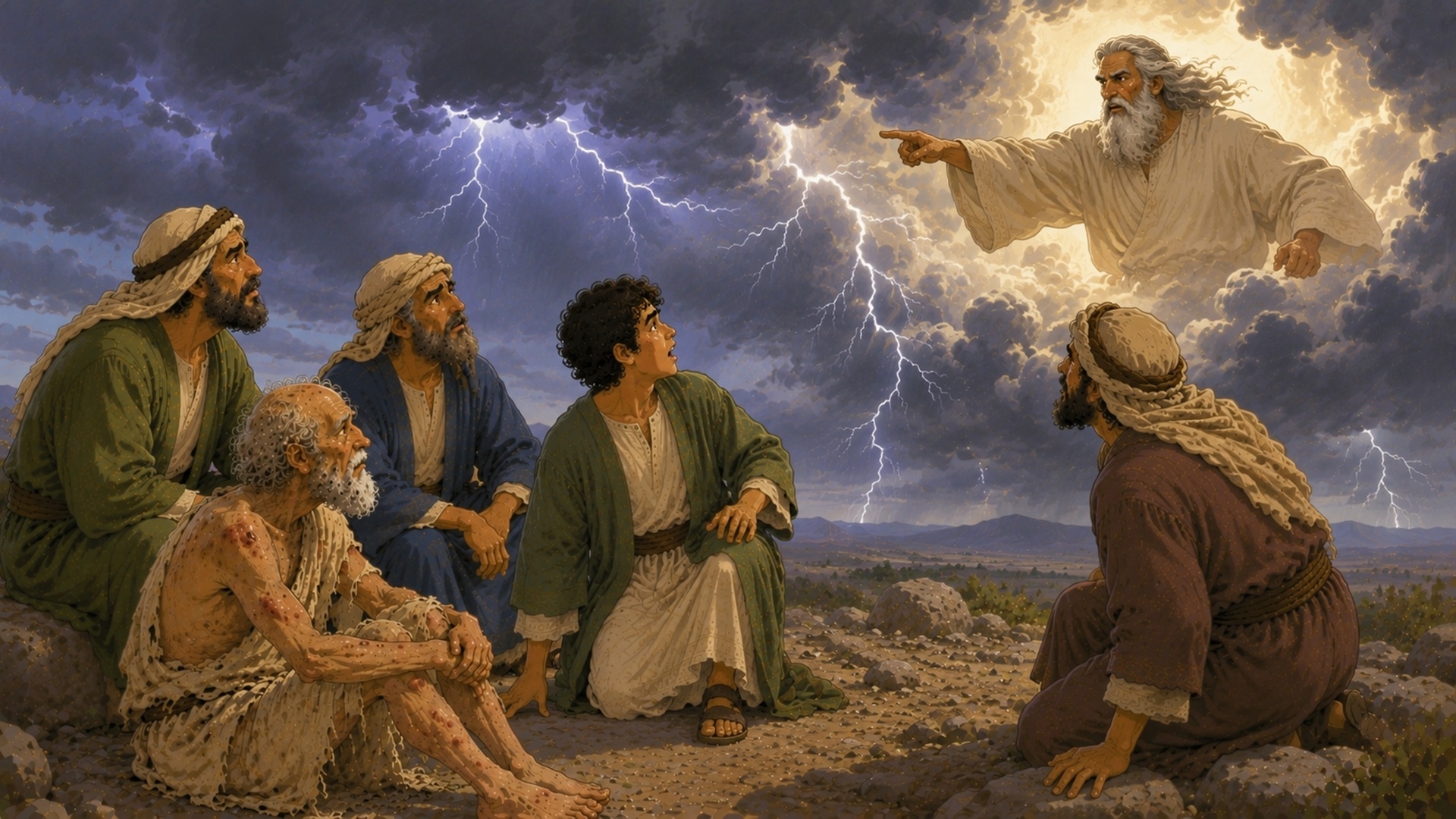
Now the great moment arrives. The human voices fall silent. Job’s friends do not have the final word. Elihu does not have the final word. God himself speaks. And he does not speak from a quiet room, a palace, or a school of the wise. The Lord answers Job from the storm.
Job had longed to meet God. He had asked why God seemed hidden. He had demanded an answer and wanted to present his case before God. Now God truly answers. Yet God’s answer begins differently from what one might expect.
God does not immediately explain every detail of Job’s suffering. He does not first reveal all the reasons that Job was unable to see. Instead, God asks questions. Great questions. Questions about the earth, the sea, the morning, the depths, light, snow, stars, rain, and animals.
This chapter leads Job to wonder. God shows him: You are a human being, and I am the Creator. You see only a small part, but I founded the earth, set boundaries for the sea, and established the order of the heavens. God’s questions are not intended to destroy Job, but to remind him of God’s infinite wisdom.
📖 The Biblical Story
🌪️ The Lord Speaks from the Storm
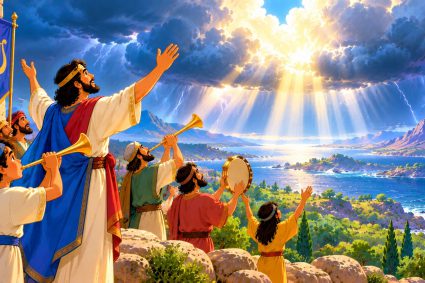
Suddenly, God speaks. After so many human speeches, the voice of the Lord is now heard. The answer comes from the storm, from a mighty manifestation that reveals that God is not small, distant, or powerless.
The storm is fitting for this moment. Job’s life had been like a storm: loss, pain, questions, loneliness, and misunderstandings had swept over him. Now God himself speaks from within the storm.
Young and grown-up hearts can imagine the scene with reverence. The sky is immense. The wind moves. The people fall silent. Job, who has called out for so long, now hears God’s voice.
God does not come to justify himself before human beings as though he were the accused. He comes as the Lord of creation. His voice carries majesty, truth, and holy nearness.
❓ Who Obscures Counsel with Words Without Knowledge?
God begins with a serious question: Who is this who obscures counsel with words without knowledge? This question addresses the many speeches that had already been given. Human beings had said many things, but they had not known everything.
Job’s friends had tried to explain God’s ways without knowing God’s hidden plan. Job, too, had spoken out of his suffering, and some of his words had been heavy and dark. None of them had seen the entire picture.
God shows that words can bring light, but they can also create darkness. When people speak about God without humility and without true understanding, they may produce more confusion than clarity.
This is an important lesson. Not every quick judgment is wisdom. Not every explanation is helpful. Sometimes a person must become silent before truly being able to listen.
🧍 Job Must Prepare Himself
God tells Job to gird up his loins like a man. This means: Prepare yourself. Stand firm inwardly. Listen carefully. I will question you, and you shall answer me.
These words sound powerful and serious. God does not treat Job like a small child who is unable to understand anything. He speaks directly to him and takes him seriously. Yet God also makes one thing clear: Job will no longer ask the questions. Now God will ask them.
Job had asked God many questions. Now the direction is reversed. God questions Job. And these are not small questions. They lead Job to the limits of his knowledge.
For children, one might say: It is as though the greatest teacher in the world were saying, “Now let us see what you truly know.” Not to make you look foolish, but to help you understand how great everything is that you still do not know.
🌍 Where Were You When I Laid the Foundations of the Earth?
God then asks one of the best-known questions in the book of Job: Where were you when I laid the foundations of the earth? Tell me, if you have understanding.
This question takes Job back to the beginning of creation. Before Job was born, before his friends lived, before people built cities or cultivated fields, God was already there. God founded the earth.
Job was not present when God called the world into existence. No human being stood beside God and gave him advice. No human being helped him plan, measure, or sustain the earth.
God reminds Job: You are a creature, not the Creator. Your pain is real, but your perspective is limited. I, however, know the beginning of all things.
📏 Who Determined the Earth’s Dimensions?
God continues asking: Who determined the dimensions of the earth? Who stretched the measuring line across it? The image resembles the construction of a great house. A master builder measures, plans, and determines where everything should stand.
The earth is not accidental, like a poorly constructed house. God placed order within it. He knows its dimensions, foundation, and boundaries. What appears enormous and incomprehensible to human beings lies ordered before God.
Young and grown-up hearts can imagine a builder spreading out a plan. Yet God’s work is infinitely greater than any house. He planned not merely walls and doors, but earth, sky, seas, mountains, and life.
God does not question Job because God does not know the answer. He asks so that Job may recognize that creation is filled with wisdom far beyond human understanding.
🪨 Upon What Were the Foundations of the Earth Set?
God asks upon what the foundations of the earth were set and who laid its cornerstone. Once again, God uses the image of a building. The earth is described like a vast temple or palace whose foundation was laid by God himself.
No human being can lift the earth and look beneath it to examine its deepest mysteries. No human being can say, “I laid its foundations.” Only God can say this.
These questions make Job feel small, but not worthless. Small, because he does not know the origin of the earth. Valuable, because the great Creator is now speaking with him.
God shows that Job does not fully understand even his own story. Yet he lives in a world upheld by God’s wisdom. The God who founded the earth has not lost sight of Job.
🎶 The Morning Stars Sang Together
God says that the morning stars sang together and all the sons of God shouted for joy when he founded the earth. This is a beautiful image. Creation does not begin with chaos and fear, but with rejoicing.
One can imagine heaven filled with wonder. God’s work comes into being, and heavenly beings rejoice. The earth appears like a new wonder, and creation sounds like a song.
For children, this is a wonderful thought: When God created the world, there was joy. Creation was neither boring nor accidental. It was a reason for wonder and praise.
God leads Job’s thoughts back to this rejoicing. Job’s heart is filled with sorrow, but God reminds him that the world came forth through God’s joy, wisdom, and power.
🌊 Who Shut In the Sea with Doors?
God then speaks about the sea. The sea is described like a mighty child bursting from the womb. It is wild, powerful, and full of movement. Yet God has set boundaries for it.
God asks: Who shut in the sea with doors? Who established its boundary and said, “This far you may come and no farther”?
The sea appears immense to human beings. Waves can roar, storm surges can terrify, and its depths are mysterious. Yet the sea is not uncontrollable before God. He sets doors and bars before it.
Young and grown-up hearts can imagine God showing the sea its boundary. The waves may roll, but they are not permitted simply to swallow everything. God’s order holds even these mighty forces in his hand.
☁️ God Clothes the Sea with Clouds
God says that he clothed the sea with clouds and wrapped it in thick darkness as though in swaddling cloths. This is a surprisingly tender image. The wild sea suddenly appears like a newborn child being wrapped.
God’s power is therefore not merely hard and mighty. It is also ordering, caring, and wise. He deals even with the tremendous forces of creation with sovereign calm.
The sea, which can terrify human beings, is not too great for God. He surrounds it, limits it, and knows its place.
Job hears this message: What appears wild and uncontrollable to you lies in God’s hand. Even the sea has received its boundary from God.
🚪 This Far and No Farther
God says to the proud waves: This far you may come and no farther; here your proud waves must stop. These words are filled with authority.
The waves may rise high, foam, and thunder. Yet they are not the rulers of the earth. God is the Lord. He determines where their power ends.
For Job, this image may have a deep meaning. His suffering also felt like a sea that threatened to overwhelm him. Yet God shows him: I set boundaries for the sea. Nothing possesses unlimited power except me.
This does not mean that Job immediately understands why he suffers. But it reminds him that God rules even over forces that human beings cannot control.
🌅 Have You Ever Commanded the Morning?
God now asks Job whether he has ever commanded the morning. Has Job shown the dawn its place? Has he summoned the light so that it might take hold of the ends of the earth?
Every morning, light appears. This seems ordinary to us because it happens so often. Yet God shows that even the morning is a miracle. No human being pulls up the sun with a rope. No human being commands the night to retreat.
One might say to children: When you wake up in the morning and light enters your room, this is not something to take for granted. It is a daily gift within God’s order.
God reminds Job: You did not create the morning. You cannot command it. But I know the way of the light.
🌄 The Light Reveals What Was Hidden
God describes how the morning takes hold of the ends of the earth and shakes the wicked out of it. Light reveals what was hidden in darkness.
At night, people may act secretly. Yet when morning comes, many things become visible. Light is a sign of order, truth, and God’s rule.
God is saying: I also hold the times of light and darkness in my hand. I know when hidden things will be revealed. I know the deeds of human beings.
This is important for Job. He had often asked why evil was not judged immediately. God shows him: I am also Lord over the morning that reveals what is hidden. Nothing remains concealed from me.
🎨 The Earth Changes Like Clay Under a Seal
God describes how the earth takes shape in the morning light like clay under a seal. In ancient times, a seal was pressed into soft clay, and suddenly a pattern appeared. In the same way, morning changes the appearance of the world.
In darkness, very little can be seen. But when light comes, mountains, fields, paths, and houses become visible. The world receives color and form.
This is a beautiful image. God does not paint the morning with brush and paint, but with light. Every day, the earth becomes visible anew.
Through this question, Job is reminded that the world is filled with wonders that he does not create, yet receives every day.
🌊 Have You Entered the Springs of the Sea?
God asks Job whether he has entered the springs of the sea or walked through the depths of the ocean. The sea possesses mysterious depths that human beings were unable to see for a very long time.
Job had never been down there. He had not explored the deepest places of the sea. He could not claim to know all the hidden regions of creation.
This is easy for young and grown-up hearts to understand. When you stand on the shore, you can see the waves. But what lies far beneath them remains hidden from the eye. God, however, knows even these depths.
This is comforting: If God knows the depths of the sea, he also knows the depths of a sorrowful heart. No pain is too deep for him.
⚰️ Have You Seen the Gates of Death?
God continues by asking whether Job has seen the gates of death or knows the gates of deep darkness. These are very serious images. Death is a boundary that human beings cannot fully see beyond through their own strength.
Job had often spoken about death. He had longed for rest and described the darkness of the grave. Yet God asks him: Do you truly know the gates of death? Have you seen and understood them?
Job must recognize that human beings know very little even about death. God, however, also knows this boundary. No gate is unknown to him.
This question is not cold. It shows that even where human knowledge ends, God remains Lord.
📐 Do You Know the Expanse of the Earth?
God asks Job whether he has comprehended the vastness of the earth. Tell me, if you know all this. Once again, God leads Job to the limits of human knowledge.
Human beings live in one place, walk their paths, see their landscape, and know their surroundings. Yet the entire breadth of the earth does not lie in their hands.
One might say to children: Perhaps you know your room, your street, or the way to school. But you do not know the entire earth with all its mountains, deserts, seas, forests, and countries. God knows them all.
Job becomes smaller before God’s questions. Yet this smallness can be healing. For those who recognize that they do not have to know everything can learn to trust God more deeply.
💡 Where Does Light Dwell?
God asks about the way to the dwelling place of light and the location of darkness. Where does light live? Where does darkness have its place?
These are mysterious questions. Light exists, but it cannot be placed in a pocket like a stone. Darkness disappears when light comes, yet even darkness has boundaries known to God.
Job cannot answer these questions. He knows light and darkness from his own life, but he does not control them. In his suffering, he has become especially familiar with darkness.
God shows him: I also know light and darkness. I know where they begin and end. Your darkness is not incomprehensible to me.
❄️ Have You Seen the Storehouses of Snow?
God asks Job whether he has seen the storehouses of snow or knows the storehouses of hail. Snow and hail suddenly appear from the sky, but God speaks of them as though they were stored in chambers.
Snow can quietly cover the earth. Hail can fall violently and cause fear. Both remain under God’s authority. He knows their time, measure, and purpose.
Young and grown-up hearts can imagine a great heavenly storehouse. Of course, this is an image. It shows that God has authority over snow and hail.
Nature is not beyond God’s knowledge. What surprises human beings is not unknown to God.
⚔️ God Knows Times of Battle and Distress
God says that he reserves snow and hail for times of distress and for the day of battle and war. This reveals that even the forces of nature may have a purpose in God’s hand.
Human beings do not always understand why certain things happen. A storm, hail, or severe weather can be frightening. Yet God makes clear: I also know the times in which such forces are used.
This does not mean that people can immediately explain every weather event. We should not hastily say, “This happened for precisely this reason.” Yet we may know that God remains Lord even over such forces.
Job learns that God’s government of the world is greater and more comprehensive than human beings can understand.
🌬️ Who Directs the East Wind on Its Way?
God asks by what way light is distributed and the east wind is scattered across the earth. Wind is invisible and yet can be felt. We do not see it directly, but we see it moving leaves, carrying sand, or pushing clouds.
Job cannot capture the wind. He cannot prescribe its path. Wind reminds human beings that not everything lies within their power.
One might say to children: You can blow with your mouth, but you cannot command the great winds of the earth. You can watch a leaf fly, but you do not control all the winds of the world.
God knows the path of the wind. What appears free and unpredictable to human beings remains under his wisdom.
🌧️ Who Makes a Path for the Rain?
God asks who created a channel for the rainstorm and a path for the thunderbolt. Rain does not fall without God’s knowledge. Thunderstorms do not roll beyond his authority.
God speaks of rain that falls even upon land where no human being lives, upon a wilderness in which no one dwells. This is remarkable. God does not provide only for places that people see and use.
Rain also falls in lonely regions. The wilderness is watered. Wild land receives moisture. Grass can grow where no human being planted it.
This reveals God’s generous care. God works even where no one is watching. His goodness extends beyond human attention.
🌱 God Waters the Empty Wilderness
God asks who sends rain to satisfy the desolate and barren land and cause fresh grass to spring forth. The wilderness is dry, silent, and seemingly empty. Yet God can touch it.
When rain falls upon dry ground, new life can appear. Small plants begin to grow, and what seemed dead becomes green again. This is an image of hope.
For Job, this image may be deeply meaningful. His life also seems like a wilderness—dry, empty, and abandoned by joy. Yet the God who sends rain upon uninhabited deserts can also bring life where everything appears lost.
God shows: My care extends farther than human beings can see. I also know the abandoned places.
💧 Does the Rain Have a Father?
God asks whether the rain has a father and who has begotten the drops of dew. Who brings forth the ice? Who causes the frost to appear?
These questions show that even ordinary things are filled with wonder. Rain, dew, ice, and frost may seem normal to us. Yet when God asks about them, we realize that we cannot produce them through our own power.
Dew rests upon grass and leaves in the morning like tiny pearls. Ice makes water solid. Frost transforms the landscape. All these things take place within God’s created order.
Job recognizes that the world is not simply a machine running without God. It is God’s work, filled with mystery and wisdom.
🧊 Water Becomes Hard Like Stone
God describes how water becomes ice, hard like stone, and how the surface of the deep freezes. Water is normally fluid and moving. Yet in the cold, it becomes solid.
This is a wonder that people often overlook. The fact that water can change reveals the astonishing order of creation. God knows this transformation and holds it in his hand.
One might say to children: When you place water in the cold and it turns into ice, you are seeing a small sign of how wonderfully God created the world.
God does not lead Job into a dry textbook, but into wonder at reality. Traces of his wisdom can be found everywhere.
✨ Can You Bind the Stars?
God now directs Job’s gaze toward the heavens. He asks whether Job can bind the chains of the Pleiades or loosen the cords of Orion. The stars stand high above humanity, shining and mysterious.
Human beings can observe the stars and use them for guidance. But they cannot bind, loosen, or move them. The heavens do not lie in human hands.
For young and grown-up hearts, a starry sky is a wonderful experience. We look upward and realize: I am small. Yet the God who knows these stars also sees me.
God shows Job: You cannot arrange the stars. But I know their paths.
🌠 Can You Bring Forth the Constellations?
God asks whether Job can bring forth the constellations in their season or guide the Great Bear with its young. The image resembles a shepherd leading his flock. Yet here God is speaking about stars.
God shows that the order of the heavens is not accidental. Seasons, constellations, and heavenly movements lie within his wisdom. What human beings can only observe, God directs.
Job cannot summon the stars. He cannot determine when they will appear. He cannot guide the heavens like a flock.
These questions lead him to reverence. The God who guides constellations is great enough to know the hidden paths of a suffering human being.
📜 Do You Know the Ordinances of the Heavens?
God asks whether Job knows the ordinances of the heavens and whether he can establish their rule upon the earth. Heaven and earth are connected within God’s wise order.
Human beings can observe, learn, and marvel. Yet they do not stand above the laws of creation. They receive them. They live within them.
One might say to children: You can look at a clock and learn when the sun will rise, but you do not create the sun. You can experience the seasons, but you do not make them.
God reminds Job: If you do not fully understand the order of the heavens, then judge my ways carefully. My wisdom reaches beyond your understanding.
☁️ Can You Command the Clouds?
God asks whether Job can raise his voice to the clouds so that floods of water cover him. Can Job call down rain whenever he wishes?
Human beings need rain. Fields, animals, and people depend upon it. Yet no human being can simply command the clouds, “Rain now, precisely in this place.”
This reminds us of an important truth: Humanity is dependent. People can work, sow, and make plans. Yet they need God’s gifts so that life may grow.
Job is invited to recognize his dependence—not as a humiliation without comfort, but as a return to the truth: God is the Giver.
⚡ Can You Send Out Lightning?
God asks whether Job can send out lightning so that it goes and says, “Here we are.” This is an astonishing image. The lightning appears like a messenger obeying God’s command.
To human beings, lightning is wild and uncontrollable. To God, it is like a servant. It goes wherever God sends it.
One might say to young and grown-up hearts: If even lightning listens to God, then God is truly great. His power extends over things that frighten us.
Job cannot summon lightning. He cannot send it out. But God can. God’s rule extends over light, fire, and the heavens.
🧠 Who Gave Humanity Wisdom?
God asks who placed wisdom within the human heart or gave understanding to the mind. After all the questions about earth, sea, light, and stars, God now turns to humanity itself.
Even the ability to think, ask questions, learn, and understand is a gift from God. Human beings do not possess their minds independently of God. They have received them.
This is very important. Job, his friends, and Elihu had all spoken and reasoned. Yet even their ability to think came from God.
One might say to children: When you understand something, learn, read, or ask a good question, this too is a gift. God made human beings capable of thinking and seeking him.
🏺 Who Counts the Clouds with Wisdom?
God asks who can number the clouds in wisdom and who can pour out the waterskins of heaven when the dust becomes hard and the clods of earth cling together.
The image shows dry ground in need of rain. When the soil becomes hard and dusty, God can open the clouds. Water falls, dust becomes soil, and the land can produce fruit again.
Human beings may recognize that rain is needed. Yet they cannot pour out the heavenly supply by themselves. God knows the proper measure and the proper time.
This image once again points toward Job. His heart has also become dry through suffering. God shows: I know when dry ground needs rain.
🦁 Do You Hunt Prey for the Lioness?
God now begins to speak about animals. He asks Job whether he hunts prey for the lioness and satisfies the hunger of the young lions when they crouch in their dens.
Lions are strong, wild, and independent. Human beings look upon them with awe. Yet they too are part of God’s creation and live through his provision.
Job does not provide for the lions. He does not know when every young lion is hungry. But God knows. He also knows the animals that human beings cannot tame.
This reveals God’s care throughout a vast world. God provides not only for human homes, but also for wild animals in hidden dens.
🐦 Who Provides Food for the Raven?
Finally, God asks who provides food for the raven when its young cry out to God and wander about without food. The raven is not a majestic eagle, nor is it an animal that human beings consider especially beautiful. Yet God sees even the raven.
Young ravens crying out in hunger are not forgotten by God. Even their cries are known to him. This is a tender conclusion to the chapter.
This is comforting for young and grown-up hearts: If God hears even the hungry ravens, then he also hears the tears of a human being. If God provides for wild animals, then he also knows Job’s need.
God does not answer Job with a quick explanation. He shows him creation. And in creation, Job sees God’s power, wisdom, order, and care.
🌅 What This Chapter Reveals
This chapter shows that God himself speaks to Job from the storm. He does not first answer Job’s questions with an explanation of suffering, but with questions about creation.
This chapter also reveals God’s infinite wisdom and power. God founded the earth, set boundaries for the sea, commands the morning, knows the depths, orders light and darkness, snow and rain, stars and clouds, and provides even for lions and ravens.
🟣 Summary
In Job chapter 38, God answers Job from the storm. After the many speeches of human beings, the Lord himself now speaks. God asks Job where he was when the earth was founded, who determined its dimensions, and who set boundaries for the sea. He asks about the morning, the depths of the sea, the gates of death, the dwelling places of light and darkness, the storehouses of snow and hail, the path of the wind, and the rain that falls upon the wilderness. God then directs Job’s gaze toward the starry heavens and asks whether he can guide the constellations or command the clouds and lightning. Finally, God reminds Job that he gives wisdom and provides even for lions and ravens. God’s answer does not first lead Job to an explanation, but to wonder before the Creator.
💚 Message for Young and Grown-up Hearts Today
We learn that God is greater than our questions. When we do not understand everything, this does not mean that God does not know what he is doing. The Creator who knows the earth, sea, stars, rain, and animals also knows our lives.
We also learn that wonder can awaken trust. Those who look upon God’s creation see traces of his wisdom and care. Even when God does not immediately explain everything, he invites us to trust him.
💭 Thoughts for Reflection
🔸 Why does God answer Job with questions about creation?
🔸 Which wonders of nature reveal God’s wisdom and power?
🔸 Why can wonder before God help us when we do not understand everything?
🧒 👧 👦
💌 Invitation to Job Chapter 39
🦌 God Shows Job the Wild Animals
God has answered Job from the storm and led him through the wonders of creation: the earth, the sea, the morning, the depths, light, snow, rain, stars, clouds, lions, and ravens.
Now God will continue asking questions. He will direct Job’s attention toward the animals: mountain goats, deer, wild donkeys, wild oxen, ostriches, horses, hawks, and eagles.
What can wild animals tell us about God’s wisdom?
Come along and discover the next chapter!
🔔 Teaser for Job Chapter 39
🦅 When Animals Tell of God’s Wisdom
God leads Job into the world of animals. Some live in the mountains, some in the wilderness, some run swiftly, and some fly high. Every animal reveals something about God’s astonishing creation.
👉 Why does God ask about mountain goats and deer?
👉 What do the wild donkey, wild ox, and ostrich reveal about freedom and mystery?
👉 And why can the eagle fly high without being guided by a human being?
✨ In the next chapter, we will see God’s wisdom in the world of wild animals—and Job will continue learning how great the Creator truly is.
