
⛪ Lesson 5: Passover
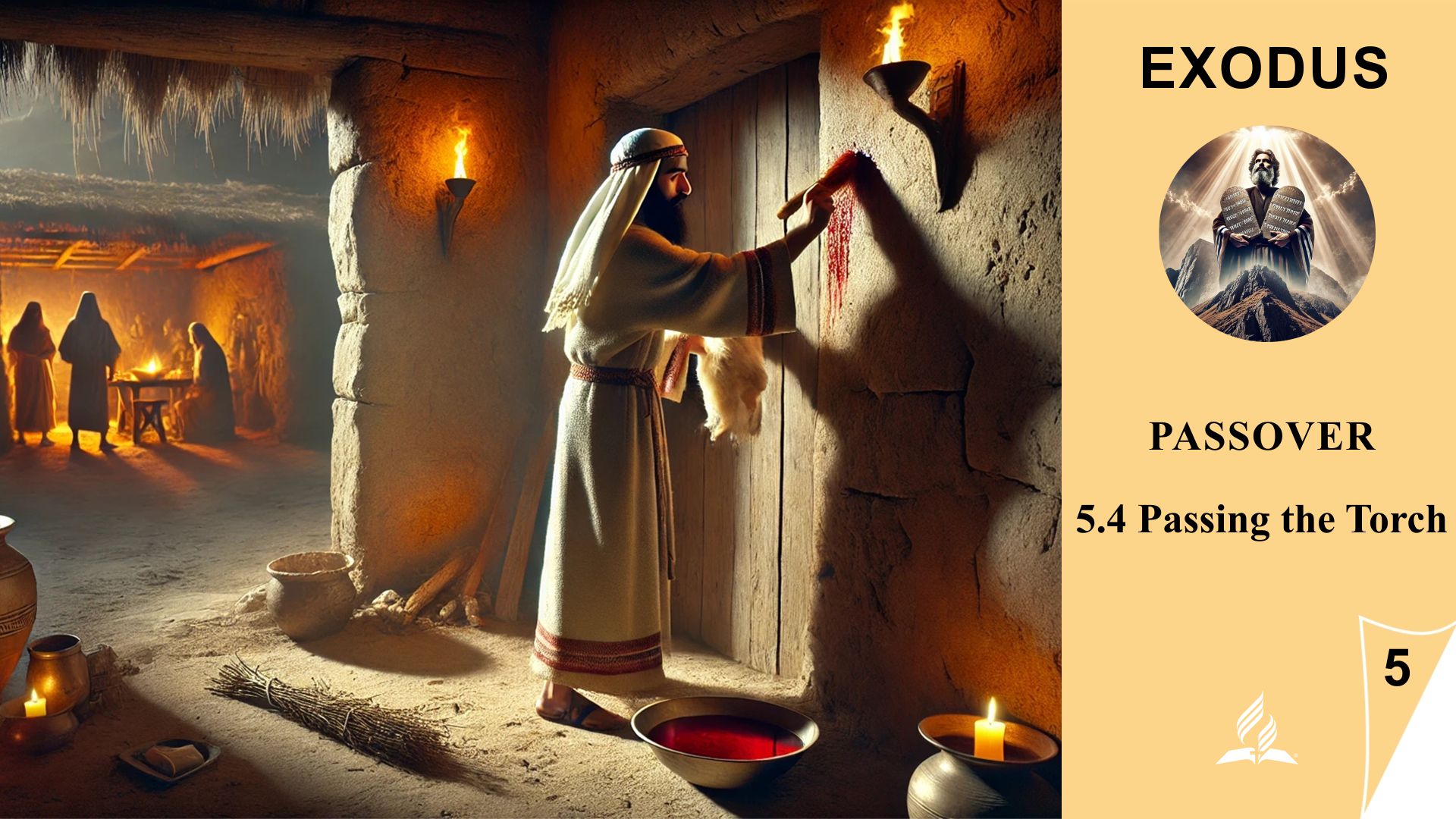
📘 5.4 Passing the Torch
✨ The Torch of Faith – Passing On What God Has Done
………………………………………………………………….
🟦 Introduction
In every family, something is passed on: traditions, values, memories – and also faith.
The Bible makes it clear: Faith in the God of Israel should not be conveyed merely through books or teachers – it should be told, experienced, and celebrated.
Psalm 145:4 says:
“One generation will commend your works to another; they will tell of your mighty acts.”
God calls parents to be faith teachers in their own homes.
The Exodus from Egypt was not just a historical event – it was passed down from generation to generation, as if each had lived through it themselves.
And that continues to this day – even through us.
………………………………………………………………….
📖 Bible Study: Exodus 12:24–38
🔹 Context Overview
We are at a pivotal moment in salvation history:
The last night in Egypt is beginning. The people of Israel stand at the threshold between slavery and freedom, between judgment and grace. The Passover instructions have been given – and in the midst of this dramatic preparation, God emphasizes one thing in particular:
👉 Don’t forget what I’ve done – and make sure it’s never forgotten.
The people are not yet free, but they are already told to celebrate, remember, teach, and tell the story annually – as if the deliverance had already taken place.
Remembrance becomes a form of faith.
🔍 Verse-by-Verse Commentary
📌 Verse 24 – “You shall observe this as an ordinance for you and your children forever.”
God establishes that the Passover is not a one-time event but an eternal ritual to remember His saving act.
“You and your children” → Faith is to be passed down across generations.
“Forever” → God’s acts of salvation are not fleeting; they are eternal moments to be made present again and again.
➡️ Application:
Faith is not static. It lives through celebration, storytelling, and reenactment – especially in the family.
📌 Verses 25–27 – “When you come into the land the LORD will give you… and your children ask, ‘What does this ceremony mean?’”
God speaks not just about the “now” but also about the future – the Promised Land.
He places a child’s question at the center.
Children will ask – it’s not “if,” but “when.”
The answer should not be doctrinal, but personal and narrative:
“It is the Passover sacrifice to the LORD, who passed over the houses…”
God expects questions to be a blessing – an invitation to tell the story.
➡️ Application:
Parents are not just providers, but storytellers of faith.
Their role is to transform history into personal experience.
📌 Verse 28 – “The Israelites did just what the LORD commanded Moses and Aaron.”
The people obey even before they’ve been delivered.
This is faithful obedience – trusting in a word whose fulfillment is not yet seen.
➡️ Lesson:
Spiritual life begins not with reward but with obedience from trust.
📌 Verses 29–30 – “At midnight the LORD struck down all the firstborn in Egypt…”
The moment of judgment arrives.
No one in Egypt is spared – except those covered by the blood.
It is divine judgment that applies to all.
The difference is not origin or morality – but the sign of faith (the blood).
➡️ Theological Insight:
This reveals God’s perfect justice – and His mercy where faith is visible.
📌 Verses 31–33 – “Pharaoh summoned Moses and Aaron… and said, ‘Leave…’”
After long resistance, Pharaoh’s power breaks – not by weapons, but by God’s intervention.
Pharaoh now pleads for them to leave.
The Egyptians urge them to flee, fearing more plagues.
The deliverance happens suddenly – they must be ready.
➡️ Spiritual Principle:
When God calls, readiness is key.
Passover is also a symbol of “departure by faith.”
📌 Verses 34–36 – “The people took their dough before it was leavened…”
This is the origin of unleavened bread – the urgency of departure left no time for rising.
It became a permanent symbol of rapid, saving deliverance.
God ensures they even leave Egypt with riches (v. 36).
➡️ Typological Meaning:
Unleavened bread becomes a sign of purity, departure, and sanctification → cf. 1 Corinthians 5:7–8.
📌 Verses 37–38 – “The Israelites journeyed… about 600,000 men… and a mixed multitude went with them.”
This was a massive exodus – not only ethnic Israelites, but people of other origins joined them (“mixed multitude”).
Deliverance was not limited to one nation, but to all who came under the blood.
This foreshadows what God does in the New Testament: calling a people from all nations.
➡️ Today:
Our churches, too, consist not of bloodlines but of those who stand under the blood of Christ – regardless of culture or background.
📚 Theological Summary: Exodus 12:24–38
| Element | Meaning |
|---|---|
| Parents’ faith | Foundation for passing on the faith |
| Children’s questions | Invitation to living storytelling |
| Remembrance & rituals | Tools for forming identity |
| Obedience beforehand | Expression of trust |
| Judgment & salvation | Justice & mercy meet |
| Unleavened bread | Sign of swift deliverance & spiritual purity |
| Mixed multitude | Symbol of God’s universal call |
🔑 Key Thoughts
-
Remembrance is a spiritual act – it keeps faith alive.
-
Faith begins at home – through storytelling, celebration, and example.
-
God saves – but we are called to pass it on like a torch that must not go out.
………………………………………………………………….
📖 Answers to the Questions
📌 Question 1: What key message is found in Exodus 12:24–38?
This passage reveals a deep spiritual truth:
👉 God ties remembrance to salvation, past to future – and storytelling to faith.
Even before the Israelites leave Egypt, God gives clear instructions on how they must annually celebrate and teach about their deliverance.
Why? Because remembrance is a pillar of a living faith.
📌 Key Points:
-
God’s acts must not be forgotten.
-
Passover becomes a festival of remembrance.
-
Faith lives not only through new experiences but by re-experiencing past victories.
-
Family is the first place faith is transmitted.
-
Children will ask – and parents must answer from the heart.
-
The story becomes personal: “I was freed.”
-
Obedience flows from trust – they celebrate before the deliverance.
-
The Exodus is more than geography – it’s a spiritual departure.
-
The unleavened bread, haste, and readiness all symbolize God’s transforming power.
📘 Conclusion:
God saves – and we are called to remember, tell, and live it out.
Passover is not a dead ritual but a living story of faith, renewed in every generation.
📌 Question 2: Why should parents share the Passover story not just as history, but as their own experience?
God wants the Exodus to become not a distant tale, but a spiritual experience for every generation.
📌 Why?
-
Narration creates identity – “I was freed” makes the story mine.
-
Faith becomes personal through language and experience.
-
Children internalize faith best when it’s felt, not just taught.
-
Storytelling is spiritual self-care – it strengthens even the speaker.
-
Re-telling is also re-living – a reminder of God’s faithfulness.
📘 Conclusion:
God wants families to say: “I was there. I was freed.”
This makes faith real, concrete, and contagious – a story that becomes your own.
📌 Question 3: Why is it important to remember and pass on faith stories – especially within the family?
Because forgetting is more dangerous than persecution.
The Bible often warns:
“Forget not what the LORD has done for you.” (Psalm 103:2)
📌 Why this matters:
-
Memory preserves identity – Forgetting leads to spiritual loss.
-
Families pass on faith through rituals, stories, and celebration.
-
Stories shape worldview – “God helped us” builds confidence.
-
Gratitude grows from remembrance.
-
Shared stories prepare us for future challenges.
📘 Conclusion:
Faith doesn’t die from doubt – it dies from silence.
And remembrance is God’s antidote to forgetting.
………………………………………………………………….
✨ Spiritual Principles
👨👩👧 Parents are the first faith teachers – it starts at home.
📖 Stories of God’s actions anchor faith deeper than theories.
🗣️ Speaking strengthens the speaker – telling God’s deeds renews us.
🕯️ Remembrance is faith maintenance – without it, faith fades.
🙏 Obedience before results is true trust – like Israel before deliverance.
…………………………………………………………………
🧩 Application for Daily Life
-
Regularly tell your children what God has done in your life.
-
Read and discuss biblical stories as family history.
-
Celebrate spiritual rituals (like Communion) intentionally.
-
Build a spiritual legacy: photos, journals, meaningful items.
-
Invite your kids to ask questions – and answer them with honesty and heart.
-
See your story in the light of God’s story of redemption.
………………………………………………………………….
✅ Conclusion
God’s story of salvation doesn’t end in the past – it continues in our homes, our conversations, and our celebrations.
Every generation carries the torch.
Each must experience, share, and believe for themselves.
Faith doesn’t die from opposition – it dies from forgetting.
So remember. Tell. Live.
………………………………………………………………….
💭 Thought of the Day
“Remembrance is not nostalgia – it’s the bridge on which faith walks into the future.”
A story from Asia about memory, deliverance, and hidden faith
Chapter 1 – Shanghai, Lantern Festival Night
The city was a sea of lights. Skyscrapers reflected in the canals.
It was the Lantern Festival – the end of Chinese New Year.
In an old district on Shanghai’s edge, a girl lit a lantern.
It wasn’t gold or ornate – it was deep red, made of rice paper, marked with a stylized lamb.
“Xiao Li,” her grandmother whispered, “hang it by the window. And never forget what it means.”
Xiao Li, 12, curious and sharp, asked, “What does it mean, Nai Nai? It’s not like the others.”
The wrinkled old woman smiled. “It’s our sign. It reminds us of the blood on the doorframe. Of the night God freed His people. Of our story.”
Chapter 2 – In the Shadows
Xiao Li’s family was different. They were secret Christians.
Their church met underground. No cross, no loud hymns.
Their faith was like a lamp under a bowl – but it still shone.
“But we’re not Jews,” said Xiao Li. “Why do we celebrate Passover?”
Her grandmother nodded. “Because Passover became our story.
Not through Moses – but through Jesus. He was the Lamb.
His blood marks our door. His grace set us free – from fear, from shame, from darkness.
And like Israel, we pass this story on to our children.”
Chapter 3 – The Secret Gathering
That evening, as fireworks lit the skies, the family met in a basement.
No windows. One oil lamp.
One family sang softly in Mandarin, another prayed in Korean.
The pastor whispered from a torn Bible. No tech. No stage.
Only words. Life. Hope.
He passed a piece of flatbread to Xiao Li.
“Tonight,” he said, “we remember the night death passed over Egypt.
But where there was blood, God passed by.
We remember that Christ is our Lamb.”
Xiao Li’s heart burned with light.
Chapter 4 – The Question
Later, walking through the alleys, Xiao Li asked:
“Nai Nai… were you in Egypt?”
Her grandmother paused. Then answered:
“Not with my feet. But with my heart.
I was in fear. In shame. In darkness.
But God delivered me. I heard His call.
So yes – I was there.”
Xiao Li looked up at the red lantern swaying softly in the wind.
“Then I was there too.
And maybe… one day, I’ll tell the story as well.”
Chapter 5 – The Next Generation
Ten years later. Xiao Li is a mother now.
Her son, Liang, sits in her lap. Outside, lanterns drift into the sky.
In the window still hangs the red lantern with the lamb.
“Mom, why is our lantern different from the others?”
Xiao Li smiles. And begins:
“Long ago… a people were slaves in Egypt…
But God sent a lamb.
And because of the blood, death stopped.
And you know what? I was there.
And so were you.
Because the God who saved then, saves now.”
🎯 Core Message of the Story:
Even in secret, under pressure, without external splendor, faith lives on – through remembrance, family, and passing on personal experience.
The red lantern is no superstition.
It is a sign:
We believe in the God who saves – and we tell His deeds, until every child can say:
“I was there too.”