
⛪ Lesson 3: Rough Start
📘 3.6 Summary
✨ When the beginning is difficult – God’s plan endures
………………………………………………………………….
🟦 Introduction
Freedom is a big word – but often a painful path. Chapters 5 to 7 in the book of Exodus describe not only the historical exodus from Egypt, but a much deeper spiritual dynamic: When God sets free, He does not always lead along the shortest route. Between divine promise and visible fulfillment lie doubts, setbacks, discouragement – and yet also hope.
Moses experiences exactly that: calling, but also rejection. Commission, but also overwhelm. Promise, but also failure. And in the midst of it all, a God who says: “I am the LORD. I will…” – and remains faithful, even when no one believes anymore.
………………………………………………………………….
📖 Bible Study
3.1 – Who is the LORD?
When human pride challenges God’s authority
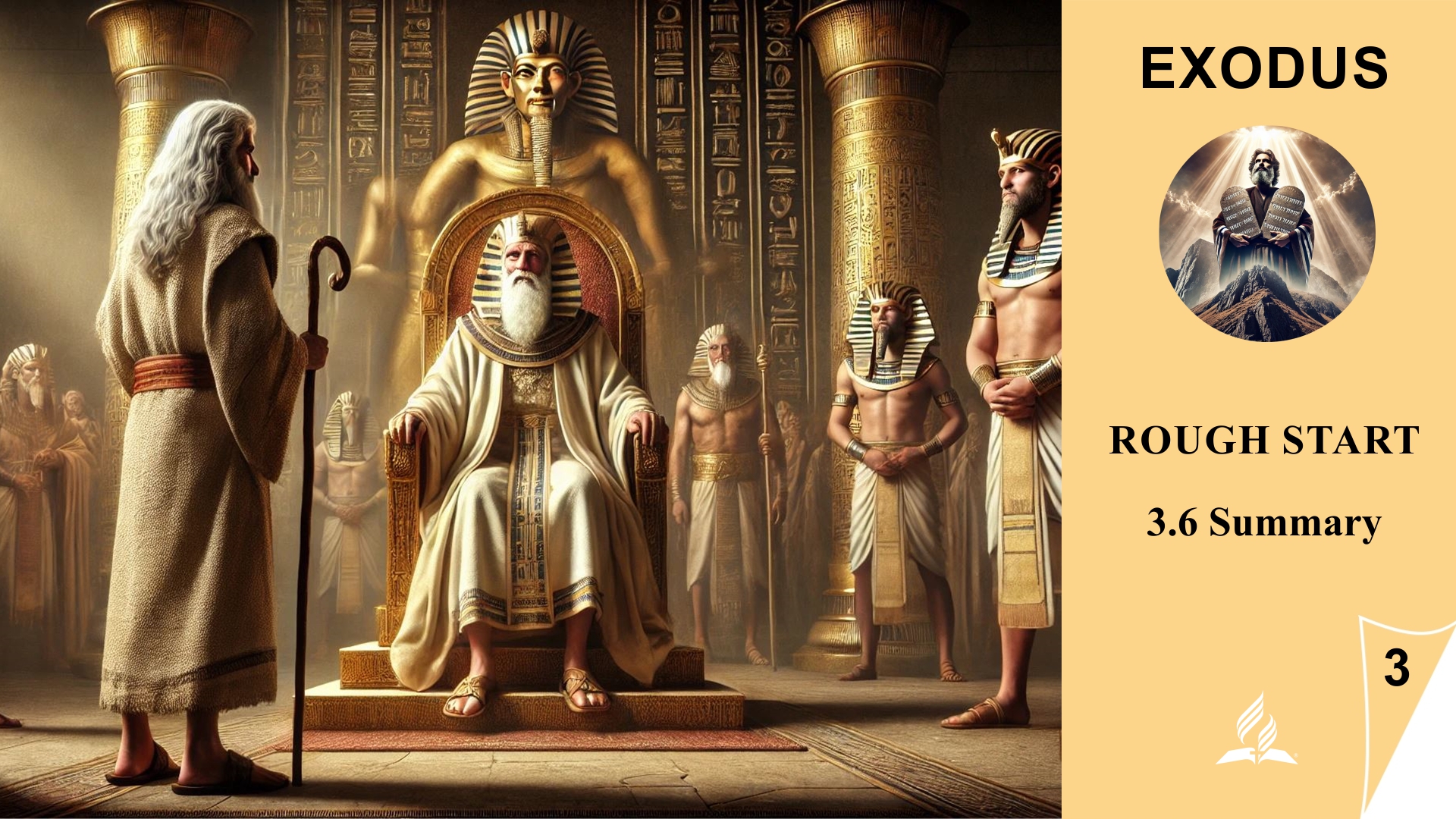
The confrontation between Moses, Aaron, and Pharaoh begins with a seemingly simple but profound question: “Who is the LORD, that I should obey His voice?” (Exodus 5:2). This question is not mere ignorance but an expression of conscious rejection of divine authority. Pharaoh places himself above God, above truth, above revelation. It’s the old rebellion of man against his Creator – pride versus humility, power versus grace.
This heart posture remains relevant today: In a world that increasingly pushes God aside, the same question is asked – out loud or silently: “Who is God, that I should listen to Him?” But God doesn’t respond with anger, but with revelation. Throughout the story, He shows Himself to be patient, gracious, just, and powerful. He endures opposition in order to set free. Whoever recognizes God is no longer the same: they are transformed – from an inner slave into a free child of God.
3.2 – A Rough Beginning
When deliverance starts with setbacks
Moses and Aaron act in obedience. They tell Pharaoh what God has commanded – but instead of an open door to freedom, they experience rejection, mockery, and increased oppression. Pharaoh raises the workload, withholds straw, and still demands the same output. The people are desperate, disappointed, and blame Moses and Aaron.
This is a hard but profound principle of spiritual reality: Obedience doesn’t always lead to immediate relief. Sometimes things get worse first. Why? Because God’s path is not linear. Faith is shaped through resistance. Setbacks are not a sign of divine silence but often stepping stones on the way to fulfillment.
For Moses, this reaction was a shock. He already felt inadequate, and now he was under pressure. But it is precisely here that God begins to shape him – patience, humility, and inner trust do not grow in success, but in crisis.
3.3 – The Divine “I”
Despair meets promise
Moses breaks down inwardly. He cries out to God: “Why have You sent me?” (Exodus 5:22). This complaint is honest, raw, and unfiltered – and yet God does not rebuke him, but repeats His promise: “I am the LORD.” Then follow seven powerful statements beginning with “I will…”
God’s answer to human despair is self-revelation. He does not question Moses, but confirms his calling and His own intentions. He reminds him of the covenant made with Abraham and declares: “I have heard the groaning of My people.”
Here we learn: God does not ignore our suffering. His promises are firmer than our emotions. And He works – even when we (still) don’t see it.
3.4 – Uncircumcised Lips
When discouragement closes ears
Even though Moses has now received powerful promises, he encounters a deeply discouraged people. The Israelites no longer listen to him – their suffering is too great, their hope too faint. And Moses again feels unfit: “I have uncircumcised lips…” (Exodus 6:12).
The disappointment runs deep – not only in the people but in Moses as well. But God’s plan remains. He doesn’t ignore the weakness of His instruments, but His calling is not dependent on their perfection. The covenant formula “I will be your God, and you shall be My people” stands above everything.
We still encounter this dynamic today: People don’t listen because they’re too wounded. Leaders doubt because they feel too weak. But God remains faithful. His word holds – even through broken vessels.
3.5 – Like God to Pharaoh
God equips those He calls
Moses continues to hesitate, but God responds with patience. He gives Moses Aaron as a helper and clearly defines their roles: Moses shall be like God to Pharaoh – and Aaron shall be his spokesman. God thus addresses Moses’ fear without rejecting him. At the same time, God openly states: “I will harden Pharaoh’s heart…”
This shows: God controls not only the called but also the opposition. Nothing slips from His hands. And although Pharaoh’s heart is hard, it leads to a greater revelation of God’s power and glory.
God does not expect flawless heroes. He expects trust despite imperfection. And when we are willing to go – He equips us.
3.6 – Overview and Spiritual Line
All these sections point to a dramatic yet deeply spiritual truth:
God’s path to freedom often leads through the valley of testing.
The Exodus from Egypt doesn’t begin with victory but with crisis.
The calling is not followed by instant success, but by rejection.
Yet in all of this, God remains steadfast. He does not act according to human strength but according to His promises and faithfulness.
The thread through Exodus 5–7 is God’s “I am” and “I will.”
It is not Moses’ faith that saves the people – but God’s covenant loyalty.
………………………………………………………………….
✨ Spiritual Principles
✔ God’s call is stronger than our excuses.
✔ Promises are real, even if not yet fulfilled.
✔ Discouragement is human – but no boundary for God.
✔ True faith complains – but holds onto God.
✔ Leadership requires patience, especially in spiritual crises.
………………………………………………………………….
🧩 Application in Daily Life
For leaders:
If you carry responsibility – expect setbacks. People will disappoint. But God remains faithful.
For doubters:
Your lament is allowed – as long as it’s rooted in trust. You can be honest with God.
For everyone:
Don’t ask: “Am I good enough?”
Ask: “Do I trust enough?”
God does not only call the capable – He equips those He calls.
In relationships with others:
Don’t respond too quickly with blame. Spiritual leaders also walk through darkness. Allow space for God’s timing.
………………………………………………………………….
✅ Conclusion
Chapters 5 to 7 of Exodus remind us: God’s work often begins hidden.
Between the call to freedom and experiencing that freedom lies a path that God intentionally shapes – not to test us, but to strengthen our faith.
Moses wasn’t perfect.
The people were disappointed.
Pharaoh was hard-hearted.
And yet: God’s word remained.
“I will be your God.”
This is what we hold on to – in our crises, setbacks, and darkest hours.
………………………………………………………………….
💬 Thought of the Day
“God doesn’t always lead the fastest way – but always the most faithful one.”
………………………………………………………………….
✍️ Illustration – “When God Was Silent”
Location: Chicago, present day
A modern story of calling, doubt, and God’s faithfulness
Chapter 1 – The Calling That Changed Everything
Caleb was 29, smart, organized, and on a clear career path in Chicago’s tech scene. And yet something else had been burning inside him for months: the impression that God was calling him. Not to the stage, not overseas – but right into his hometown, into the part no one wanted to go: the South Side – drugs, gangs, broken families.
He sensed: “I’m supposed to be there for these kids. Mentoring. Bible. Listening. Staying.”
So he quit. Studied theology on the side. Launched a small local project with a few donations. The name was simple: Breakroom – a space for new paths.
Most friends thought he was naive. Others thought he was impulsive. A church leader asked:
“Do you really think God wants you there? Or are you running from something?”
But Caleb was certain: God had spoken. This is my path.
Chapter 2 – The Wall After the Start
At first, everything went well. Two boys from the neighborhood came regularly. They helped with renovations, played chess, asked questions about God. Caleb was hopeful.
Then came the setbacks: One boy got caught stealing. A parent complained that Caleb was trying to “push religion on the kids.” Police stopped him at night walking home – because he “didn’t look like he belonged.”
Worse: A promised grant from a local church fell through. The fridge was empty, the bank account shrinking. And the kids stopped coming. It felt like someone had slammed the door shut.
Caleb asked himself: Lord, did You really send me? Or did I get it wrong?
Chapter 3 – The Night of Open Questions
One cold November evening, Caleb sat alone in the center. The lights flickered. It smelled like cold dust. A worn Bible lay in the corner. He opened it mechanically – Exodus 6.
“I am the LORD. I will deliver you… I will lead you… I will be your God.”
Caleb read the verses aloud. And suddenly, it was as if someone whispered right into his disappointment:
“I’m not gone. I’m here. You see nothing – but I’m working.”
He cried. Not from despair. But because he felt: God isn’t loud – but He is faithful.
Chapter 4 – When No One Listens Anymore
But the wave didn’t last. The kids stayed away. The center was repeatedly vandalized. Caleb realized: Even the best words fall flat when people are drowning in pain.
One boy he had deeply connected with ended up in jail. Caleb felt powerless.
“What can I do if they won’t even listen? If they don’t care? If I can’t make a difference?”
His prayer was simple: “Lord, I can’t do this.”
There was no voice. No solution. But deep inside, one phrase echoed:
“It doesn’t depend on you. It depends on Me.”
Chapter 5 – A Different Kind of Strength
A few days later, his old friend Anthony dropped by. Once in gangs himself, now a social worker.
“I heard about your project. You’re not giving up, are you?”
Caleb shook his head.
“Actually – almost. I’m at my limit.”
Anthony looked at him quietly.
“You know what changed me? Not words. Not money. Someone who stayed. No matter what.”
That sentence hit deep. Maybe what mattered most wasn’t Caleb’s strength – but his presence.
God didn’t need a hero – but a witness. Someone who stands firm in the storm.
Chapter 6 – When Hope Returned
It was a rainy Friday when Caleb opened the letter. A Christian foundation from Colorado had heard about his work – and decided to fund it for a year. No application. No strings attached.
Soon after, one of the boys returned. No big words. Just:
“Still got time for chess?”
Caleb smiled.
Yes. He had time.
He thought back to his questions, his weariness, his doubt. And he understood:
God hadn’t been silent. He had been working – quietly, deeply, faithfully.
💬 Final Thought
Sometimes the greatest miracle is not in what we achieve, but in what we endure without giving up.
Caleb’s story echoes Moses’. Not in scale, but in soul.
Both were called.
Both doubted.
Both faced rejection.
And both discovered: God’s plan stands, even when ours fall apart.