

⛪ Lesson 10: Upon Whom the Ends Have Come
📘 10.7 Questions
………………………………………………………………….
🟦 Introduction
We live in a time full of tension. On one hand, as Christians we are called to be light in the world, to reach people with the Gospel, and to bear witness to the truth. On the other hand, Scripture urgently warns us not to let the world influence or defile us.
This tension accompanies the life of every believer: How can we live in society without adopting its patterns of thought and lifestyle? How can we be around people who do not know God without absorbing their aimlessness ourselves?
The biblical accounts we have studied this week—about Noah, Lot, Moses, and humanity’s ultimate decision—challenge us to think more deeply about our responsibility, our hope, and God’s sovereign action.
This introduction aims to set a framework, preparing us to focus on the important questions every faithful believer must ask in order to live faithfully in a world that is increasingly drifting away from God.
………………………………………………………………….
📖 Answers to the Questions
📌 Question 1: Jesus told His disciples that they are in the world but not of the world (see John 15:19; 17:14–16). How do we reconcile our responsibility to win the world with the need to keep ourselves “unstained by the world” (James 1:27)?
Answer:
Jesus sent us into the world—not into a monastery, not into isolation, but right into relationships, challenges, and tensions. We are called to love, serve, and bear witness. At the same time, James (1:27) warns that true godliness consists in staying “unstained by the world.”
This means: We immerse ourselves, but we do not lose ourselves. Like a boat on the water—it only fulfills its purpose when it floats, but it sinks if the water gets inside.
✨ Spiritual Principle
Relationship without merging, influence without conforming, love without compromise.
🧩 Application in Daily Life
– Use social media intentionally: be a light rather than get lost in it.
– Make clear decisions in relationships: do they draw you closer to Jesus, or do they pull you away?
– Set aside daily times of silence with God to recalibrate your “inner compass.”
📌 Question 2: What does Noah’s public ministry before the Flood teach us about the progression of the great conflict? In what way do we hold the same role today?
Answer:
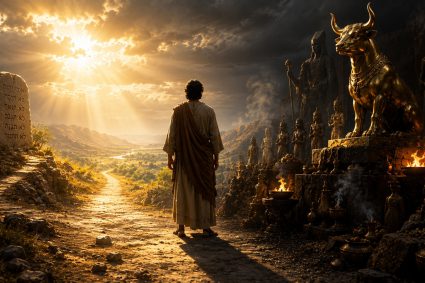
Noah was a “herald of righteousness” (2 Peter 2:5) in a time of profound moral darkness. His public ministry consisted not only of words—it was his entire way of life. Building the Ark was simultaneously a warning, an act of faith, and a sign of hope.
Just like Noah, we live in the end times. Our “Ark” is faith in Jesus, His grace, and His coming Kingdom. Our calling: to live boldly, persistently, and uncompromisingly—and to invite others through our witness.
✨ Spiritual Principle
A believer’s life itself is a sermon—either toward salvation or toward judgment.
🧩 Application in Daily Life
– Consciously build your “Ark”: character, relationships, community.
– Do not give up, even if you are mocked. Truth requires perseverance.
– Be a voice of hope in the world—both in word and in deed.
📌 Question 3: Before God consumes the wicked with fire from heaven (as He did with Sodom), He raises them from the dead and allows Satan to work among them for a short time (Revelation 20:7–9). What reasons can you think of for why this must be the necessary final step before God sets everything right?
Answer:
At first glance, it seems strange: Why resurrect them only to kill them again? Yet here God’s infinite justice becomes evident. God wants everyone to see and understand—even the lost—that His judgment is righteous.
Satan is released one final time to show that, even after a thousand years without influence, he does not change—and neither do his followers. No one can ever say, “I had no chance.” God’s judgment is not impulsive, but open, understandable, and just.
✨ Spiritual Principle
God’s justice is perfect—and His patience is boundless.
🧩 Application in Daily Life
– Learn to trust God, even when you do not yet understand His actions.
– Avoid judging others hastily—God knows the whole picture.
– Recognize: Every day is an invitation to grace, as long as it lasts.
📌 Question 4: What warnings do you find for your own life as you reflect on the accounts you studied this week? What do these accounts teach you about your hope in Christ?
Answer:
Whether Noah, Lot, or Moses—they all lived in dark times. Yet their hope was not in politics, technology, or self-improvement. Their hope was in a God who sees, saves, and intervenes at the right time.
Today we face similar challenges: judgments flood the world—morally, socially, environmentally. But our hope remains the same: Jesus Christ. He is the Rock, the Ark, the saving hand.
✨ Spiritual Principle
Our hope is not that this world will get better—but that Jesus will return.
🧩 Application in Daily Life
– Maintain a living hope: read the Bible daily, pray, connect with other believers.
– Recognize: your life is embedded in a much larger plan.
– Live as if Jesus could come today—but work as if He will come tomorrow.
………………………………………………………………….
✅ Conclusion
These questions do not lead us to academic knowledge, but to a deep decision of the heart. We stand in the current of time—between judgment and grace, between calling and temptation. Our task: remain watchful, remain faithful, remain connected.
………………………………………………………………….
💭 Thought of the Day
“You cannot save the world—but you can make a sign. For truth. For grace. For Jesus.”
………………………………………………………………….
✍️ Illustration – The Sound of Another World
It was a cold, windy morning in Berlin. Gray sky, crowded streets, hurried U-bahn trains. Amid all the noise, Julian, age 32, a software developer at a rising startup, moved through the station. From the outside, his life seemed “successful”: an apartment in a trendy neighborhood, a good salary, smart friends, travel, a gym membership. Yet inside he felt a fracture. Not loud or glaring—more like a background note that never quite went away. Like a distant yearning.
Julian had grown up in a Christian home. His mother often prayed with him at night, sharing stories of Noah, Moses, and Jesus. As a teenager, all of that felt too restrictive, too “alien to the world out there.” He wanted to fit in, build a career, have fun. And yet—on some days, it all caught up with him again.
That morning, on the U2 platform, an elderly woman entered. She wore a gentle, warm gaze and carried a well-worn Bible under her arm. She sat right next to him—though the car was half empty. He didn’t mind. As he stood to exit, she said only: “God will remind you of your calling.” He looked at her—her eyes seemed to look right through him. He said nothing, and the doors closed.
At home that evening, he lay awake for a long time. Her words would not let him go. What am I called to? Who am I—really? He opened a closet door and found an old Bible from his confirmation. He opened it at random. It landed on the Epistle of James: “Pure and undefiled religion before God the Father is this: to visit orphans and widows in their distress, and to keep oneself unstained from the world.”
That was the moment. It was as though something inside him burst forth—not loudly, but inevitably. In the following days, he kept reading: about Noah, who built and preached for 120 years; about Lot, who fled from Sodom; about Moses, prepared in the wilderness; about a final decision, a resurrection for judgment, as described in Revelation 20.
He began to ask questions. Why do we live as though everything here is eternal? Why do we build on things that perish? Why do we talk about love yet ignore God, who is love itself?
A few weeks later, Julian quit his job. Not out of escape—but out of clarity. He began working at a residential project for youth with troubled backgrounds. He used his programming skills to give them new opportunities—and told them about a God who has not forgotten them.
Some of his friends thought he was crazy. Others ignored him. Yet he felt: he was finally on the right path. Not an easy one—but a genuine one. One with depth. One with meaning.
One evening, as he walked through the park, he thought again of that woman on the train. He whispered softly, nearly to himself: “Thank you for reminding me.”
The wind rustled through the trees. And for a moment, it was as if another world echoed through them. The world for which we were truly created.