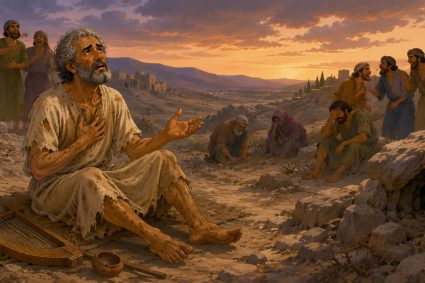






🤩 Bible Stories to Marvel At
Where God’s miracles become great – for little and big children
🗣️ Job Chapter 8 – Bildad Begins to Speak
⚖️ When Simple Answers Are Not Enough
🌅 Introduction
Job had brought his difficult questions to God. He had spoken of long nights, of pain, of weariness, and of longing for an answer. His words were not easy, but they were honest.
Now his friends were sitting with him again. One of them, Bildad, could no longer remain silent. He had heard Job’s complaint and now wanted to respond.
Bildad firmly believed that God is just. That was right. But he also thought that Job’s suffering must have a simple explanation. That was exactly where the problem lay.
This chapter tells us how difficult it is to truly understand a suffering person when we too quickly think we already know all the answers.
📖 The Bible Story
😟 Bildad Hears Job’s Words
Bildad had listened as Job expressed his pain. To him, Job’s words probably sounded very intense. Perhaps he was shocked by how openly Job spoke with God.
So Bildad began to speak sternly. He asked Job how long he would keep saying such words. To Bildad, Job’s complaints sounded like a strong wind stirring everything up.
But Job did not speak this way because he wanted to despise God. He spoke this way because his heart was wounded.
Bildad saw the grief, but he did not understand it deeply enough.
⚖️ Bildad Speaks About God’s Justice
Bildad said that God does not twist justice. He was convinced that God always acts justly.
That was true. God is just and does nothing evil.
But Bildad drew a harsh conclusion from this. He suggested that Job’s children may have died because of their own guilt.
These words must have hurt Job deeply. A father who had just lost his children now heard from his friend that their death may have been a punishment.
Bildad wanted to speak about God’s justice, but his words became a new wound for Job.
🙏 Advice That Sounds Too Simple
Then Bildad advised Job to seek God and ask for mercy. If Job was truly pure and upright, Bildad thought, then God would raise him up again and restore his home.
This idea also sounded good at first. It is good to seek God. It is good to ask Him for help.
But Bildad spoke as if Job’s suffering were easy to solve. As if Job only had to do the right thing, and then everything would quickly be well again.
But Job’s suffering was not that simple. Job was not suffering because he had left God. He was suffering even though he had remained faithful to God.
🌾 Pictures from Nature
Bildad spoke of plants that dry up without water. That, he thought, is what happens to people who forget God.
He also spoke of a spider’s web that cannot provide secure support. Whoever trusts in something false finds no firm ground.
These pictures were impressive. Children can easily imagine how a plant becomes weak without water or how a thin spider’s web tears when someone tries to hold on to it.
But again, the pictures did not really fit Job. Job had not forgotten God. In his suffering, he was still clinging to God, even though he was full of questions.
🌤️ Bildad Speaks of Hope
At the end of his speech, Bildad said that God would not reject an upright person. He thought Job could laugh again and that his enemies would be put to shame.
That sounded hopeful. And indeed, one day God would turn Job’s story around.
But Bildad did not know when or how. He spoke as if he already held the whole explanation in his hands.
For Job, that was hard. His friends spoke of hope, but they did not truly hear his pain.
🌟 When Words Must Be Careful
Job chapter 8 shows us that right thoughts can have the wrong effect when they are spoken without compassion. Bildad said that God is just. That is true.
But he turned that into a quick explanation for Job’s suffering. He spoke about guilt, even though he did not know what had really happened.
So we learn from this chapter: when someone is suffering, we should speak slowly and listen quickly. Not every suffering has a simple explanation, and not every sad person immediately needs a lesson.
Job’s story continues. Soon Job will answer, because he still does not feel understood.
🌅 What This Chapter Shows
This chapter shows that simple answers are often not enough when someone is deeply suffering. Bildad speaks about God’s justice, but he does not truly understand Job’s pain.
We also learn that compassion is important. Anyone who wants to comfort should speak carefully and first listen well.
🟣 Summary
Bildad, Job’s second friend, begins to speak. He defends God’s justice, but too quickly interprets Job’s suffering as the result of guilt. He advises Job to seek God and speaks of hope, yet his words do not truly comfort Job. Bildad says some things that are right, but without enough compassion.
💚 Message for Children Today
When someone is sad, we should not be too quick to explain why something happened. Sometimes we simply do not know.
Good friends listen, speak lovingly, and do not make the pain of others seem smaller.
💭 Reflection Thought
🔸 Why did Bildad’s words probably sound harsh to Job?
🔸 Why are simple answers often not enough in great pain?
🔸 How can you treat someone with compassion?
🧒 👧 👦
💌 Invitation to Job Chapter 9
🌌 Job Thinks About God’s Greatness
Bildad has spoken, but Job still does not feel understood. He knows that God is great and just. But precisely because of this, he wonders how a human being can stand before God.
Job begins to think about God’s power, His greatness, and his own helplessness.
Come along and discover the next chapter!
🔔 Preview of Job Chapter 9
✨ When God Is Greater Than All Questions
Job looks at God’s power and realizes how small human beings are in comparison.
👉 How does Job describe God’s greatness?
👉 Why does he still feel helpless?
👉 And what does he long for between God and humanity?
✨ In the next chapter, we will hear Job’s deep thoughts about God’s greatness and his own distress.