

🌿 Traces of Creation – Discoveries from Nature
🐟 3rd Series: Life in the Hidden Realm – The World of Fish
❄️ Episode 4 – Cold, Yet Alive – Life Without a Constant Body Temperature
🌡️ Introduction: Life Without Internal Heating
For humans, a constant body temperature is taken for granted.
Even a deviation of just a few degrees affects performance,
and greater fluctuations can become life-threatening.
Fish live under completely different conditions.
Their body temperature adapts to their surroundings.
They have no internal “heater,”
no constant heat production like mammals or birds.
And yet they are:
- active
- mobile
- capable of high performance
How is life possible
when warmth does not come from within?
🧊 1. Cold-blooded – a Misunderstood Term
Fish are often described as “cold-blooded.”
That sounds like sluggishness or limitation.
In reality, they are ectothermic:
their body temperature follows the temperature of their environment.
That does not mean:
- functionless
- slow
- inflexible
Rather:
- energy-efficient
- adapted
- stable within certain limits
Ectothermy is not a deficiency,
but a different life strategy.
🌡️ 2. Temperature Influences Everything
In fish, temperature directly affects:
- metabolism
- muscle activity
- digestion
- reaction speed
Colder water:
- slows down processes
- saves energy
Warmer water:
- speeds up processes
- increases energy demand
Fish do not “function” independently of their environment,
but in close coordination with it.
⚡ 3. Saving Energy as a Survival Advantage
Keeping a warm body temperature constant
requires enormous energy.
Fish save this energy.
This enables them to:
- survive longer periods without food
- live in nutrient-poor waters
- maintain large populations
What appears to be a disadvantage from a human perspective
is actually a strategic advantage.
🐟 4. Active Despite the Cold
Ectothermic does not mean motionless.
Many fish are:
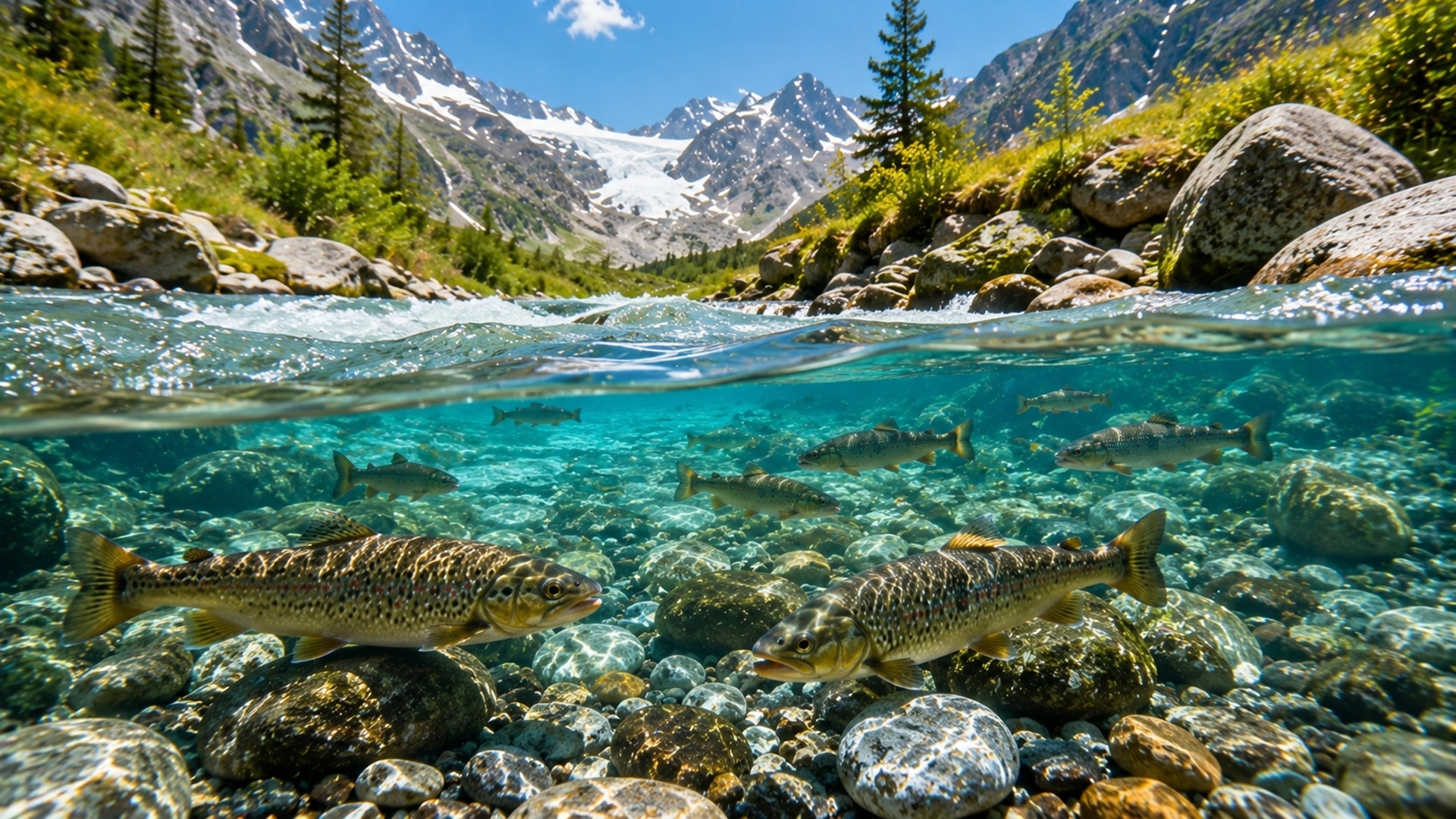
- active in cold mountain streams
- able to live under sheets of ice
- at home in depths with constantly low temperatures
Their enzymes, muscles, and nerves
are adjusted to these temperatures.
They work efficiently there
where other systems would fail.
🧭 5. Behavior Replaces Internal Regulation
Because fish do not regulate their body temperature themselves,
they do it through behavior.
They:
- change water depths
- seek warmer or cooler zones
- adjust their activity times
Temperature regulation does not happen internally,
but spatially.
This requires:
- perception
- orientation
- a suitable environment
Here too we see:
biology uses existing possibilities
instead of creating unnecessary systems.
🔥 6. Special Case: Warm Muscles in Cold Water
A few fish species,
such as tuna or certain sharks,
can keep parts of their bodies warmer than their surroundings.
What is interesting:
- they still remain basically ectothermic
- heat production is locally limited
- it serves a clear purpose: fast movement
This exception also confirms the rule:
regulation happens only where
it is functionally necessary.
🐣 7. Coordinated from the First Day of Life
Already as a young fish,
the metabolism must fit the environment.
There is:
- no warm-up phase
- no transitional solution
- no safety reserve
Temperature, enzyme activity, and behavior
must fit together from the beginning.
A poorly coordinated system
would not survive.
🧠 8. A Rational Look at Biological Efficiency
In technical systems, the principle applies:
the less energy is available,
the more efficiently it must be used.
Ectothermy follows exactly this principle.
No energy loss through constant heating.
No oversupply.
No unnecessary complexity.
The system is not maximal,
but optimal.
✝️ 9. The Christian Perspective: Life with Measure
The Christian view of life
emphasizes measure and appropriateness.
Fish do not possess everything
that would be imaginable—
but everything
they need.
Their dependence on the environment
is not a sign of weakness,
but part of an order
in which life is embedded.
Not isolated.
Not autonomous.
But connected.
💡 10. What the Ectothermy of Fish Teaches Us
It teaches us:
- performance does not always require maximum control
- dependence can create stability
- efficiency arises through adaptation
Perhaps it also reminds us
that life does not have to function the same way everywhere
in order to be meaningful.
🌌 Final Thought
A fish swims in cold water,
its body follows the temperature,
its life remains stable.
Not despite this dependence,
but through it.
Whoever takes this form of life seriously
discovers even in the cold
traces of creation.
