





✉️ FIRST AND SECOND CORINTHIANS
🏛️ Lesson 1: Paul’s Ministry in Corinth
📝 1.5 Paul’s Letters to the Corinthians
❤️ Letters Written Out of Concern, Love, and Spiritual Responsibility
📖 1. Introduction
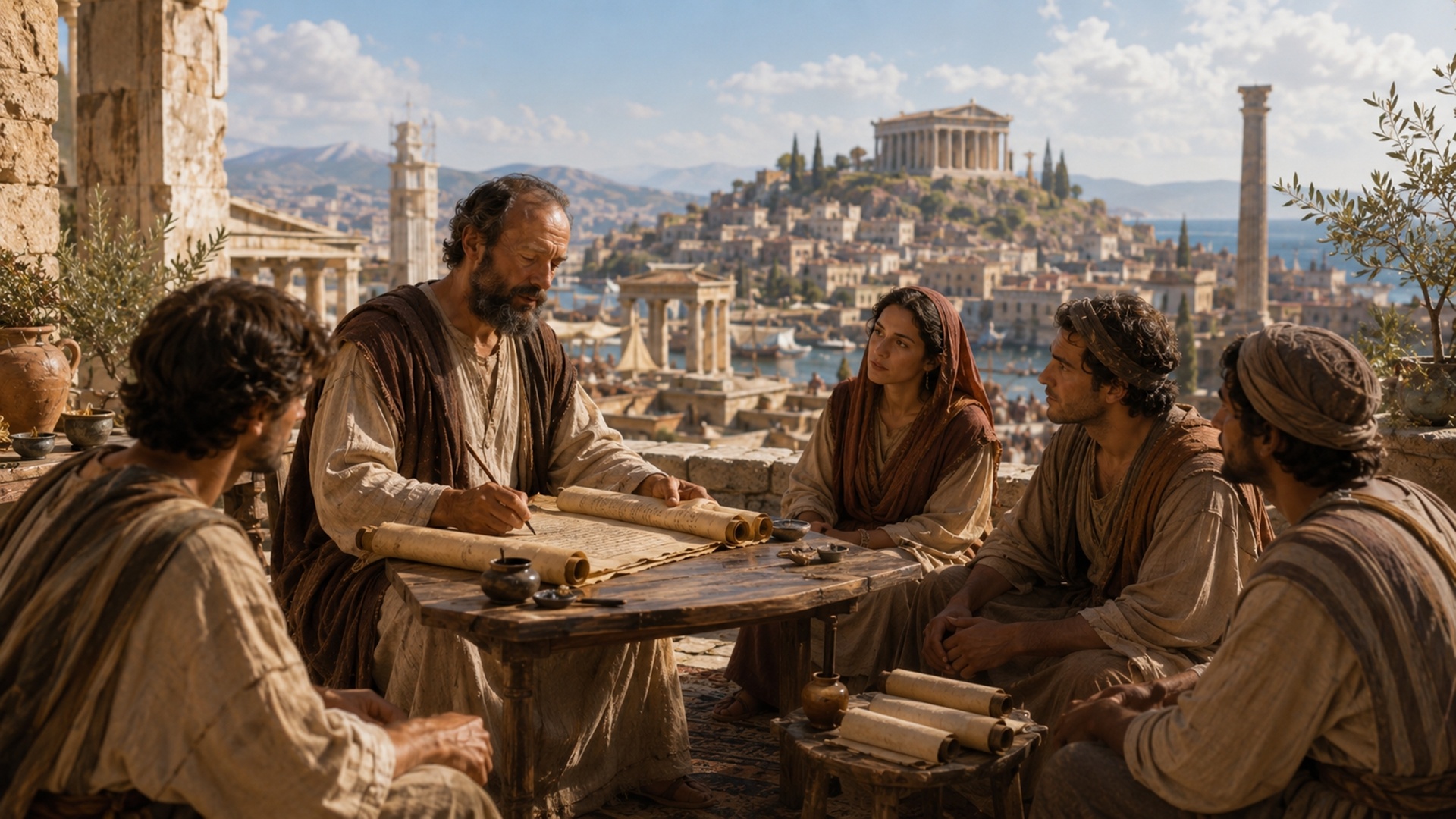
Paul did not write his letters to the Corinthians out of anger or personal disappointment, but out of deep concern for the church. He had learned that there were divisions, immorality, pride, wrong ideas, and spiritual disorder in Corinth. The church was rich in gifts, yet at the same time immature in faith. Paul did not want to shame the believers, but to direct them back to Christ. His letters show that spiritual leadership sometimes must correct, but it should always do so out of love. Therefore, the letters to the Corinthians remain important today, because many of their problems can also be found in churches today.
📜 2. The Biblical Foundation
Paul writes about the disputes in Corinth:
“For it has been declared unto me concerning you, my brethren, by them which are of the house of Chloe, that there are contentions among you.” 1 Corinthians 1:11
He does not write in order to destroy, but to admonish:
“I write not these things to shame you, but as my beloved sons I warn you.” 1 Corinthians 4:14
Paul also answered specific questions from the church:
“Now concerning the things whereof ye wrote unto me.” 1 Corinthians 7:1
In 2 Corinthians it becomes clear how deep his concern was:
“For out of much affliction and anguish of heart I wrote unto you with many tears.” 2 Corinthians 2:4
These verses show that Paul wrote out of love, responsibility, and spiritual concern in order to lead the church back to Christ.
🌍 3. Connection to Today
Churches today often face challenges similar to those in Corinth. There are disputes, pride, differing opinions, moral questions, spiritual immaturity, and sometimes also the influence of culture on the thinking of believers. Many problems arise when Christ is no longer truly at the center. The letters to the Corinthians remind us that a church must not only be outwardly active or gifted, but spiritually healthy and founded on the gospel. Paul shows that true love does not remain silent when danger exists. Spiritual admonition is necessary when it comes from love and has the goal of bringing people closer to Christ.
💡 4. Central Message of the Lesson
👉 Paul wrote to the Corinthians in order to direct a problematic and immature church back to Christ and the gospel through truth, love, and spiritual responsibility.
✝️ 5. Theological Focus
Paul’s letters to the Corinthians show that the gospel is not important only at the beginning of the Christian life, but for every area of church life. Paul addresses many different topics: divisions, immorality, marriage, food sacrificed to idols, order in worship, spiritual gifts, resurrection, the collection for those in need, and apostolic authority. Yet behind all these topics stands one central question: Is the life of the church shaped by the gospel of Christ?
Paul wrote 1 Corinthians because he had received reports about serious problems. The people of Chloe had told him about divisions in the church. The Corinthians had begun to group themselves around human leaders: “I belong to Paul,” “I belong to Apollos,” “I belong to Cephas,” or “I belong to Christ.” In this way, the unity of the body of Christ was endangered.
For Paul, this division was not merely an organizational problem, but a spiritual problem. When Christians define themselves by human leaders, they lose sight of Christ. The church does not belong to Paul, Apollos, or any other human being. It belongs to Christ, who was crucified for it.
Therefore, Paul repeatedly leads the church back to the cross. The cross destroys human pride. It shows that salvation does not come through wisdom, achievement, power, or reputation, but solely through God’s grace. A church that understands the cross cannot be proud of human parties, gifts, or positions.
Another reason for the letters was moral disorder. In 1 Corinthians 5, Paul speaks about sexual immorality that was even being tolerated within the church. Paul makes it clear that grace does not mean minimizing sin. The church is called to live in holiness because it belongs to Christ.
It is important to note that Paul does not write out of harshness, but out of spiritual responsibility. He knows that sin destroys. It destroys the person, the church, and the witness to those outside. Therefore, love must sometimes speak clearly. A love that never corrects is not true spiritual love.
Paul also answered questions that the Corinthians had asked him. Beginning in chapter 7, he deals with topics such as marriage, singleness, divorce, food sacrificed to idols, freedom, worship, spiritual gifts, and resurrection. This shows that the church needed guidance. They had questions, but often lacked the spiritual maturity to discern rightly.
It is especially important that Paul answers these questions not only practically, but theologically. He does not first ask: What is convenient? What is socially accepted? What pleases people? Instead, he asks: What corresponds to Christ? What serves love? What builds up the church? What honors God?
In 2 Corinthians we see Paul’s heart even more clearly. He does not defend his ministry out of wounded pride, but because the church was endangered by false influences. Some questioned his authority and were impressed by ideas of power, success, and outward strength. Paul, however, shows that true ministry is marked by weakness, surrender, suffering, and dependence on Christ.
This is a deep theological contrast: the world admires power, eloquence, success, and self-presentation. But Paul points to Christ, the Crucified One. God’s power is not always shown in outward strength, but often precisely in weakness, faithfulness, and suffering love.
The letters to the Corinthians therefore teach us that the church needs a different culture than the world. Corinth was marked by competition, status, wealth, and moral freedom. Paul wanted to form a Christ-centered culture: marked by humility, love, holiness, unity, readiness to serve, and hope in the resurrection.
The theological focus is therefore clear: the gospel must be the lens through which the church sees everything. Conflict, freedom, sexuality, gifts, leadership, money, suffering, and hope must be understood in the light of Christ. Where this happens, the church is renewed.
🌟 6. Spiritual Deepening
The letters to the Corinthians show us how deeply Paul loved the church. He could have given up on the Corinthians. They were difficult, proud, immature, and full of problems. Yet Paul wrote to them again and again because he knew that this church belonged to Christ.
This is an important lesson for us. Sometimes in the church we first see the weaknesses of other people. We see disputes, mistakes, immaturity, lack of love, or wrong attitudes. But Paul reminds us that God’s church is precious despite its problems. Christ purchased it with his blood.
Spiritual love is not indifferent. Paul loved the Corinthians too much simply to ignore their problems. He knew that silence is sometimes easier than admonition. But true love does not seek the easiest path; it seeks the spiritual good of the other person.
This challenges us. How do we react when we see problems in the church? Do we talk about people, or do we pray for them? Do we condemn them inwardly, or do we seek their restoration? Paul shows that spiritual responsibility can be connected with tears. He did not write coldly or arrogantly, but with anguish of heart and love.
Especially moving is 2 Corinthians 2:4. Paul wrote “with many tears.” This shows that correction in the kingdom of God should never be loveless, harsh, or self-righteous. Whoever admonishes others in God’s name needs a heart that loves, suffers, and hopes.
Today too, we need churches in which truth and love belong together. Truth without love becomes harsh. Love without truth becomes weak. Paul combines both. He speaks clearly about sin, division, and error, but he does so in order to lead people back to Christ.
The letters to the Corinthians also ask what kind of culture shapes our churches. Are we shaped by the gospel or by the world? Is Christ our concern, or human opinions? Do we seek unity, or do we enjoy winning arguments? Do we use our gifts for service, or for self-display?
The church in Corinth had many spiritual gifts, but little spiritual maturity. This is a serious warning. Gifts alone do not prove spiritual depth. A church can be active, gifted, and impressive, and still be loveless, proud, or disorderly. That is why Paul places love at the center in 1 Corinthians 13.
Without love, even the best gifts lose their value. Without love, knowledge becomes cold, service becomes empty, and devotion becomes hollow. The love of Christ is the mark of true spiritual maturity.
Paul did not only want to correct the Corinthians, but to shape them. He wanted them to learn to live as people of the cross. This means less pride, more humility; less self-assertion, more service; less adaptation to culture, more faithfulness to Christ.
This is also important for our personal lives. The question is not only whether I belong to the church, but whether my thinking is shaped by the gospel. Do I evaluate conflicts in the light of the cross? Do I use my freedom in a way that builds others up? Do I seek my own honor or the honor of Christ?
Paul’s letters show that spiritual growth often happens through correction. None of us likes to receive admonition. But God uses his Word, spiritual leaders, brothers and sisters, and sometimes difficult situations to cleanse us and make us more mature.
Therefore, we should not read the letters to the Corinthians only as letters to a problematic church, but as a mirror for ourselves. Where am I proud? Where do I need more love? Where has culture shaped my thinking more than Christ? Where do I need to realign myself with the gospel?
The good news is that Paul wrote because there was hope. God did not give up on the Corinthians. Despite their mistakes, his grace was at work in them. This gives us hope too. God can renew churches. He can change hearts. He can turn conflict into unity, disorder into spiritual maturity, and weakness into a testimony of his power.
🔧 7. Application in Everyday Life
Practical steps:
- Read the letters to the Corinthians with this question: What does God want to change in my thinking?
- Ask God for a heart that combines truth and love.
- Seek unity in the church instead of encouraging factions or arguments.
- Examine whether Christ is truly at the center of your decisions.
- Receive spiritual correction humbly when it comes from God’s Word.
- Use your gifts not for self-display, but to build up others.
- Pray for difficult people and situations in your church.
- Regularly ask yourself whether your life is shaped more by culture or by the gospel.
❓ 8. Reflection Question
Where do I personally need the correcting and renewing power of the gospel so that Christ may again stand more clearly at the center?
🌟 9. Final Thought
Paul wrote to the Corinthians because he loved the church and recognized its spiritual danger. His letters were not an expression of control, but of concern, tears, and responsibility. He wanted to lead the believers back to the center: Jesus Christ, the Crucified and Risen One. The letters to the Corinthians show that the gospel touches every question of personal and church life. Today too, we need churches that are not shaped by pride, disputes, or cultural values, but by Christ, love, and spiritual maturity. Where the cross stands at the center, God can renew people and churches.
“I write not these things to shame you, but as my beloved sons I warn you.” 1 Corinthians 4:14 ✨📝❤️✝️