✉️ FIRST AND SECOND CORINTHIANS
🏛️ Lesson 1: Paul’s Ministry in Corinth
🌆 1.3 The City of Corinth
💡 The Gospel in the Midst of a Challenging City
📖 1. Introduction
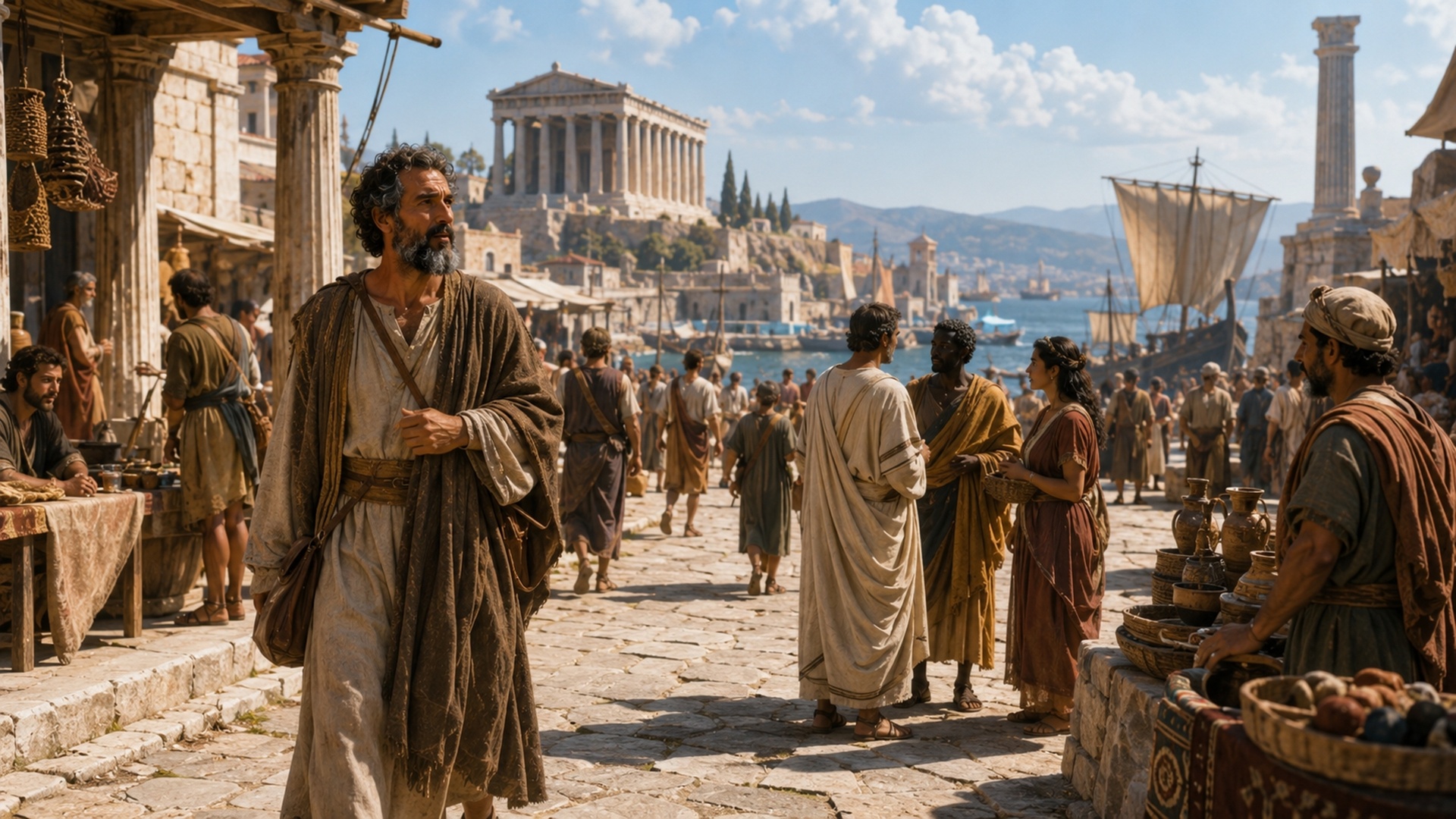
In Paul’s time, Corinth was one of the most important cities of the ancient world. It was wealthy, lively, and strategically well located because it connected important trade routes. Through its harbors, people, goods, ideas, and religions from many parts of the world came together. Yet precisely this diversity also brought great spiritual and moral challenges. Corinth was known for idolatry, religious confusion, and sexual immorality. It was into this very city that God sent Paul to proclaim the gospel of Jesus Christ.
📜 2. The Biblical Foundation
In Acts 18 we read that Paul came to Corinth and there met Aquila and Priscilla:
“And because he was of the same trade, he stayed with them and worked; for they were tentmakers by trade.” Acts 18:3
In 1 Corinthians it becomes clear what problems the church in this city was facing. Paul writes about how to deal with people who live in immorality:
“But now I have written to you not to keep company with anyone named a brother, who is sexually immoral, or covetous, or an idolater.” 1 Corinthians 5:11
The religious pluralism of the city also becomes visible:
“Therefore concerning the eating of things offered to idols, we know that an idol is nothing in the world, and that there is no other God but one.” 1 Corinthians 8:4
These verses show that Corinth was economically active, morally vulnerable, and strongly shaped by idolatry.
🌍 3. Connection to Today
Many modern cities resemble Corinth in a surprising way. Today too, there is prosperity, trade, cultural diversity, and many different worldviews. At the same time, we encounter moral confusion, consumerism, sexual permissiveness, and spiritual indifference. People are often busy, connected, and informed, but inwardly disoriented. The church of Jesus therefore faces the challenge of remaining faithful in the midst of this environment while also reaching people with love. Corinth shows us that the gospel is needed precisely where society is complicated, loud, and spiritually challenging.
💡 4. Central Message of the Lesson
👉 God does not send his gospel only to simple and devout places, but also into the heart of cities marked by wealth, idolatry, immorality, and spiritual confusion.
✝️ 5. Theological Focus
Corinth was not an important place for Paul’s ministry by chance. The city was strategically located and, through its harbors, connected with many parts of the world at that time. What took root in Corinth could spread far beyond the city. Paul recognized that a great city could also be a great missionary opportunity.
God sees cities differently than people do. People often first see sin, problems, dangers, and rejection. God sees people who are to be saved. Therefore, despite its moral and religious darkness, Corinth was a place of divine possibilities.
The economic importance of Corinth also played a role. Paul was able to work there as a tentmaker and at the same time proclaim the gospel. This shows that God can also include ordinary professions and practical skills in his service. Mission does not happen only through preaching, but also through work, relationships, and a credible life.
But Corinth was not only economically strong; it was also spiritually confused. The city was shaped by many religions and gods. In 1 Corinthians 8, it becomes clear that food sacrificed to idols and involvement with pagan temples were real problems for Christians. The believers had to learn to remain faithful to the one true God in an idolatrous environment.
Paul confronted Corinth’s religious confusion with the clear truth: there is only one God. For Christians, not every religious practice is harmless. Idolatry is not only an outward ritual, but a wrong orientation of the heart. Anything that takes God’s place becomes an idol.
The moral problems of Corinth were also serious. Sexual immorality was part of the culture and even influenced the church. Paul had to make clear that Christians may not simply adopt the values of their surroundings. Whoever belongs to Christ is called to a new life.
This is not about self-righteous separation, but about holiness. The church was to live differently because it belongs to Christ. The gospel calls people not only to forgiveness, but also to transformation. Grace does not mean minimizing sin, but being set free from the power of sin.
Corinth therefore shows us an important tension: the church lives in the world, but it does not belong to the world. It is to reach people without allowing itself to be shaped by the values of its surroundings. Paul had to teach the Corinthians how to remain faithful to Christ in the midst of a corrupt culture.
The theological core of this lesson is this: the gospel is stronger than culture. No city is too corrupt, no environment too difficult, and no society too confused for God to work there. Christ can call people out of idolatry, immorality, and disorientation, and form them into a new community.
🌟 6. Spiritual Deepening
The city of Corinth challenges us to see our own cities and communities with spiritual eyes. Often we first see the problems: indifference toward God, moral confusion, pride, materialism, broken relationships, and a culture that rejects God’s Word. But Paul shows us that such places are not hopeless places.
Precisely where the darkness is great, the light of the gospel is especially needed. If Christians withdraw out of fear, people are left without a witness. Paul did not go to Corinth because it was easy, but because people there needed Christ.
Today too, we are in danger of either condemning our surroundings or adapting to them. Both are wrong. If we only condemn, we lose love for people. If we adapt, we lose the strength of our witness. Paul shows another way: clear truth joined with missionary love.
The church in Corinth had to learn that it must not be determined by the culture around it. This also applies to us. The values of our society easily enter our thinking: success, self-fulfillment, sexual freedom, possessions, recognition, and power. These things can shape our hearts without us even noticing.
That is why we need the correction of the gospel again and again. The question is not: What is normal in society? The more important question is: What corresponds to Christ? Christians are called to align their thinking, relationships, and decisions with the Word of God.
Corinth also reminds us that a church in the midst of a difficult environment remains vulnerable. The problems of the city did not stop at the church door. Conflict, immorality, pride, and wrong thinking found their way into the congregation. That is why every church needs spiritual watchfulness.
At the same time, we must not forget: Paul did not give up on the church. Although the Corinthians had many problems, he wrote to them, admonished them, taught them, and loved them. This shows God’s patience with his church. God does not only see what is still wrong, but also what can become possible through his grace.
For our personal lives, this means that we should examine which influences shape our hearts. What “idols” exist today? Perhaps they are not statues of stone, but career, money, beauty, entertainment, relationships, or the self. Anything that becomes more important than God can bind our hearts.
The gospel calls us back to Christ. He alone deserves first place. He alone gives true identity, purity, freedom, and hope. In a world full of voices, we need his voice. In a culture full of confusion, we need his truth.
Paul’s ministry in Corinth gives us courage. God can save people even in difficult places. He can build churches in challenging cities. He can turn people shaped by their culture into witnesses of his grace.
Therefore, we should not give up on our cities. We may pray for them, serve them, and share the gospel boldly. Perhaps our surroundings look like Corinth, but the God who worked in Corinth is still at work today.
🔧 7. Application in Everyday Life
Practical steps:
- Pray intentionally for your city, your church, and your neighborhood.
- Ask God to show you people who need the gospel.
- Examine which cultural influences shape your thinking and behavior.
- Consciously put Christ first in your life.
- Live clearly and lovingly without adapting to sin.
- Use your profession, your contacts, and your daily life as opportunities for witness.
- Do not condemn people, but meet them with truth and grace.
- Remember that no place is too difficult for God’s work.
❓ 8. Reflection Question
Which influences from my surroundings shape my thinking, and how can I remain faithful to Christ while lovingly reaching people with the gospel?
🌟 9. Final Thought
Corinth was a wealthy, influential, and at the same time spiritually dangerous city. Yet it was precisely there that God wanted to make his gospel visible. Paul was not intimidated by idolatry, immorality, or cultural confusion, but brought the message of Jesus Christ into the heart of that environment. This reminds us that God is still at work today in difficult cities, communities, and life situations. The darkness of an environment is no obstacle to God’s grace. Where Christ is proclaimed, people can be transformed and churches renewed.
“Therefore concerning the eating of things offered to idols, we know that an idol is nothing in the world, and that there is no other God but one.” 1 Corinthians 8:4 ✨🌆💡✝️