
🤩 Bible Stories to Marvel At
Where God’s wonders become great – for little and big hearts
🛡️ Psalm 16 – God Is My Secure Portion
🌅 When true security grows from closeness to God
🌅 Introduction
Psalm 16 is a psalm of trust. David prays to God and says, “Preserve me, O God, for in You I put my trust.” The very first sentence reveals what this psalm is about: a person seeking protection not primarily in other people, possessions, or personal strength, but in God.
In Psalm 15, we asked: Who may dwell with God? That psalm focused on living an upright life in God’s presence. Psalm 16 now shows us what a heart that has truly found refuge in God sounds like. David speaks not merely about rules, but about joy, security, and hope in God.
David recognizes that the Lord is his greatest good, his portion, and his inheritance. This means that God himself is the greatest treasure of his life. Neither land, wealth, reputation, nor success gives him his deepest security, but God.
This psalm leads us from a request for protection to joy in God’s presence. David knows: If God is with me, I am not forsaken. If God guides me, I am walking on a good path. If God is my portion, I am not poor.
Psalm 16 even looks beyond our present life. It speaks about a hope that is stronger than the grave and death. For this reason, the psalm was later also applied to Jesus Christ, who did not remain in death but rose again. Psalm 16 thus becomes a song filled with trust, joy, and the hope of resurrection.
📖 The Biblical Story
🙏 David Seeks Protection in God
David begins with a simple yet profound request: Preserve me, O God. He knows that he needs protection. He does not pretend to be strong enough to bear everything alone.
Preservation means more than protection from visible danger. David needs God’s protection over his life, heart, decisions, and path. He does not want to be drawn away from God.
For hearts young and old, this is a good way to begin every prayer. We may come to God and say: Lord, preserve me. Guard my thoughts. Guard my words. Protect my heart from fear, pride, and wrong paths.
David trusts God. He does not merely say, “Preserve me because I am afraid.” He says, “Preserve me, for I trust in You.” Trust brings warmth to his prayer. David is not fleeing into emptiness, but toward his God.
👑 The Lord Is David’s Lord
David says to God: You are my Lord. This is a deeply personal confession. God is not merely some distant power. He is David’s Lord, his King, his protection, and his highest source of security.
When David says, “You are my Lord,” it also means: I do not belong to myself. My life should remain under your good authority. You may guide me.
Many people want God’s help but not God’s authority. They want his blessing but not his guidance. David reveals a different kind of heart: God should not only rescue him, but also rule his life.
For children, we could say: If God is my Lord, I do not merely ask, “What do I want?” I ask, “God, what is your good path for me?”
💎 There Is No True Good Apart from God
David recognizes that he possesses no true good apart from God. Everything good he has ultimately comes from God. Without God, even the most beautiful things lose their deepest meaning.
People may possess many things: a home, friends, food, clothing, talents, success, and happiness. All these things are gifts, but no gift can replace God himself.
When someone loves only the gifts but forgets the Giver, the heart becomes poor. David, however, understands that God is not only the one who gives good things. God himself is his highest good.
This is an important truth for hearts young and old: When God is our greatest treasure, all his other gifts find their proper place. They are beautiful, but they are not our God.
🤝 David Rejoices in God’s People
David speaks about the saints in the land and the excellent ones in whom he delights. He loves fellowship with people who belong to God and trust him.
This shows that genuine faith does not remain lonely and cold. Those who love God also rejoice in people who love him. God’s people become a spiritual family.
This is important for hearts young and old. It is good to have friends who lead us closer to God. People who pray, live honestly, love God’s Word, and encourage us are a gift.
David does not primarily seek the company of the proud and godless. He finds joy in those who honor God. This agrees with Psalm 15: Those who desire to be near God honor those who fear the Lord.
⚠️ Wrong Paths Bring Sorrow
David also speaks about people who pursue other gods. He says that their sorrows will multiply. Those who leave God and follow false sources of security will ultimately find no genuine joy.
In David’s time, these other gods may have been visible idols. Today, they may be other things: money, reputation, pleasure, power, human praise, or our own ego. Anything that takes God’s place becomes dangerous.
At first, a wrong path may appear exciting. But if it draws the heart away from God, it ultimately brings emptiness, unrest, and pain.
David is saying: I do not want to follow that path. I will not take the names of false gods upon my lips. My heart belongs to the Lord.
🏆 The Lord Is My Good and My Portion
Then comes one of the most beautiful thoughts in the psalm: The Lord is my good and my portion. David sees God as his share, his inheritance, and that which truly belongs to him and will remain.
In Israel, an inheritance was extremely important. Land represented a home, provision, and a future. But David says: My deepest inheritance is not primarily a piece of land. My deepest inheritance is the Lord himself.
For hearts young and old, we could say: If God is my portion, then I am not empty, even if I do not possess everything other people have. I possess the greatest treasure.
This statement sets the heart free. We do not need to look enviously at everything other people possess. Those who have God possess more than visible wealth. They have a source of security that cannot be broken.
🍷 God Holds David’s Cup
David also says that God holds his cup. The cup can represent what has been assigned to someone in life. David believes that his life is not ruled by blind chance, but rests in God’s hands.
Sometimes the cup of life is filled with joy. At other times, it also contains difficult experiences. Nevertheless, David trusts that God is holding his life.
This is not always easy. David also knew fear, flight, enemies, and tears. But that is precisely why his trust is so precious. He does not say, “My life is always easy.” He says, “God holds my cup.”
For children, we could say: Even if you do not know what tomorrow will bring, God knows. Your life cannot slip out of his hands.
📏 The Boundary Lines Fell in Pleasant Places
David describes his inheritance with an image: The boundary lines have fallen for him in pleasant places. This means that what God has given him is good, beautiful, and precious.
A measuring line was used to divide the land. David views his life as an inheritance measured out for him by God, and he says: Yes, what God has given me is beautiful.
This is a grateful heart. David does not see only what is missing. He also sees what God has given him. Gratitude opens our eyes to God’s goodness.
For hearts young and old, this is a valuable exercise: Do not ask only what else you would like to have, but also look at what God has already given you.
🙌 David Praises the Lord Who Counsels Him
David praises the Lord because God counsels him. God is not only his possession and protection, but also his Counselor. David needs wisdom for the path ahead.
People need counsel. Children need counsel. Adults need counsel. Kings need counsel. No one is so wise that they no longer need God’s guidance.
God counsels us through his Word, through his work within our hearts, through prayer, and sometimes through people who speak wisely and reverently.
David praises God for this. He knows that not having to make every decision alone is a gift. The Lord guides his children.
🌙 The Heart Instructs Even During the Night
David says that his inner being instructs him even during the night. At night, when everything becomes quiet and the outside voices grow softer, the heart may become especially attentive.
Sometimes we think about the day during the night. We remember words, decisions, worries, or questions. David experiences this truth: God can guide my heart even there.
For hearts young and old, this can be comforting. When you lie in bed at night and cannot fall asleep, you may speak with God. You may ask him: Lord, bring order to my thoughts. Show me your way.
God’s guidance is not only for the bright hours. He can instruct the heart even during silent nights.
👁️ David Always Sets the Lord Before Him
David says: I have set the Lord always before me. This means that he does not want to forget God. God’s presence should accompany his thoughts and actions.
Those who keep God before them live differently. They seek God’s will when making decisions. They remember his presence when facing temptation. They seek comfort in him when fear comes.
This does not mean that David sits in the temple all day long. It means that God is not excluded from his everyday life. God is present in his thinking, speaking, working, waiting, and hoping.
For hearts young and old, this is a beautiful attitude toward life: God, I do not want to forget you today. Walk with me throughout this day.
🪨 Because God Is at His Right Hand, David Will Not Be Moved
David says: Because the Lord is at my right hand, I will not be moved. The right side represents closeness, help, and protection. David knows that God is standing beside him.
To be moved means to become uncertain, lose our footing, or fall. David does not say that there will be no storms. He says that God is so near that he will not be permanently overthrown.
This is a profound security. It does not come from David’s own strength, but from God’s presence. When God is at his side, his heart has a firm foundation.
Children can imagine it this way: When a small child holds a father’s strong hand while walking along a difficult path, the child can walk more securely. God’s presence gives us stability.
😊 Therefore David’s Heart Rejoices
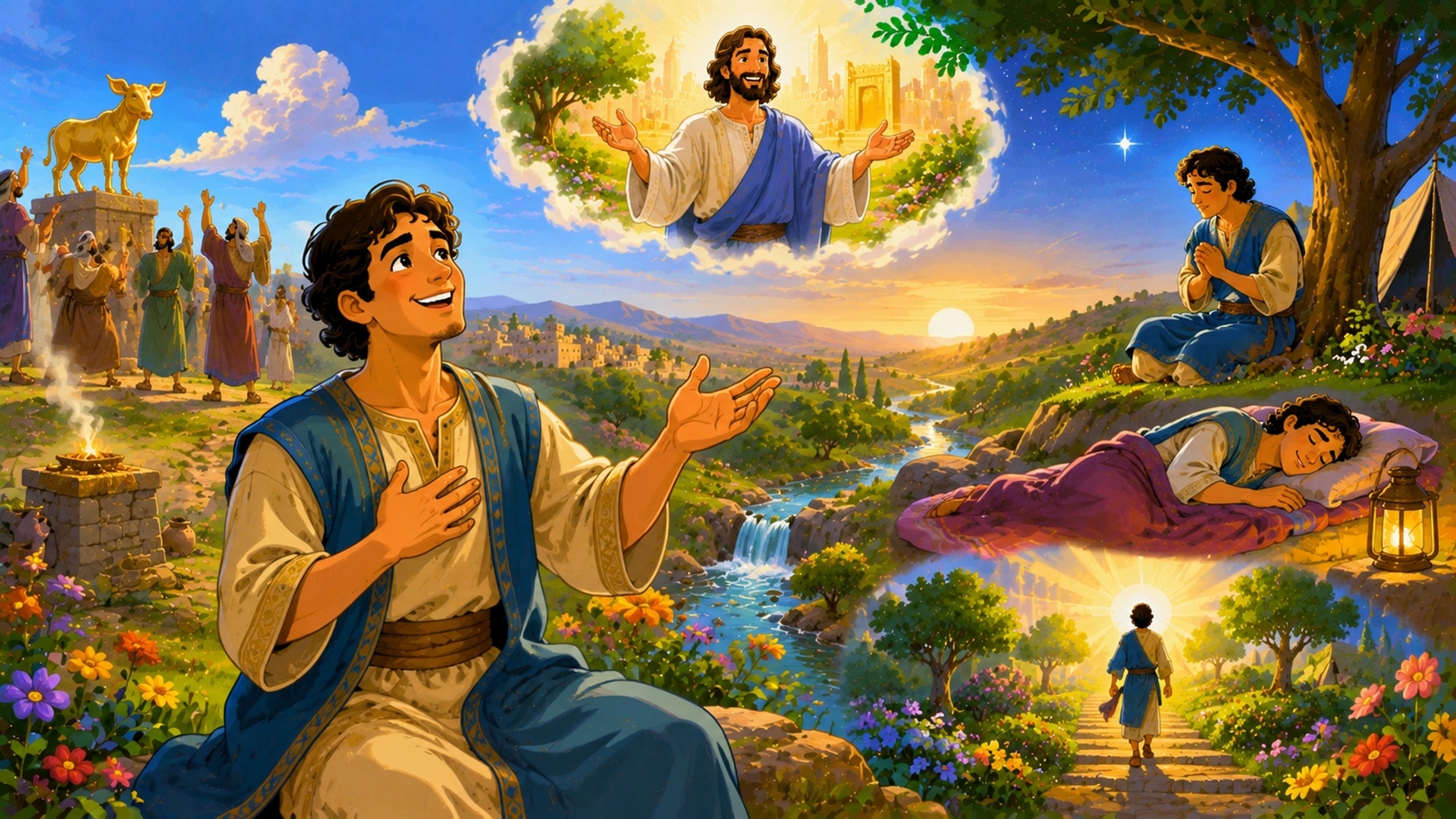
Because God is his protection, portion, and security, David’s heart rejoices. His whole being is glad, and even his body can rest securely. Trust in God brings joy into the deepest parts of a person.
This joy is not superficial. It does not mean that David never had worries. It is a joy that comes from God’s presence. It can remain even when life is not easy.
A heart that knows, “God is holding me,” can breathe freely. It does not need to constantly prove that everything is under control. It may rest.
Psalm 16 shows us that genuine joy does not grow only from pleasant circumstances. It grows from the assurance that the Lord is with us.
🛏️ Even the Body May Rest Securely
David says that his body will rest securely. This is a deeply human statement. Faith does not concern only our thoughts and emotions, but also our bodies, rest, and sleep.
Those who are afraid often have difficulty sleeping. Those who feel threatened cannot find peace. But David trusts: God holds my entire life. Therefore, even my body may find rest.
For hearts young and old, this is a beautiful evening prayer: Lord, I place myself in your hands. Preserve me. Give peace to my heart and rest to my body.
God is not interested only in the great questions of life. He also understands tired bodies, restless nights, and hearts that need security.
🌑 God Does Not Leave His Faithful Ones in Death
David then speaks about a hope that reaches beyond our present life. He says that God will not abandon his soul to the realm of the dead or allow his Holy One to see corruption.
David trusts that God is stronger than death and the grave. This is a tremendous thought. Human beings cannot conquer death, but God can give life where human ability comes to an end.
In the New Testament, this verse is applied to Jesus Christ. Jesus truly died, but God did not leave him in the grave. He rose again. Therefore, the hope of Christ already shines through Psalm 16.
For hearts young and old, this means that God’s hope does not end at the grave. Those who take refuge in God may know that he is the God of life.
✝️ Looking to Jesus, the Risen One
Psalm 16 is not merely David’s personal song of trust. It also becomes a prophetic reference to Jesus. The apostles later recalled that Jesus did not remain in the grave and that his body did not see corruption.
David died and was buried, but Jesus, the Son of David, was raised by God. In him, this hope finds its deepest fulfillment.
This makes Psalm 16 shine even more brightly. David trusts God in life and beyond death. In Jesus, we see that this trust is not empty. God truly possesses power over death.
Therefore, hearts young and old may know that our hope does not rest merely upon beautiful thoughts. It rests upon the living Lord who rose from the dead.
🛤️ God Reveals the Path of Life
David says: You show me the path of life. This is a beautiful statement. God does not merely give rules; he reveals a path that leads to life.
The path of life is the path into God’s presence. It is a path of trust, truth, joy, purity, and hope. It does not lead into emptiness, but toward God.
We could explain it to children this way: When you do not know the way, you need someone who does. God knows the path of life. He can guide you.
David trusts that God will show him this path—not only at the end, but step by step.
🌟 Fullness of Joy in God’s Presence
At the end, David says that there is fullness of joy in God’s presence. This means that our deepest joy is found not far away from God, but with God himself.
People search for joy in many places. Some forms of joy are good and are gifts from God. But the perfect joy that truly fills the heart comes from God’s presence.
To be in God’s presence means living close to him, being seen by him, and knowing him. There, the heart does not become emptier, but fuller.
Psalm 16 shows us that God is not a harsh Lord who takes joy away. He is the source of genuine joy.
🤲 At God’s Right Hand Are Pleasures Forevermore
David concludes with the hope that at God’s right hand are pleasures forevermore. This is more than momentary happiness. It is joy that remains because it flows from God’s eternal presence.
Everything on earth passes away. Toys break. Flowers wither. People grow older. Possessions can be lost. But God’s joy never ends.
Those who have God as their portion possess a hope that extends beyond time. David is therefore confident: My life is not lost. My path does not end in darkness, but with God.
For hearts young and old, this is the great invitation: Do not seek your deepest joy in things that pass away. Seek it in God, because his presence remains forever.
🛡️ God Is David’s Secure Future
Psalm 16 begins with a request for preservation and ends with eternal joy. Between these two points, David confesses that God is his Lord, his greatest good, his portion, his Counselor, his stability, and his path of life.
This is what makes the psalm so powerful. David does not trust God for only one moment. He trusts him throughout his whole life and even beyond death.
Those who have God as their secure portion do not need to despair when other sources of security begin to shake. God’s presence gives the heart a firm foundation.
Psalm 16 invites us to say with David: Lord, you are my greatest treasure. Preserve me. Guide me. Show me the path of life. Let my heart find joy in your presence.
🌅 What This Psalm Reveals
Psalm 16 reveals that true security comes from closeness to God. David seeks protection from the Lord and recognizes that God is his highest good, his portion, and his inheritance.
The psalm also shows that God offers hope not only for this life. David trusts that God will not abandon him to death. In Jesus Christ, this hope shines even more brightly because God raised him from the dead.
🟣 Summary
Psalm 16 is a psalm of trust. David asks God to preserve him because he trusts in him. He confesses that the Lord is his Lord, his greatest good, and his secure portion. David rejoices in God’s people and turns away from false gods. He recognizes that God maintains his inheritance and has given him a good portion. The Lord counsels him, instructs him even during the night, and stands at his side so that he will not be moved. Therefore, David’s heart rejoices, and his body can rest securely. David trusts that God will not abandon him to death, but will show him the path of life. In the end, he confesses that in God’s presence there is fullness of joy, and at his right hand are pleasures forevermore.
💚 A Message for Hearts Young and Old Today
We learn that God himself is the greatest treasure. Possessions, success, and recognition cannot provide our deepest security. Those who have God as their portion possess a source of security that will never pass away.
We also learn that God’s presence makes the heart joyful and secure. When the Lord remains before our eyes and stands at our side, we do not need to be moved. He guides us step by step along the path of life.
And we learn that our hope extends beyond this life. In Jesus, we see that God is stronger than death. Therefore, we may live with trust and look toward the future with hope.
💭 Reflection
🔸 What does it mean that God is my portion and my greatest treasure?
🔸 How can I consciously keep the Lord before me today?
🔸 Why does the resurrection of Jesus give us genuine hope beyond death?
🧒 👧 👦
💌 Invitation to Psalm 17
👁️ God Hears the Prayer of an Upright Heart
Psalm 16 has shown us that God is David’s secure portion. David trusts that the Lord will preserve him, guide him, and show him the path of life.
Psalm 17 now leads us into a serious prayer. David calls upon God because he feels threatened. He asks the Lord to examine his heart, preserve him, and protect him as the apple of his eye.
What does it mean when a person in danger does not immediately strike back, but instead calls upon God?
Come along and discover the next psalm!
🔔 Preview of Psalm 17
🛡️ When God Guards Us as the Apple of His Eye
Psalm 17 is a prayer for protection and justice. David asks God to hear him, examine his heart, and preserve him from his enemies.
👉 Why does David ask God to examine his heart?
👉 What does it mean to be guarded as the apple of God’s eye?
👉 And why does David find hope in the presence of God?
✨ In the next psalm, we will learn that those who are oppressed by others may seek refuge in God and trust in his righteous help.
