🌱LIVING FAITH | 1.Persecuted but Not Forsaken | 1.5 The Churches of Philippi and Colossae | ✉️ CHRIST IN PHILIPPIANS AND COLOSSIANS
✉️ CHRIST IN PHILIPPIANS AND COLOSSIANS
⛪ Lesson 1: Persecuted but Not Forsaken
📘 1.5 The Churches in Philippi and Colossae
✨ Holiness, order, and strategic mission
🟦 Introduction
The early churches in Philippi and Colossae may have seemed small and geographically insignificant, yet their spiritual influence was immense. Paul wrote to them not only theological truths—he addressed them as “saints,” “brothers,” “servants.”
This shows that the church of Jesus is not a loose network, but a spiritually organized movement with clear identity, structure, and purpose. And although Paul never personally visited Colossae, his letter testifies to how powerfully God can work through faithful coworkers like Epaphras.
………………..✉️………………..
📖 Bible Study
🔍 Philippians 1:1–3 & Colossians 1:1–2
Phil 1:1: “Paul and Timothy, servants of Christ Jesus, to all the saints in Christ Jesus who are in Philippi, together with the overseers and deacons.”
Col 1:1–2: “Paul, an apostle of Christ Jesus by the will of God, and Timothy our brother, to the holy and faithful brothers in Christ at Colossae…”
📌 Observations:
-
Both churches are addressed as “saints” — set apart, consecrated to God.
-
In Philippi, Paul mentions “overseers and deacons” — early church leadership is visible.
-
In Colossae, he speaks of “faithful brothers” — coworkers in ministry.
➡️ Both churches were organized, spiritually active, and connected to Paul, even when he was not physically present (especially in Colossae).
────────────────────
📜 Comparison with the Old Testament:
“You shall be to Me a kingdom of priests and a holy nation.” — Exodus 19:6
➡️ The New Testament church takes up Israel’s calling: a holy people, a spiritual body, organized and entrusted with a divine mission.
────────────────────
✍️ Paul, Timothy, and Epaphras — teamwork in ministry:
-
Paul — the apostle who planned, taught, and wrote.
-
Timothy — a young coworker, co-responsible, co-author of several letters.
-
Epaphras — a local believer who evangelized Colossae and founded the church.
➡️ The spread of the gospel was teamwork.
➡️ Organization strengthened the mission—it did not weaken it.
────────────────────
🏛️ Early Church Order:
-
Acts 6:1–6 — the first deacons are appointed.
-
1 Timothy 3:1–13 — qualifications for elders and deacons.
-
Titus 1:5 — Paul instructs Titus to appoint elders.
➡️ Church structure is not a human add-on, but part of the New Testament model.
………………..✉️………………..
🗣️ Answers to the Questions
Question 1: How are the churches described, and what does this description mean?
The Christians in Philippi and Colossae are described as:
-
Saints (Greek hagios = set apart),
-
Faithful brothers,
-
Members with responsibility (overseers, deacons).
This means:
-
They were not only believers, but also servants and leaders.
-
There was spiritual order expressed in love and service.
-
The church was one body with many members—organized yet spiritually alive.
These terms also show:
Being a Christian is more than just “being saved”—it means being part of an organized, spiritual body that grows, serves, and sends together.
………………..✉️………………..
💎 Spiritual Principles
-
God calls His people to holiness—not to isolation.
-
Church structure is divine, not bureaucratic.
-
Faithful coworkers are key to spreading the gospel.
-
Every church—small or large—has a place in God’s plan.
-
Church means belonging, responsibility, and growth.
………………..✉️………………..
🛠️ Practical Application
-
Are you part of a church? Ask yourself: Am I a spectator—or a coworker?
-
Are you “holy”—set apart for God—or mixed with the world?
-
Do you support your church leadership through prayer, service, and trust?
-
Maybe you are an “Epaphras”—God is calling you to reach your city.
“The strongest church is not the biggest—but the one that is faithfully organized and spiritually active.”
………………..✉️………………..
✅ Conclusion
The churches in Philippi and Colossae were living evidence of God’s plan:
-
to call people out of the world,
-
to sanctify them,
-
and to form them into a serving, organized body of Christ.
Organization is not the opposite of spirituality—it is its framework.
………………..✉️………………..
💭 Thought of the Day
“God does not call lone fighters, but a people—holy, organized, and sent.”
………………..✉️………………..
✍️ Illustration
“The Church at the End of the Road”
How a living room became a church—and a movement was born
🟩 Part 1 – The Woman with the Open Window
Valeria Díaz, 32, lived with her two children in the small town of Quillabamba, on the edge of the Peruvian rainforest. Her house was old, the shutters loose, the roof leaking. But what was open was her heart.
She had once worked as a cook in an Adventist church in Cusco. There she heard the gospel, but never experienced baptism. The pastor was kind—but she felt unworthy.
Now, alone with two children back in her hometown, she wondered:
“Is there no one here who speaks about Jesus?”
🟩 Part 2 – The Old Bible
While cleaning, she discovered an old, worn Bible, a gift from the church in Cusco. Inside was a dedication:
“Read, share, serve.”
She began reading every evening—to her children. Then to her neighbor. Then her cousin. Within three weeks, eight people were sitting in her small living room, listening.
Someone said: “Valeria, you are our pastor.”
She laughed: “I’m not even baptized!”
But a movement had begun.
🟩 Part 3 – The Voice on the Radio
One evening, Valeria heard a broadcast on a small shortwave radio from Pucallpa—an Adventist message in Quechua:
“If you are somewhere where no church exists—you are the church. You are called.”
The next day she wrote a letter to the Peru-South Mission:
“We are not a church. But we want to be. We are hungry for the truth.”
🟩 Part 4 – The Visit
Three months later, a visitor arrived: Pastor Elías, 58, retired but passionate. He traveled by motorcycle through mud and steep paths to find her.
He found 20 people in a living room—open Bibles, notes, questions.
He said: “You are a church. Now we will bring order.”
🟩 Part 5 – Structure Instead of Chaos
Pastor Elías stayed two weeks, teaching daily:
-
What does it mean to be an elder?
-
What is the ministry of deacons?
-
How do you lead worship—without stage or microphone, but with heart?
He appointed three people:
-
Marcos, a quiet widower, became deacon.
-
Nina, a passionate teenager, became children’s ministry leader.
-
Valeria, the founder, was recognized as church leader.
His motto:
“No church lasts without order. But order without love is dead.”
🟩 Part 6 – The First Communion
On the Sabbath of his departure, they celebrated their first communion.
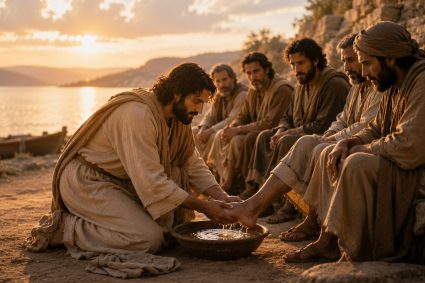
A plastic cup served as the chalice; foot washing took place in the courtyard with an old clay bowl.
It was holy.
A teenager later said:
“I felt that Jesus was really here—in Quillabamba.”
🟩 Part 7 – Epaphras Lives
Pastor Elías said to Valeria at farewell:
“You are like Epaphras. You’ve never been to Lima. But you bring the gospel where no one else goes.”
She felt it wasn’t praise—it was calling.
A year later, Valeria was baptized, along with 12 others.
Two youths began leading a group in the neighboring village of Maranura.
The same pattern began again:
-
A woman opened her home.
-
A circle formed.
-
A worker came.
-
A church grew.
🟩 Part 8 – The Letter to “Colossae”
Pastor Elías wrote to the mission leadership:
“I found a church I had never visited—but which was prepared like Colossae: through a faithful servant.
I did not found it.
The Holy Spirit was faster than I was.”
………………..✉️………………..
📌 Final Thoughts on the Story
Valeria was neither a theologian nor a pastor.
But she was called, holy, faithful—like the members of the church in Colossae.
She showed:
-
Spiritual order is possible—even in poverty.
-
Leadership does not begin with titles, but with service.
-
Epaphras lives—wherever people allow themselves to be sent without waiting for “the pastor to come.”

More Stories