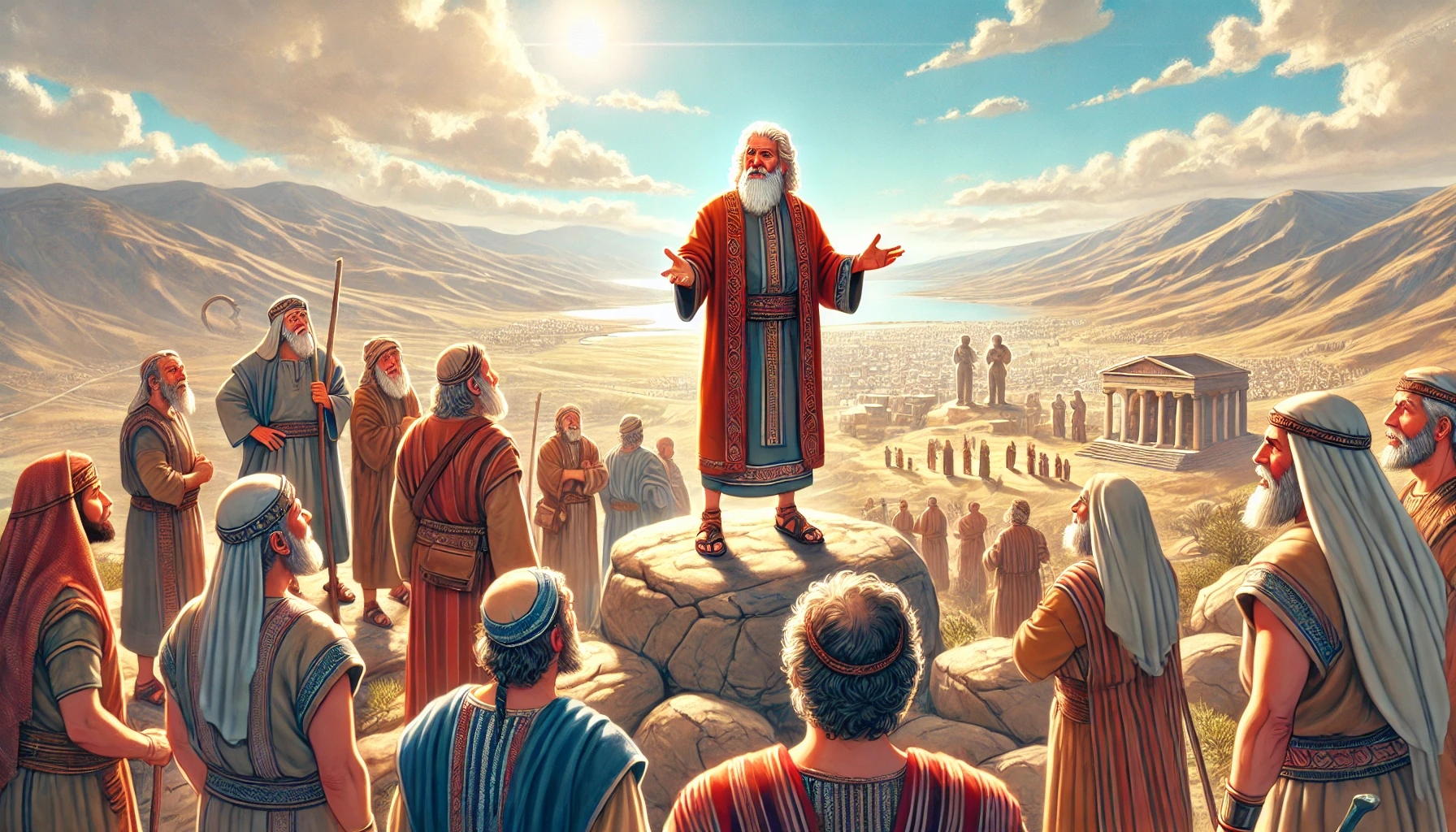
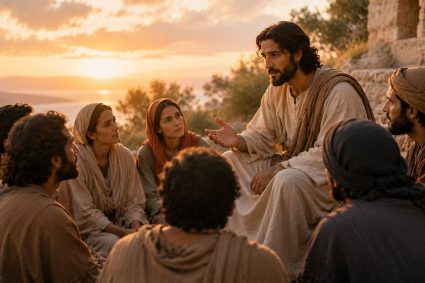
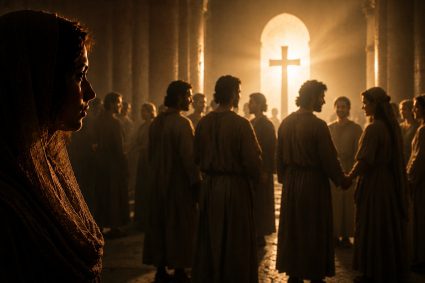
Many battles in the life of faith are not fought with loud noise, but quietly and invisibly—in our thoughts, in our values, in our relationships. Joshua, the great military leader of Israel, knows this. In his farewell speech, he does not speak about swords, but about gods, marriages, and words. Why? Because the greatest danger lies not outside, but inside—in the gradual adaptation to a godless environment.
This lesson calls us to protect the spiritual boundaries of our faith—not out of pride, but out of faithfulness.
………….. 🗺️ …………..
📖 Bible Study
🔍 Joshua 23:6–8, 12–13 – A Call to Spiritual Separation
📜 The Text:
“So be very strong to keep and to do all that is written in the Book of the Law of Moses … that you may not mix with these nations remaining among you …”
🧠 Meaning:
Here Joshua echoes God’s words from Joshua 1:7–8. His message is clear:
“The key to blessing lies not in weapons, but in the Word.”
Three core spiritual messages:
-
Preserve God’s Law (v. 6)
– It is the spiritual lifeline of the people.
– Without the Law, Israel will lose direction.
-
Avoid spiritual entanglement (vv. 7–8)
– The warning is not merely against foreign cultures, but against their worship and ideologies.
– “Do not cling to their gods, but to the LORD.”
-
Avoid dangerous bonds (vv. 12–13)
– Especially marriages with idol worshipers become a trap.
– This warning is not ethnic, but spiritual.
– The real enemy is not blood, but idolatry.
In ancient times, it was common to use the names of foreign gods in daily speech (oaths, greetings, curses). Joshua understands:
Language shapes faith.
⚔️ Faith as Spiritual Warfare
This passage makes one thing clear:
God’s people live in a constant spiritual battle—then and now. The greatest danger is not the external enemy, but compromise with the world.
………….. 🗺️ …………..
🗣️ Answers to the Questions
📌 Question 1: Why did Joshua take such a firm stance toward the surrounding nations? (Josh 23:6–8, 12–13)
Answer:
Joshua knew that the military conflict was largely over, but the spiritual battle was still ahead.
-
The greatest danger was not hostility, but friendship with pagan nations, which could lead to idolatry.
-
Even invoking the names of foreign gods was a spiritual compromise—in the ancient world, this meant acknowledging authority.
-
Idolatry was attractive because it was visible, sensual, and culturally widespread, unlike the invisible and demanding God of Israel.
-
Marriages with unbelievers meant not only emotional bonds, but often religious mixing.
👉 In short:
Joshua is not defending ethnic separation, but spiritual identity. He knows:
Lost separation = lost blessing.
────────────────────────
📌 Question 2: How can we today find a balanced relationship with the world?
Answer:
-
Live IN the world, but do not be OF the world
– John 17:15–16: Jesus prays not that we are taken out of the world, but that we are protected.
– This is about heart separation, not physical withdrawal.
-
Build relationships with wisdom
– We need contact with society to witness—but we must protect ourselves spiritually (cf. 2 Cor 6:14).
– Especially intimate relationships (like marriage) require spiritual unity, or faith is endangered.
-
Clearly distinguish between influencing and being influenced
– Ask yourself: Who is shaping whom?
– If you are constantly giving in, it is time for new boundaries.
-
Spiritual clarity instead of cultural conformity
– We are called to live holy lives (1 Pet 1:15–16)—not “better,” but different.
👉 Conclusion:
We are called to be the light of the world—a light that does not blend in, but shines clearly.
………….. 🗺️ …………..
✨ Spiritual Principles
-
Holiness means being spiritually set apart, not socially isolated.
-
False closeness often leads to spiritual compromise.
-
Spiritual purity preserves spiritual strength.
-
Language, relationships, and values express spiritual belonging.
………….. 🗺️ …………..
🛠️ Practical Application
-
Regularly reflect: Which friendships strengthen my faith? Which weaken it?
-
Create spiritual spaces in your relationships: pray together, read Scripture, share testimony.
-
Set boundaries without arrogance: clarity is not condemnation, but protection.
-
Speak intentionally about your faith instead of repeating worldly phrases.
-
Choose your influences wisely: media, role models, values—they shape your heart.
………….. 🗺️ …………..
✅ Conclusion
Joshua calls Israel to remain spiritually alert—not out of fear, but out of love for God. The great danger was not war, but dilution. The same is true today: faith rarely dies through enemies, but through compromise.
God calls us to a clear, loving, and determined life of spiritual purity and faithfulness.
………….. 🗺️ …………..
💭 Thought of the Day
“You don’t have to leave the world—but you must not lose yourself in it.”
………….. 🗺️ …………..
✍️ Illustration
“The Line in the Sand”
A story about faithfulness, temptation, and spiritual identity
────────────────────────
Chapter 1 – The New Job
Lina Schröder, 29, moves from Adelaide to Melbourne. She gets a well-paid job at a media agency. Her colleagues are friendly, relaxed, modern—but with very different values. Soon she is invited to after-work parties, later also to yoga retreats and spiritual workshops.
✦ ──────── ✦ ──────── ✦
Chapter 2 – The Thin Line
Lina wants to belong—but she begins to loosen her Sabbath habits. She says “maybe” instead of “no.” She prays less. Her faith becomes quiet—almost invisible.
✦ ──────── ✦ ──────── ✦
Chapter 3 – The Conversation with Nana
During a visit to her grandmother in Perth, she casually mentions her new life. The elderly Adventist looks at her seriously and says:
“People don’t slowly get used to idols without losing God. You need boundaries—or you lose yourself.”
✦ ──────── ✦ ──────── ✦
Chapter 4 – The Decision
A company outing is scheduled for a Sabbath. Lina is asked to take photos. It sounds harmless. But the night before, she can’t sleep. She reads Joshua 23, and the words strike her like an arrow:
“If you mix with the nations …”
She declines. One colleague laughs—another asks curiously, “Why?” She explains the Sabbath—and the God who changed her life.
✦ ──────── ✦ ──────── ✦
Chapter 5 – Light Instead of Conformity
Weeks later, two colleagues invite her to talk—not to drink, but because they want to know:
“How do you hold on to your faith when everyone else lives differently?”
Lina smiles.
“Because I know who I am. And who I belong to.”
………….. 🗺️ …………..
🧠 Final Reflections
Spiritual boundaries are not fences of fear—but lines of love.
They protect our identity, our faith, and our relationship with God.
The world is loud, seductive, and subtle—but God is faithful. And He calls us to live clearly—in the world, but not as part of it.