
🤩 Bible Stories to Marvel At
Where God’s miracles become great – for little and big children
🌍 Job Chapter 14 – Job Reflects on Life
🌱 When a Person Searches for Hope
🌅 Introduction
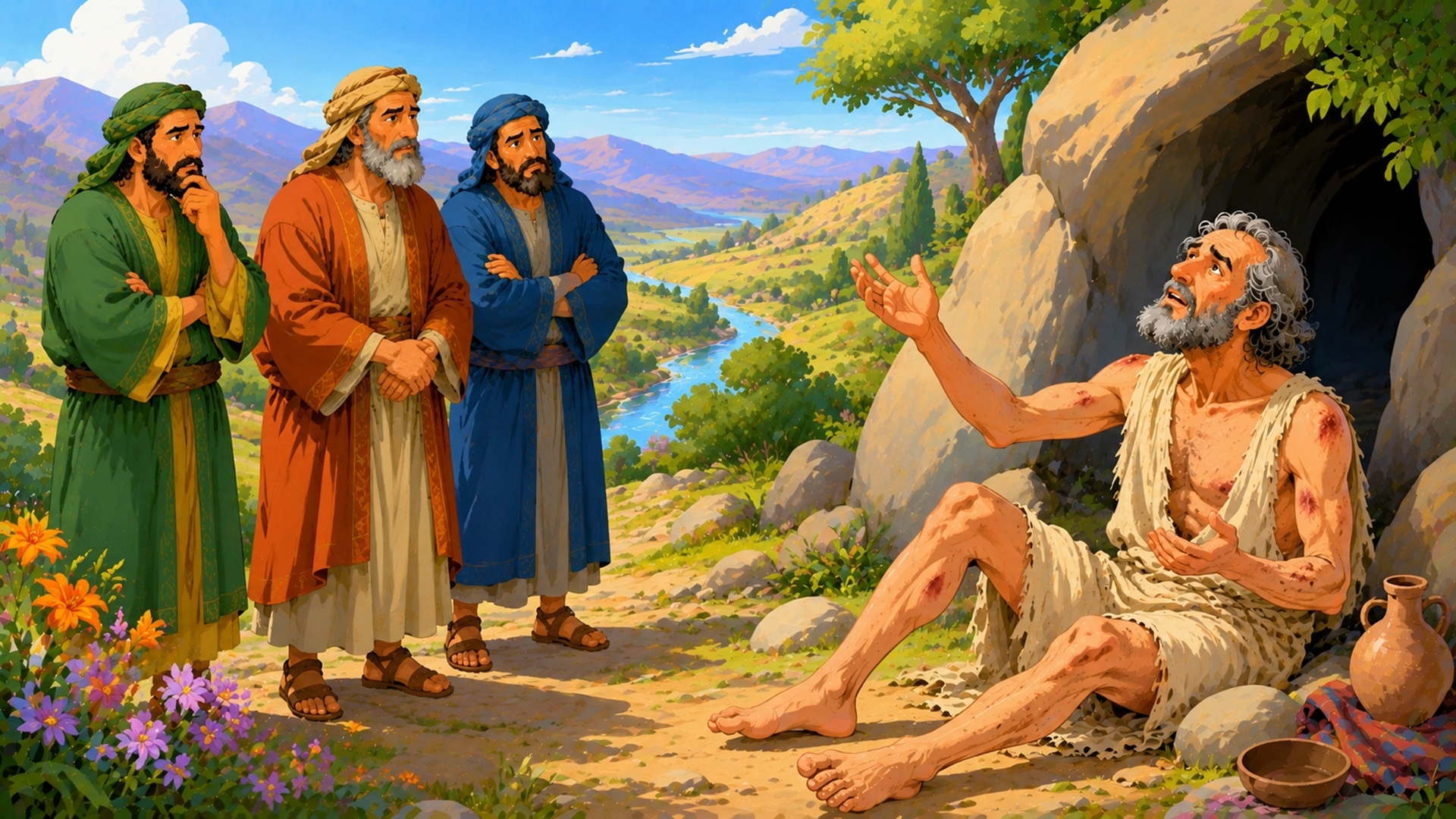
Job had spoken very honestly. He had told his friends that their words did not comfort him. They had spoken a great deal, but their explanations were like empty bowls without bread. He did not need quick answers, but someone who truly saw his pain.
Then Job had lifted his eyes to God. He did not want to present his case only before people. He wanted to speak with God Himself. But this desire was not easy. Job knew that God is great and holy, and he felt small, weak, and fragile.
Now Job’s voice becomes even more thoughtful. He looks not only at his own suffering, but at the whole of human life. He sees how short a person’s life is. It begins like a flower that blossoms and passes away again like a shadow moving on.
Job wonders why such a fragile human being is tested so severely. If life is already short and difficult, why are so many pains added to it? His words are sad, but also very deep. He expresses what many people sometimes feel when they experience suffering.
This chapter tells how Job reflects on life, death, and hope. His questions are difficult. Yet in the middle of his dark thoughts, a quiet desire appears: Could God not call a person again one day? Could there still be hope after suffering?
📖 The Bible Story
🌸 Life Is Like a Flower
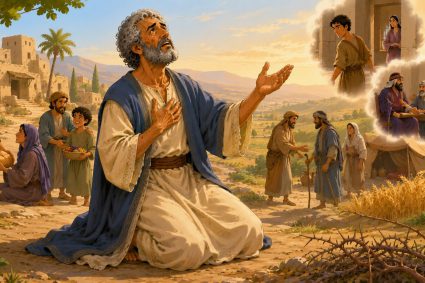
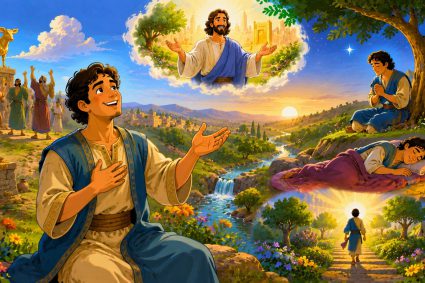
Job began to reflect on human life. He said that a person lives only a short time and has many troubles during that time. Life comes quickly and passes quickly. It is like a flower that blossoms beautifully in the morning and later withers.
Children can imagine it this way: a flower in a meadow looks beautiful. It shines in the sunlight, moves gently in the wind, and appears alive and strong. But when the heat comes or time passes, it loses its petals. Its beauty does not remain forever.
This is how Job sees human life. A person grows up, laughs, works, loves, hopes, and dreams. But no one remains strong forever. Illness, pain, and old age remind us that life is fragile.
Job does not say this to make people seem unimportant. He says it because, in the middle of his suffering, he feels how weak a human being can be. He does not understand why God watches and tests such a fragile person so severely.
🌫️ A Person Is Like a Shadow
Job also compares a person to a shadow. A shadow is there, but it cannot be held. It moves, changes, and disappears when the light falls differently.
Job feels that life passes quickly. What seems important today may look completely different tomorrow. People make plans, build houses, collect things, and seek security. Yet in the end, no one can stop time.
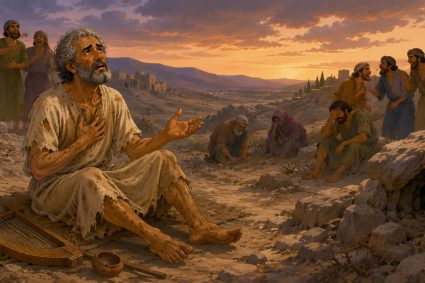
These thoughts make Job sad. He has lost much, and now he senses especially strongly how little a person can control. He once had a family, possessions, respect, and health. Now he sits in pain and reflects on how quickly everything can change.
But Job does not speak these thoughts into emptiness. He speaks them before God. He brings his sadness to the One who gave life. Even though his words sound dark, his speech remains a conversation with God.
🕯️ Job Asks for Rest
Then Job asks God to turn His gaze away from him for a moment so that he may find a little rest. Job feels as though he is standing under a heavy burden. His body hurts, his soul is tired, and his questions will not leave him alone.
He longs for a moment of relief. Not because he wants to forget God, but because he feels so weak. Sometimes a suffering person does not need more pressure, but a little room to breathe.
Job sees a person like a worker who must endure a hard day. A worker longs for the day to end so that he may rest. In the same way, Job longs for a moment when his pain no longer weighs so heavily on him.
This request shows how honest Job is. He does not make his suffering sound better than it is. He tells God that he is exhausted. And through this we learn that we may also tell God when we are tired and no longer know how to go on.
🌳 A Tree Seems to Have More Hope
Then Job looks at a tree. A tree may be cut down, and yet hope can remain. If its roots are still in the ground and water comes, it may sprout again. New branches may grow, and fresh green leaves may appear.
This image is powerful. Job sees that a tree can show life again after being severely cut. Even if its trunk looks old and almost dead, water can bring new strength.
But then Job’s heart becomes heavy again. He wonders: Does a human being have this hope too? When a person dies, will that person rise again? What happens when life comes to an end?
Job looks at the tree and discovers a longing in it. He wishes that everything would not remain forever dark for human beings either. He wishes that God would call again one day and give new life.
❓ Job’s Great Question
In this chapter, Job asks a very great question: If a person dies, will that person live again? This is not an easy question. It does not come from curiosity, but from a suffering heart searching for hope.
Job knows that no one can escape death by their own strength. He knows that people do not simply sprout again like trees when their time on earth comes to an end. Therefore, he looks to God.
Perhaps God could hide him until His anger had passed. Perhaps God could remember him. Perhaps God could call him one day, and Job would answer.
Here a small spark of hope shines. It is not yet bright like the sun. It is more like a little light in a dark night. But it is there. Job considers that God does not have to forget the human being.
🤲 Job Longs for God to Call Him
Job imagines that God might call him one day. Then Job would answer. This thought is gentle and beautiful. It shows that, despite all his questions, Job still knows that God is the Creator.
A creator does not simply forget what he has made. If God created the human being, then He knows that person. He knows their weakness, their tears, their paths, and their longing.
Job wishes that God would not look at his guilt forever, but would look upon him kindly again. He longs for God to show His hand not only as a mighty hand, but also as a hand that can restore.
This is not loud rejoicing. Job has not yet reached the end. But in his words, one can sense a search for hope. He is looking for a morning beyond the night.
🌊 Yet the Sadness Remains Heavy
After this small light of hope, Job’s voice becomes dark again. He thinks about how water wears away stones and rain washes away the earth. This is how he feels human hope slowly disappearing.
Job experiences that suffering can make a person weary. It can feel as though strength is being lost piece by piece. What was strong yesterday becomes weak today. What seemed secure yesterday becomes uncertain today.
He also speaks about how a person no longer knows what happens on earth after death. Their children may be honored or may suffer, but the person no longer sees it. These thoughts make Job sad because he is thinking about life and its limits.
At the end of the chapter, Job remains in his lament. His questions are not answered. Yet we have seen that, in the middle of his sadness, a special desire shines forth: if God calls, new life may be possible.
🌅 What This Chapter Shows
This chapter shows that human life is short and fragile. Job compares a person to a flower and a shadow because he feels how quickly strength, beauty, and security can pass away.
This chapter also shows that people may search for hope even in dark times. Job does not understand many things, but he reflects on whether God might one day call the human being again and give new life.
🟣 Summary
In this chapter, Job reflects on the short and difficult life of human beings. He compares a person to a flower that blossoms and then withers, and to a shadow that quickly passes away. Job asks God for rest and wonders why such a fragile person is tested so severely. Then he looks at a tree that can sprout again after being cut down and asks whether there is also hope for human beings after death. Although Job remains sad, a small spark of hope shines in his words: perhaps God can call a person one day, and that person will answer.
💚 Message for Children Today
Sometimes we notice that life is fragile. People become ill, things change, and not everything remains the way we want it to. Then we may come to God with our questions.
Job shows us that God also hears difficult thoughts. We do not have to hide our sadness. And we may hope that God is stronger than everything that frightens us.
💭 Thought for Reflection
🔸 Why does Job compare a person to a flower and a shadow?
🔸 What gives a cut-down tree new hope?
🔸 Why is it important to come to God even with difficult questions?
🧒 👧 👦
💌 Invitation to Job Chapter 15
🔥 Eliphaz Answers Again
Job has reflected on the short life of human beings. He has asked whether there is hope when everything passes away and whether God can call a person again one day.
But his friends are still not silent. Now Eliphaz speaks again. He hears Job’s questions, but instead of becoming gentler, he speaks even more harshly.
Will Eliphaz understand Job better this time?
Come along and discover the next chapter!
🔔 Preview of Job Chapter 15
⚡ When Harsh Words Return
Eliphaz hears Job’s lament, but his heart does not soften. He believes that Job speaks too boldly and needs to be corrected.
👉 Why does Eliphaz become stern again?
👉 What accusations does he make against Job?
👉 And why can harsh words wound a suffering person even more deeply?
✨ In the next chapter, we will hear Eliphaz speak again and see how his words make Job’s heart even heavier.