

📅 August 31, 2026
📚 BELIEVE HIS PROPHETS
📖 Daily Bible Reading: 🎵 Psalm 24
🚪 Open Wide the Gates for the King of Glory
✨ The World Belongs to the Lord—and Our Hearts Should Open to Him as Well
🌐 Read online here
🌅 Introduction
Psalm 24 begins with a powerful declaration: The earth belongs to the Lord, together with everything that lives upon it. From this universal sovereignty of God, David moves to a deeply personal question: Who may ascend the mountain of the Lord and stand before the holy God? The answer directs our attention to clean hands, a pure heart, and a life that does not surrender itself to falsehood. Finally, the psalm opens into a majestic scene: The gates must open wide because the King of glory is coming. Psalm 24 thus connects God’s sovereignty over the entire creation with the holiness of His people and the expectation of His victorious King.
⋯⋯⋯⋯⋯⋯⋯⋯⋯⋯◆⋯⋯⋯⋯⋯⋯⋯⋯⋯⋯
🔍 Commentary
David opens the psalm with a foundational confession: “The earth is the LORD’s, and everything in it, the world, and all who live in it.” This rejects every idea that human beings are the true owners of this world. The earth belongs to its Creator. Land, resources, animals, people, and nations ultimately stand under God’s sovereignty.
This truth also transforms how we treat everything entrusted to us. If everything belongs to God, we are not absolute owners, but stewards. Our lives, abilities, time, and possessions are gifts for which we are responsible.
David bases God’s right of ownership upon creation. The Lord established the earth and set it firmly in place. Its existence is not a human achievement. Behind the world stand the will and creative power of God.
After taking this expansive view of the whole earth, David suddenly asks a personal question: “Who may ascend the mountain of the LORD? Who may stand in his holy place?” The God to whom the entire world belongs is also the holy God, into whose presence no one may enter thoughtlessly.
The question recalls Psalm 15, but Psalm 24 expresses the answer with particular conciseness: “The one who has clean hands and a pure heart.” The hands represent visible actions, while the heart represents the inner life. God is concerned with both. Outward devotion without a heart surrendered to God is no more sufficient than good intentions without corresponding actions.
Clean hands describe a life that does not knowingly cling to wrongdoing. A pure heart means sincerity before God, undivided devotion, and a willingness to allow Him to examine our motives. Holiness therefore concerns not merely certain religious activities, but the whole person.
David also mentions the person who does not trust in what is false or swear deceitfully. Truth is inseparably connected with fellowship with God. Deliberately cultivating deception contradicts the character of the One who is the truth.
Such a person receives blessing from the Lord and righteousness from the God of their salvation. The connection between responsible living and received salvation is significant. A person lives sincerely before God, yet salvation continues to come from God Himself.
David then speaks about the generation of those who seek God and desire to see His face. This reveals what ultimately matters. God’s people do not consist merely of individuals bearing a religious designation, but of people who long for God Himself.
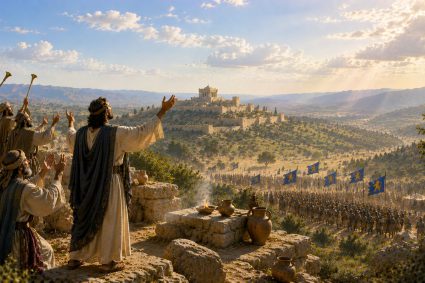
In the final part of the psalm, the scene changes dramatically. David calls out: “Lift up your heads, you gates; be lifted up, you ancient doors, that the King of glory may come in!” Before our inner eyes arises the image of a triumphant entrance. The gates must open for a King whose greatness surpasses every ordinary human ruler.
The question then follows: “Who is this King of glory?” The answer is: “The LORD strong and mighty, the LORD mighty in battle.” The coming King is God Himself. He is neither weak nor threatened, but the victorious Lord.
The call is repeated, increasing the sense of anticipation and solemnity. Once again, the gates are commanded to lift up their heads, and once again the question is asked: Who is this King of glory?
This time, the answer is: “The LORD Almighty—he is the King of glory.” The expression “LORD Almighty” identifies Him as the Lord of heaven’s armies. No power can limit His sovereignty.
Within its historical context, Psalm 24 was often associated with the entrance of the ark of the covenant and the worship of God in Jerusalem. Its language, however, reaches farther. The psalm celebrates God’s universal kingship while also carrying a powerful messianic perspective.
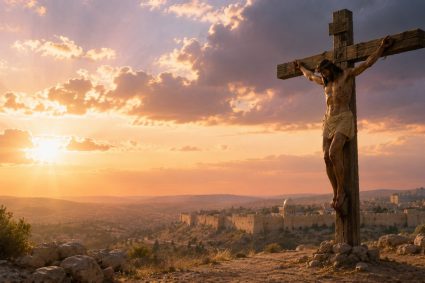
From a Christian perspective, our attention is directed toward Jesus Christ. He entered Jerusalem as King, was rejected and crucified, rose from the dead, and ascended to the Father. The King who appeared to have been defeated proved victorious over sin and death.
The words “Lift up your heads, you gates” therefore acquire a personal spiritual meaning as well. Christ claims not only sovereignty over the world; He also desires to reign as King within our lives. The decisive question is not merely whether we theoretically acknowledge His sovereignty, but whether we truly give Him access to every area of our lives.
Psalm 24 also looks toward the future. The King of glory will not remain hidden forever. The Bible carries this hope forward to the day when Christ returns as King and His sovereignty becomes visible to everyone.
Psalm 24 thus combines creation, holiness, and kingship into one great message: Everything belongs to God, His people are called to live in His presence, and the King of glory is coming. The appropriate response is a life whose hands, heart, and doors are open to Him.
⋯⋯⋯⋯⋯⋯⋯⋯⋯⋯◆⋯⋯⋯⋯⋯⋯⋯⋯⋯⋯
📌 Summary
Psalm 24 first proclaims God’s unlimited sovereignty over the earth and all humanity. David then asks who may stand in God’s holy presence and describes a life characterized by clean hands, a pure heart, and truthful words. The final part of the psalm majestically announces the entrance of the King of glory. The psalm thus connects God’s creative power, the call to holiness, and the hope of the victorious King.
⋯⋯⋯⋯⋯⋯⋯⋯⋯⋯◆⋯⋯⋯⋯⋯⋯⋯⋯⋯⋯
💡 Message for Us Today
If the earth and our lives belong to the Lord, faith cannot be confined to isolated religious areas. God desires to shape both our visible actions and our hidden motives. At the same time, Psalm 24 reminds us that Jesus Christ is not only Savior, but also King. Waiting for Him therefore means allowing Him to reign over our lives today. We prepare for the coming King not merely by speaking about His return, but by opening the doors of our hearts and allowing Him to cleanse and guide our lives.
⋯⋯⋯⋯⋯⋯⋯⋯⋯⋯◆⋯⋯⋯⋯⋯⋯⋯⋯⋯⋯
💭 Thought for Reflection
Is there still a closed door in my life—an area over which I desire to retain control—or may the King of glory truly reign over my entire life?
