🌱LIVING FAITH | 13.Choose This Day! | 13.6 Summary | 🗺️ LESSONS OF FAITH FROM JOSHUA

⛪ Lesson 13: Choose This Day!
📘 13.6 Summary
✨ God’s faithfulness stands firm — your decision makes the difference
🟦 Introduction
At the end of the book of Joshua, we find not only reflections — but decisions. Five major themes run through this final lesson:
-
Remembering God’s actions in history (13.1)
-
The necessity of genuine, sincere devotion (13.2)
-
The freedom to choose God — or not (13.3)
-
The danger of slowly turning away from God without noticing (13.4)
-
The responsibility of one generation to finish faithfully and pass the faith on (13.5)
This summary invites us to examine our own lives in the light of these truths. Not theoretically, but very practically: What does my decision for God look like today? And tomorrow?
…………………………🗺️…………………………
📖 Bible Study
Main text: Joshua 24:14–33
1️⃣ Looking Back and Identity (13.1)
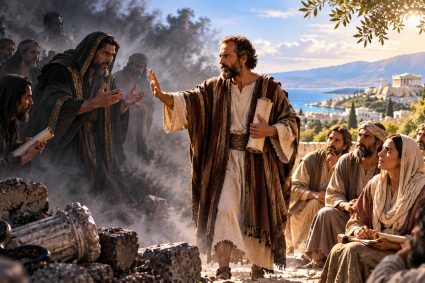
God’s story is also our story. Joshua gathers the people at Shechem — the place where Abraham received God’s promise. There God reminds the people:
“I have led you, protected you, and provided for you.”
➡️ Commentary:
God ties identity to history. Those who know where they come from also recognize to whom they belong. This divine review calls us to gratitude and humility.
────────────────────────
2️⃣ A Decision from the Heart (13.2)
“Serve the Lord with sincerity and truth” (Josh 24:14). No half-measures. No religion of mere tradition.
➡️ Commentary:
God desires an undivided heart. Tamim (sincerity) means whole, complete — not perfect, but honest. ’Emet (truth) stands for faithfulness and reliability. Joshua calls the people to a real, deep relationship.
────────────────────────
3️⃣ Free to Say Yes (13.3)
Joshua makes it clear:
You don’t have to — but you must decide.
He even warns:
You cannot serve God if you are not serious about it!
➡️ Commentary:
Faith is voluntary. God does not want slaves, but children. Yet a real decision has consequences. Joshua shows: grace is free, but not cheap.
────────────────────────
4️⃣ The Invisible Idols (13.4)
Despite the promise, it remains unclear whether the people actually removed the idols. These are not the idols of Egypt — they are among you.
➡️ Commentary:
Idolatry begins in the heart. It shows itself where people compromise God’s truth — out of fear, comfort, or tradition.
────────────────────────
5️⃣ A Life That Leaves Traces (13.5)
At the end, Joshua is buried — not as a hero, but as a servant of the Lord. Eleazar and Joseph also find their final resting place in the promised land. The promise is fulfilled — but what will the next generation do with it?
➡️ Commentary:
Faith is not inherited genetically — it is inherited through decision. Everyone must choose again, every day.
…………………………🗺️…………………………
💎 Spiritual Principles
-
God acts through history — and expects a response.
-
True devotion flows from relationship, not obligation.
-
Freedom means responsibility — spiritually as well.
-
Idols are often subtle — they must be exposed.
-
A faithful life becomes a lasting testimony.
…………………………🗺️…………………………
🛠️ Everyday Application
-
Ask yourself: Am I consciously living within God’s story — or only my own?
-
Make daily choices that show devotion — even in secret.
-
Watch out for “modern idols”: comfort, approval, control, fear.
-
Prepare others spiritually: children, siblings, church — through example, not only words.
-
Pray: “Lord, give me an undivided heart today.”
…………………………🗺️…………………………
✅ Conclusion
The book of Joshua ends with a burial — but not with death.
It ends with fulfilled promises, open questions, and an invitation:
Do you want to live faithfully — and finish faithfully?
For everyone is responsible for their generation.
And God’s story continues — through you.
…………………………🗺️…………………………
💭 Thought of the Day
“Faithfulness is not shown in the moment of decision — but in the perseverance that follows.”
…………………………🗺️…………………………
✍️ Illustration
“The Decision of the Third Day”
A story about faith, failure — and a new generation
Part 1 – The Recall
It was the third day after his grandfather’s funeral when Elias found the letter.
The envelope was yellowed, the ink faded:
“For Elias. When I am gone.”
Elias was 32 years old, an IT analyst in Berlin — rational, pragmatic, and for years completely estranged from his family’s faith. His grandfather Jakob had once been a church elder in a small Adventist village church in Bavaria. A devout man, warm-hearted, yet unwavering in conviction. Their conversations had grown rare over the years — their worlds too different. And yet there lay the letter, handwritten, not digital. Personal.
“Dear Elias,
if you are reading this, I have gone home. Maybe you are angry at God. Maybe at me. Or maybe you no longer believe at all. That is okay. I told all of this to my God. Again and again. 327 prayers for you — at least. I counted.”
Elias smiled — bitterly.
327 prayers.
What a number.
What faithfulness.
Part 2 – The Chapel
Two days later, Elias sat in the small chapel where the farewell had taken place. All the flowers had withered. Only the wooden candleholder on the altar was still burning — someone must have forgotten to extinguish it.
Elias sat down in the front row — the same bench where his grandfather had sat every Sabbath.
Beside him lay an old, worn book:
“Joshua — A Leader with a Long Shadow.”
He flipped through it mechanically, when a sentence caught his eye:
“Joshua died, but the work continued. For faithfulness does not die with a name — it lives through decision.”
He closed the book.
Something stirred within him.
An echo.
────────────────────────
Part 3 – The Woodshed
Behind the chapel stood an old barn where his grandfather once stored firewood — for winter, but also as a small workshop for simple carvings.
Elias had often been there as a child. It smelled of pine resin, dust, and the past.
In one corner stood the workbench. Above it hung a wooden sign:
“As for me and my house, we will serve the Lord.” (Joshua 24:15)
It was the verse his grandfather quoted most often. In sermons. At lunch. At goodbyes.
Back then, it had annoyed Elias.
Today… it sounded like a question:
And you, Elias? What do you choose?
Part 4 – The Idols
That same evening, Elias sat on the balcony of his Berlin apartment. Cars roared below. On the table: laptop, smartphone, two open windows with emails and stock data.
A thought crept into his heart:
What is your idol, Elias?
Not wooden figures.
No carved images.
But perhaps… control? Independence? The belief that he could manage everything on his own?
He remembered a line from his grandfather’s letter:
“The most dangerous idols are not the loud ones — but the ones that whisper: You don’t need God.”
Elias closed the laptop. For the first time in years. And he prayed. Not out loud. Just:
“If you exist, God of my grandfather… can you hear me?”
Part 5 – The Next Generation
Six months later, Elias returned once more to his grandfather’s church. Not as a convert. Not as a teacher. Just as a seeker.
The new pastor was young, a bit awkward, but with an open heart. He spoke about Joshua — and about the decision every new generation must make.
“We can honor the past,” he said. “But we must choose for ourselves. Again and again.”
After the service, a boy with wide eyes stood before Elias and asked:
“Do you really know Joshua’s story? Can you tell it to me?”
Elias hesitated. Then he knelt beside the boy.
“You know… it begins with a man who was quiet. But faithful. And in the end, he stood before the whole people and said: I will serve God. Because God was faithful — in everything.”
“Was he a hero?” the boy asked.
“No,” Elias said. “He was faithful. And that was enough.”
────────────────────────
Part 6 – The Third Day
Elias wrote a letter himself — to his unborn daughter.
“If one day you have questions — about God, about life, about failure — remember this: your great-grandfather prayed. I searched. And you will walk your own steps. But we are all part of a story that continues. If you choose it.”
He signed it:
“With hope — and growing faith.”
The next Sabbath, the candleholder in the chapel was lit again.
One more light in the line of those who had decided:
We and our house will serve the Lord.
…………………………🗺️…………………………
🧠 Closing Thoughts
Elias’ story is the story of many.
People who want to believe — but struggle.
Who remember — yet doubt.
Who ask — and decide.
Faith is not inherited. But it is seen. And sometimes — carried forward.
💬 “Decisions build the future. Faithfulness preserves it.”

More Stories