


✉️ FIRST AND SECOND CORINTHIANS
⚔️ Lesson 12: Dealing with False Teachers
⛓️ 12.4 Suffering for the Sake of the Gospel
🔥 Faithful Ministry Is Revealed in Suffering, Humility, and Dependence on God’s Power
📖 1. Introduction
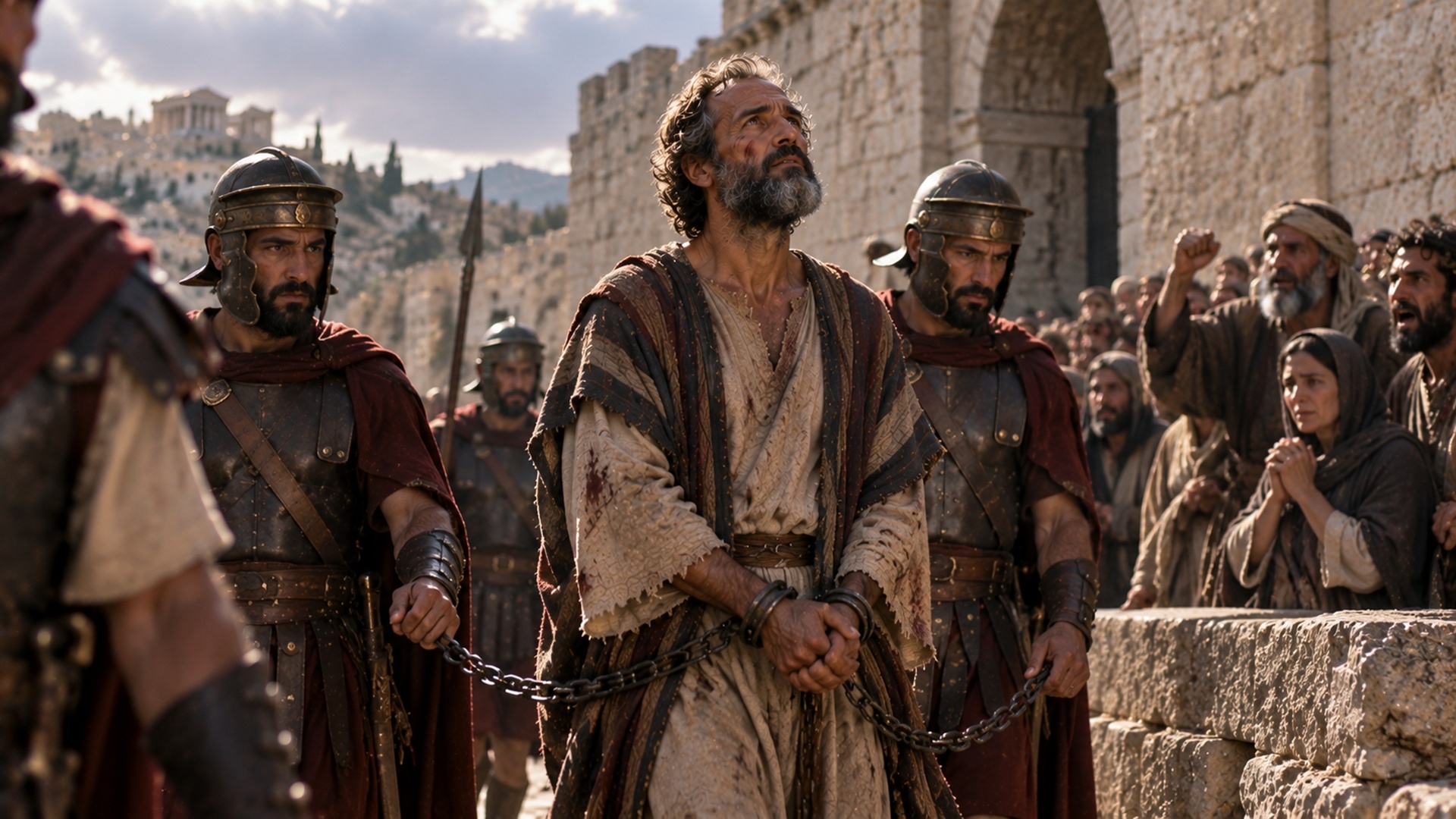
In this section, Paul speaks about his sufferings in an unusual way. Because the false teachers in Corinth boasted about themselves and wanted to impress others with human strength, Paul shows the Corinthians how foolish such boasting really is. If he boasts at all, he does not boast in his greatness, but in his weakness, his sufferings, and the grace of God that sustained him. His imprisonments, beatings, dangers, hardships, and concerns for the churches show that his ministry was not characterized by comfort or self-interest. Paul lived for the gospel and was willing to suffer for it. Precisely in this, it became clear that he was not seeking himself, but serving Christ.
📜 2. The Biblical Foundation
Paul writes:
“Are they servants of Christ? I am speaking like a madman: I am more so; in far more labors, in far more imprisonments, with countless beatings, and often near death.”
2 Corinthians 11:23
Then he lists specific sufferings:
“Five times I received from the Jews forty lashes less one. Three times I was beaten with rods, once I was stoned, three times I suffered shipwreck; a night and a day I spent in the deep.”
2 Corinthians 11:24–25
He continues by speaking of dangers:
“I have been on frequent journeys, in danger from rivers, danger from robbers, danger from my own people, danger from the Gentiles, danger in the city, danger in the wilderness, danger at sea, danger among false brothers.”
2 Corinthians 11:26
And he also mentions physical and emotional burdens:
“In toil and hardship, through many a sleepless night, in hunger and thirst, often without food, in cold and exposure; and apart from other things, there is the daily pressure on me of my anxiety for all the churches.”
2 Corinthians 11:27–28
Later, he summarizes the secret of his ministry:
“My grace is sufficient for you, for my power is made perfect in weakness.”
2 Corinthians 12:9
These verses show that faithful ministry can lead through great suffering, but God’s grace sustains, and His power becomes visible precisely in human weakness.
🌍 3. Connection to Our Time
Even today, service for Christ can involve opposition, misunderstandings, weariness, rejection, and personal sacrifice. Not everyone suffers as Paul did, but every faithful follower of Jesus will eventually experience that the gospel costs something. Sometimes it means enduring ridicule, accepting disadvantages, standing against the current, or carrying heavy burdens for others. Paul reminds us that suffering in ministry is not automatically a sign of failure. Rather, it can show that someone remains faithful to Christ even when the path becomes difficult. What matters is not how strong we appear, but whether in our weakness we are sustained by God’s grace.
💡 4. Central Message of the Lesson
👉 Genuine service for Christ is revealed not in boasting about human strength, but in faithfulness under suffering, humility before God, and dependence on the power of His grace.
✝️ 5. Theological Focus
The theological focus of this lesson lies in the cruciform nature of Christian ministry. Paul does not present service for Christ as a path of human self-glorification. He shows that genuine ministry often passes through weakness, suffering, and willingness to sacrifice. In this respect, his life stands in contrast to the false teachers, who apparently wanted to impress others through outward strength, appearance, and self-praise.
Paul “boasts” only reluctantly. He adopts the language of his opponents in order to expose their foolishness. If they want to boast according to human standards, Paul could list far more. Yet his very list shows how different genuine ministry looks. He does not boast about comfort, success, or recognition, but about dangers, beatings, imprisonments, hunger, cold, exhaustion, and concern.
This is theologically profound because the apostle’s ministry reflects the pattern of Christ. Jesus Himself did not come as a domineering ruler, but as a suffering servant. He was rejected, mocked, beaten, and crucified. Those who serve Him should therefore not expect the path always to be marked by recognition and comfort. The servant stands under the sign of the cross.
At the same time, this does not mean that suffering is saving in itself. Only Christ’s suffering on the cross has redemptive power. Paul does not add anything to Jesus’ sacrifice through his own sufferings. Rather, his suffering shows that he is attached to Christ and willing to bear sacrifices for the sake of the gospel. His suffering is not the basis of redemption, but the fruit of his faithfulness to the Redeemer.
Paul’s sufferings refute the accusation that he was seeking personal gain. Someone who works for fame, money, or influence normally chooses the comfortable way. Paul, however, bears burdens that no self-interested person would willingly carry. His hardships show that his ministry was shaped by love for Christ and concern for the churches.
Especially moving is his concern for all the churches. Paul suffers not only physically, but emotionally as well. He carries the burden of people, churches, conflicts, dangers, and spiritual developments. This shows that genuine ministry is not cold and distant. Whoever serves Christ loves people so deeply that their spiritual condition affects his own heart.
Yet Paul does not stop with suffering. In 2 Corinthians 12, he shows that God kept him humble through a “thorn in the flesh.” This pain was intended to keep him from becoming conceited because of extraordinary revelations. This makes something clear: God can even use burdens to protect His servants from pride and lead them deeper into dependence on His grace.
The key lies in God’s word to Paul: “My power is made perfect in weakness.” This is one of the most important principles of Christian ministry. God’s power is not visible only where people appear strong, successful, and unchallenged. It becomes especially visible where a weak person nevertheless remains faithful because God sustains him.
Therefore Paul can say that he will boast in his weakness. This is not an unhealthy love of suffering, but spiritual insight. Paul knows that when his own strength breaks down, room is made for the power of Christ. When he has nothing left to display from himself, God’s grace becomes all the more clearly visible.
The theological core is this: authentic ministry is not triumphalistic self-presentation, but crucified discipleship. The servant of Christ lives by grace, remains faithful in suffering, and recognizes that God’s power is revealed precisely in weakness. In this way, the human being is not glorified, but Christ.
🌟 6. Spiritual Deepening
This lesson turns our thinking about success, strength, and spiritual ministry upside down. We tend to judge ministry by visible impact, recognition, security, and success. Paul shows another standard. His ministry was genuine not because he appeared outwardly invulnerable, but because he remained faithful to Christ in weakness.
This is important because suffering can easily unsettle us. When difficulties come, we quickly ask: Did I do something wrong? Has God abandoned me? Is my ministry useless? Paul shows that suffering does not automatically mean God’s displeasure. A person can stand right in the center of God’s will and still suffer greatly.
This truth protects us from false expectations. Following Jesus is not a guarantee of a comfortable life. Christ did not promise His disciples that they would never experience opposition. But He did promise to be with them. Paul’s life shows that God’s presence does not always mean deliverance from every hardship, but often strength in the midst of hardship.
Paul’s list of sufferings is shocking. It includes physical pain, public humiliation, danger to life, natural dangers, violence, hunger, cold, exhaustion, and betrayal by false brothers. Yet perhaps one of the heaviest burdens is his concern for the churches. Physical suffering is difficult, but the burden of people who are spiritually endangered can hurt just as deeply.
Anyone who carries responsibility understands something of this. Parents worry about their children. Leaders worry about churches. Teachers worry about students. Pastoral workers worry about people in guilt and pain. Missionaries worry about people who do not yet know Christ. Love makes us vulnerable. Whoever loves suffers not only because of personal problems, but also because of the distress of others.
Paul shows, however, that this concern does not have to lead to bitterness. It can lead to prayer, faithfulness, and deeper dependence on God. When people are close to our hearts, we should not try to carry their burdens alone. We may bring them to Christ. He loves them even more than we do.
It is especially important that Paul does not remain trapped in self-pity despite his sufferings. He does not use his sufferings to portray himself as a hero. When he speaks about them, he does so only to warn the Corinthians and show them the difference between true and false ministry. His goal remains the church and faithfulness to Christ.
This is an important test for us. How do we speak about our sacrifices? Do we tell others about them in order to receive pity or admiration? Or do we speak about them in order to make God’s faithfulness visible? Paul ultimately directs attention not to himself, but to the grace of Christ. His weakness becomes the setting in which God’s power can be recognized.
The statement “My power is made perfect in weakness” is spiritually profound. Many people want to experience God’s power, but without weakness. Paul learns that God sometimes works differently. He does not immediately remove every burden, but gives sufficient grace. This grace is not always a change in circumstances, but the strength to remain faithful within those circumstances.
This does not mean that we should seek suffering. The Bible does not call us to create pain artificially or reject help. Paul himself prayed that the thorn in the flesh would be removed. It is right to pray for deliverance, healing, and change. But if God does not immediately remove a burden, His grace can still be sufficient.
This truth is comforting for everyone who feels weak. Perhaps you do not have the strength you wish you had. Perhaps you are tired, tested, hurt, or burdened. Perhaps you feel your limits in ministry very clearly. Paul would say: Precisely there, you are not useless. Precisely there, the power of Christ can become visible.
Weakness can also protect us from pride. Success, knowledge, spiritual experiences, and special responsibilities can place the heart in danger. Paul knew this. God allowed something that kept him humble. This shows that God’s love sometimes does more than comfort; it also protects. He even protects His servants from themselves.
This is not easy to accept. No one likes weakness. No one naturally rejoices in limitation, pain, or dependence. But spiritually considered, this very dependence can become a place of deep fellowship with Christ. There we learn that we do not live by our own strength, but by grace.
This lesson also helps us recognize false teachers more clearly. Anyone who promises only strength, success, self-fulfillment, and outward triumph has often failed to understand the cross. The New Testament shows a Redeemer who went through suffering to glory and servants who follow Him on that path. A gospel without the cross quickly becomes superficial.
At the same time, hope remains strong. Paul does not suffer without hope. He knows that Christ has risen. He knows that glory is coming. He knows that no labor in the Lord is in vain. Therefore, he can endure. Suffering for the sake of the gospel is difficult, but it is not meaningless when it is borne in faithfulness to Christ.
In the end, this lesson calls us to a mature attitude: we should not flee from every sacrifice, but neither should we try to suffer in our own strength. We are to remain faithful to Christ, acknowledge our weakness, and seek God’s grace. Faithful ministry does not arise from human invulnerability, but from trusting that Christ’s power dwells in weak human beings.
🔧 7. Application in Everyday Life
Practical Steps:
- Do not expect service for Christ always to be easy or recognized.
- Bring your sufferings, worries, and disappointments honestly before God.
- In suffering, do not ask only, “How can I get out of this?” but also, “How can I remain faithful to Christ?”
- Do not boast in your sacrifices, but in the grace that sustains you.
- Do not confuse weakness with uselessness; God can work precisely there.
- Ask Christ for strength when your own strength is not enough.
- Carry your concern for people in prayer instead of holding it alone on your shoulders.
- Hold firmly to the gospel even when faithfulness brings disadvantages, opposition, or pain.
❓ 8. Reflection Question
Where do I experience weakness in ministry or discipleship, and how can I learn there to depend more on the power of Christ and His sufficient grace?
🌟 9. Closing Thought
Paul shows that faithful service for Christ is often connected with suffering. His dangers, beatings, hardships, and concerns for the churches prove that he did not proclaim the gospel for personal gain. Yet Paul does not place his own courage at the center, but the grace of God that sustained him through everything. His very weakness became the place where the power of Christ could be seen. Therefore, suffering for the sake of the gospel is not defeat when it is borne in faithfulness to Christ. Whoever trusts God’s grace may know this: the servant is weak, but Christ is strong.
“My grace is sufficient for you, for my power is made perfect in weakness.”
2 Corinthians 12:9 ⛓️🔥✝️✨
