


🌅 Back to the Source of Life
Sabbath Reflections for Stillness, Renewal, and Encounter with God
🌿 Series 3: Encounters with Jesus
🍞 3.5 The Feeding of the Five Thousand
🌾 When a Little Becomes Enough
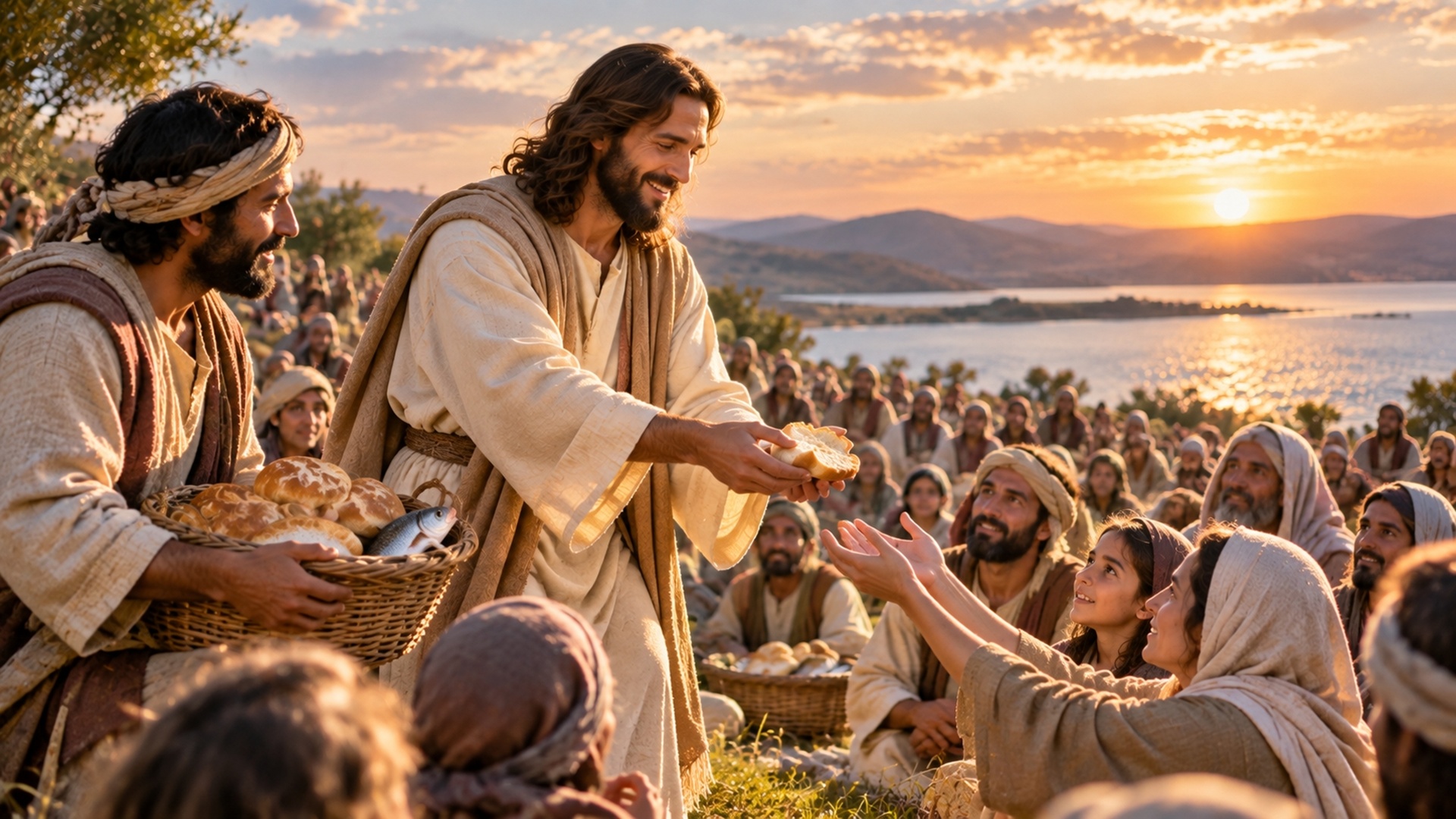
“Then Jesus took the loaves, gave thanks, and distributed them to those who were seated; and likewise of the fish, as much as they wanted.”
John 6:11
🕊️ A Story – When a Great Crowd Followed Jesus
The people had long since begun to follow Jesus wherever He went. They had heard about His healings, some had witnessed His miracles themselves, and others wanted to meet the Man who was now being spoken about in villages and towns. John tells us that Jesus crossed the Sea of Galilee and that a great crowd followed Him “because they saw the signs which He performed on those who were diseased” (John 6:2). What may initially have looked like a retreat from the immediate public eye for Jesus and His disciples soon became another encounter with thousands of people.
Jesus went up on a mountain and sat down there with His disciples. Passover was near, which meant that Israel was in a season when the memory of God’s deliverance from Egypt was especially vivid. People thought about the Exodus, God’s guidance through the wilderness, and the manna with which He had provided for His people. John does not mention this timing by accident, because the feeding of the crowd and the conversation that followed about the bread of life would take on a deeper significance against precisely this background.
When Jesus looked up, He saw the great crowd coming toward Him. He did not merely see many faces; He saw people with needs. Some had probably been traveling for hours. Families had come, old and young, sick and healthy, the curious and those who were sincerely seeking. Many had left other things behind that day because they wanted to hear and experience Jesus. It was now becoming increasingly clear that these people could not simply be sent home without their physical needs being considered.
Jesus turned to Philip and asked, “Where shall we buy bread, that these may eat?” (John 6:5). John explicitly adds that Jesus asked this in order to test Philip, because He Himself already knew what He was going to do.
This is a remarkable detail. Jesus did not ask because He lacked a solution. He asked because Philip needed to learn to look at an apparently impossible situation in a different way.
Philip first responded with a calculation. Two hundred denarii worth of bread would not be enough for everyone to receive even a little. His assessment was reasonable. Thousands of people stood before him, and even a considerable amount of money would hardly have been sufficient. Philip saw the magnitude of the task and compared it with the resources available. The result was clear: it was not enough.
It is precisely here that the spiritual tension of this story begins. Philip was not wrong in his calculation. His mistake was not that he had calculated badly. He had simply left one decisive factor out of his calculation: Jesus was standing right beside him.
🌿 When We First See What Is Missing
Philip’s reaction is surprisingly familiar to us. When we face a great task, we usually begin by examining our possibilities. How much time do we have? What resources are available? What can we accomplish? Who could help? These are sensible questions and belong to responsible action. Yet they can become a spiritual problem when our conclusion is determined solely by what we ourselves possess.
Philip saw thousands of hungry people and inadequate resources. Between these two realities, he saw an impossible contradiction. Jesus saw the same crowd and yet knew what He was going to do.
There are also situations in our lives in which the disproportion between the task and our possibilities seems overwhelming. Perhaps we lack the strength for what lies ahead, the time for everything that needs to be done, or the ability for a responsibility entrusted to us. Perhaps we see a need and want to help, but we do not know how our limited possibilities could possibly make any difference.
Then the thought easily arises: It is not enough.
Our time is not enough. Our strength is not enough. Our experience is not enough. Our influence is not enough. Perhaps even our faith seems insufficient in our own eyes.
The feeding of the five thousand does not deny the reality of our limitations. Five loaves truly were little. Two fish truly were little. Philip was right that the human resources were insufficient. Jesus did not want to teach His disciples to pretend that a little was suddenly a lot. He wanted to show them that what is insufficient in human hands takes on an entirely new significance in His hands.
This is the decisive difference. Faith does not mean denying our limitations. It means refusing to regard them as the limit of what God can do.
🧺 A Boy with Five Loaves and Two Fish
While Philip was thinking about the cost, Andrew brought another observation into the conversation. He said to Jesus, “There is a lad here who has five barley loaves and two small fish.” Yet Andrew immediately added, “But what are they among so many?” (John 6:9).
Something concrete was suddenly available, but in view of the size of the crowd it seemed almost ridiculously small. Five barley loaves and two small fish might feed a boy or perhaps a small family, but never thousands of people.
Yet it was precisely this inconspicuous meal that Jesus took into His hands.
John does not tell us the boy’s name. We learn nothing about his family and do not know how he came to Jesus. Yet his small supply became part of one of the best-known miracles in the Gospels. What appeared insignificant in the eyes of the crowd became, in the hands of Christ, the starting point of a provision that generations would remember.
This detail is especially comforting because it corrects our human tendency to regard only what is great as significant. We compare ourselves with others and often evaluate our own possibilities according to how impressive they appear. When we cannot give much, we quickly get the impression that our contribution does not matter.
Jesus, however, does not first ask whether we possess much. The decisive question is whether we make available to Him what we do have.
Perhaps our strength is small. Perhaps we can encourage only one person, take on only a limited task, give only a little time, or offer only a simple prayer. In our hands it may seem insignificant. Yet we do not know what Christ can make of it.
The miracle therefore does not begin with abundance.
It begins with something limited that is placed in the hands of Jesus.
🔥 Jesus Has the People Sit Down
Jesus said to His disciples, “Make the people sit down.” John reports that there was much grass in that place and that the people sat down. The number of men alone was about five thousand; women and children were there as well.
We can imagine how unusual this instruction must initially have sounded. The disciples still had no visible solution. There were no piles of bread ready, no carts of food had arrived, and no one had explained where the provision would come from. Yet the people were to sit down.
An order of receiving was thus established before it was visible what they would receive.
There is also a lesson of faith in this. Jesus did not require the crowd to produce a solution for themselves. They were to sit down and receive what He would give them. The disciples, in turn, were to learn that they were not the source of the provision. They would later distribute the bread, but the bread did not come from their own ability to multiply it.
This distinction is especially important for people who like to take responsibility. God can use us to give something to others, but we remain recipients of what ultimately comes from Him. We are not the source.
When we forget this, service quickly becomes a burden. We begin to believe that we must constantly produce more from our limited reserves than is actually there. Eventually we become exhausted because we are trying to take on a role that was never given to us.
The disciples were to distribute the bread.
Jesus was to multiply it.
🌾 Gratitude in the Midst of Scarcity
Then Jesus took the five loaves.
What He did next is remarkable. He did not look at the small amount and complain that it was too little. John writes that Jesus gave thanks.
Five loaves lay before Him while thousands of people waited to be fed. From a purely human perspective, there was no reason at all to consider this amount sufficient. Yet Jesus began with gratitude.
This attitude challenges our usual perspective. We often give thanks when we see abundance. Jesus gave thanks before the multiplication became visible. He consciously received what was present from the Father’s hand and acted in trust that God’s possibilities were not limited by the visible amount.
Gratitude therefore does not mean that we have to pretend everything is enough when we are experiencing lack. Rather, it directs our attention to the fact that even in a situation of scarcity, something is already present that we can place in God’s hands.
Perhaps in a difficult situation we first see what is missing. Christ invites us also to notice what God has already given.
What lies in our hands today?
What ability, opportunity, relationship, time, experience, or small gift is already present?
We do not have to turn it into a miracle ourselves.
We may give it to Christ.
🍞 In the Hands of Jesus, the Little Becomes Enough
After Jesus had given thanks, He had the bread distributed to the people. The same happened with the fish. John describes the result with a simple expression: everyone received “as much as they wanted” (John 6:11).
This is more than bare provision.
Jesus did not give everyone a tiny bite so that later it could be said that everyone had at least received something. The people ate until they were satisfied. The One who had begun with five loaves provided for a crowd that, from a human perspective, could never have been satisfied by them.
The miracle therefore reveals something about the character of Christ. Jesus sees human needs and does not respond to them reluctantly. His care is not an abstract idea. The people were hungry, and He gave them food.
At the same time, the feeding points beyond itself. A little later in John 6, Jesus would explain that the deepest need of the human being cannot be satisfied by bread alone. The crowd had received food, but the next day they would be hungry again. Christ wanted to lead them to a greater realization: the One who had given them bread was Himself the bread of life.
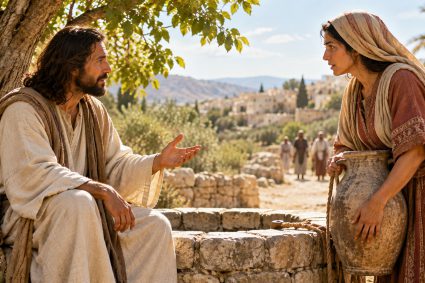
In this respect, this encounter resembles that of the woman at Jacob’s well. There Jesus began with water and led the conversation to living water. Here He begins with bread and leads the people to the bread of life. In both cases Christ takes a fundamental human need seriously and at the same time uses it to point to the deeper need of the heart.
🌿 When God Involves Us in His Work
Jesus could have performed the miracle in many other ways. He could have caused bread to appear directly before every person. He could have sent the crowd home and miraculously provided for them there. Instead, however, He involved the boy and the disciples in what He was doing.
The boy gave what he had.
Jesus took it, gave thanks, and multiplied it.
The disciples distributed it.
The people received.
This movement reveals something fundamental about the way God works. Christ does not need our limited resources because He would otherwise lack possibilities. Nevertheless, He repeatedly chooses to involve people in His work. He takes what we make available to Him and makes us participants in something far greater than our own ability.
This is precisely where the dignity of service lies. We do not have to be the source of blessing. We may pass on what we ourselves have received from the hands of Christ.
Ellen G. White emphasizes in her account of the feeding of the five thousand that Christ deliberately involved His disciples in providing for the crowd. They received the bread from His hand and passed it on to the people. She sees in this a principle of ministry: what Christ entrusts to His followers is not to be kept for themselves but passed on for the blessing of others. At the same time, Christ remains the true source from whom everything proceeds.
(Cf. Ellen G. White, The Desire of Ages, chapter on the feeding of the five thousand.)
This truth takes a great deal of pressure off us. God does not demand that we be enough for everyone out of ourselves. He asks us to place what we have into His hands and trust Him with what can become of it.
🧺 Twelve Baskets Full of Leftovers
After everyone had eaten and was satisfied, Jesus said to His disciples, “Gather up the fragments that remain, so that nothing is lost” (John 6:12). The disciples went through the crowd and filled twelve baskets with the fragments of the five barley loaves.
At the beginning of the story, they had too little.
At the end, each of the twelve disciples carried, as it were, visible evidence that their original calculation had not been the limit of God’s possibilities.
Twelve baskets remained.
This does not mean that God always promises material abundance or that every small sacrifice will automatically be transformed into visible success. The miracle was a special sign of Jesus’ messianic authority. Yet it reveals a spiritual principle that reaches far beyond that day: we should never judge God’s possibilities solely by what lies in our hands at the beginning.
The disciples had looked at five loaves and wondered how they could ever be enough.
Jesus had looked at the same five loaves and given thanks.
Perhaps one of the most important lessons of this encounter lies precisely between these two perspectives. We can constantly look at our lives in terms of what is missing and thereby become increasingly small, anxious, and hesitant. Or we can learn to place what is present gratefully into God’s hands and leave the question of how far it can reach to Him.
The story does not promise us that we will possess an unlimited amount.
It shows us something better:
We do not have to be enough ourselves when the little we have is in the hands of Christ.
“And Jesus said to them, ‘I am the bread of life. He who comes to Me shall never hunger, and he who believes in Me shall never thirst.’”
John 6:35
🕊️ When the People Sought Jesus Again
On the evening after the feeding of the five thousand, the great crowd had slowly dispersed, but the memory of the miracle remained. Thousands had witnessed how Jesus had fed a multitude with five barley loaves and two fish, even though from a human perspective they could never have been satisfied by them. For many, it had become clear that they were dealing with an extraordinary Man. John even reports that the people wanted to make Jesus king. A Man who healed the sick and multiplied bread seemed to be exactly the ruler they desired. Jesus, however, withdrew from their plans and went up the mountain alone.
The following day the people searched for Him. When they realized that Jesus was no longer at the place of the feeding, they went to Capernaum and found Him there. Outwardly, their search looked like great spiritual interest. They had gone to considerable effort to find Jesus again, but Christ recognized that another motive lay behind their search. He said to them, “Most assuredly, I say to you, you seek Me, not because you saw the signs, but because you ate of the loaves and were filled” (John 6:26).
Jesus was not rejecting them because they had physical needs. After all, He Himself had recognized those needs the day before and had given them food. The problem was that they had stopped at the gift and had failed to recognize the Giver. The bread had satisfied their hunger, but the sign was meant to direct their attention to the One who wanted to give them something far greater.
Here the story touches on a fundamental question of our faith: Do we seek God for His own sake, or primarily because of what we expect from Him? We can ask for health, protection, help, success, a solution to a problem, or strength for a difficult situation, and the Bible explicitly invites us to bring our needs to God. Yet when our relationship with Him depends entirely on His giving us the gifts we desire, our faith remains superficial.
Jesus did not merely want to give the people bread again. He wanted to show them that their deepest hunger was for Him.
🌿 When the Gift Becomes More Important Than the Giver
The people had experienced a genuine miracle, but they had not yet understood its meaning. At first, they saw in Jesus primarily the One who could improve their living conditions. Perhaps some thought of Israel’s history in the wilderness and of the manna that came from heaven every day. If Jesus could also provide food, He seemed to possess the solution to one of the most basic problems of human life.
But Christ did not want to be reduced to the role of a miracle-working provider of bread. Therefore He said, “Do not labor for the food which perishes, but for the food which endures to everlasting life” (John 6:27). He was not saying that food, work, or the material needs of life were unimportant. Rather, He was raising the question of the priorities of the heart.
We invest an astonishing amount of energy in things whose effect is limited. We work to earn our living, plan for the future, care for our homes, and try to arrange our lives as well as possible. All of this belongs to responsible living. Yet even if we succeed in all these things, a limit remains. No possession can give eternal life, no professional achievement can forgive guilt, and no human recognition can satisfy the deepest longing of the heart for fellowship with its Creator.
This is precisely why Jesus’ question is so important. We can spend our whole lives repeatedly searching for bread and overlook the One who is the bread of life.
Sometimes this even becomes evident in our prayer life. We come to God with a list of concerns and scarcely notice that we seek His presence itself only on the margins. We want His help, but not always His guidance; His gifts, but not necessarily His correction; His peace, but perhaps without looking at the areas of our lives that He wants to change.
Christ invites us deeper. He does not merely want to do something for us. He wants fellowship with us.
🔥 “What Shall We Do?”
The listeners responded to Jesus’ words with a question: “What shall we do, that we may work the works of God?” (John 6:28). Their reaction is understandable. If there was food that endured to eternal life, they wanted to know what achievement was required in order to obtain it.
Jesus answered surprisingly: “This is the work of God, that you believe in Him whom He sent” (John 6:29).
In this way He led them away from the idea that eternal life had to be earned through some special religious achievement. The decisive step was to trust the One whom God had sent.
We too often think first in categories of doing. What more must I accomplish? What must I improve? What spiritual discipline am I lacking? How can I prove to God that my faith is serious? Obedience, growth, and spiritual discipline have their place, but they must never become an attempt to acquire what God offers as a gift.
The gospel does not begin with our achievement, but with God’s gift.
The people had to learn that the bread of life could not be earned. It stood directly before them in the person of Jesus.
🌾 From the Manna to the True Bread
The listeners now reminded Jesus of the manna in the wilderness. Their ancestors, as Scripture said, had eaten bread from heaven. Behind their remark was apparently the expectation of another sign. Remarkably, the feeding of the previous day was not enough for them. If Jesus truly was the One sent by God, perhaps He should do something comparable to Moses.
Jesus corrected their perspective. It was not Moses who had given the bread from heaven; the Father was the Giver. Then He explained, “For the bread of God is He who comes down from heaven and gives life to the world” (John 6:33).
The people answered, “Lord, give us this bread always.”
This request strikingly resembles that of the Samaritan woman at Jacob’s well. She had said to Jesus, “Sir, give me this water.” She too did not yet fully understand that Jesus was speaking of something greater than the satisfaction of a physical need.
Jesus now answered the crowd with one of the great “I am” declarations of the Gospel of John:
“I am the bread of life.”
He did not merely say, “I give you the bread of life.”
He said: “I am it.”
The message of the previous day’s miracle now became clear. The people had received bread, but the true sign stood before them. The One who had multiplied the bread was Himself God’s answer to the deepest hunger of humanity.
🌙 A Hunger That Only Christ Can Satisfy
What does it mean that Jesus is the bread of life? Bread was one of the basic foods of the ancient world. It was not an occasional addition, but part of daily provision. When Jesus applies this image to Himself, He is not describing Himself as an optional addition to an otherwise self-sufficient life. He is saying that human beings need Him as fundamentally as the body needs food.
We can be very busy spiritually and still remain hungry. A person can listen to sermons, read Christian books, fulfill religious duties, and even serve others while personal fellowship with Christ becomes increasingly thin. Then there is a danger that we know much about Jesus but live only very little from Him.
The bread on the mountain could strengthen the people only if they ate it. In the same way, the truth about Christ remains external if it is not received in faith. Jesus does not merely want to be the object of our convictions. He wants to shape our thinking, our hope, our decisions, and our identity.
To live from Him means returning to Him again and again. We receive forgiveness because we cannot produce it ourselves. We receive strength because our own strength is limited. We receive guidance because our vision remains incomplete. We receive hope because our circumstances do not always give us a reason for it.
This is precisely where the freedom of the gospel lies: We do not have to be enough out of ourselves.
🧺 The Twelve Baskets and the Fear of Not Having Enough
At the end of the feeding, twelve baskets of bread were left over. This image must have remained in the disciples’ memories. At the beginning they had wondered how five loaves could ever be enough. At the end they themselves carried away the remains of what they had previously regarded as completely insufficient.
How often our lives are shaped by the fear of not having enough. We fear that we do not have enough time, strength, security, or possibilities. Sometimes this fear even turns against ourselves: I am not gifted enough, not strong enough, not spiritual enough, or not sufficiently prepared for what lies ahead.
The story of the feeding does not answer this with a message of human self-exaltation. Jesus does not say, “In reality you have much more strength than you think.” The five loaves remained five loaves as long as they were considered in human hands. The decisive difference came through Christ.
This brings relief. Our trust does not have to depend on our eventually becoming enough. We may acknowledge that we have limits. Those very limits can remind us where our true provision comes from.
Ellen G. White connects the feeding of the crowd with this principle of receiving and passing on. The disciples could give the people only what they had first received from Christ. They were not the source of the provision, but the hands through which His gift was passed on.
(Cf. Ellen G. White, The Desire of Ages, chapter on the feeding of the five thousand.)
This principle applies not only to material giving. We cannot continually impart peace to others if we ourselves do not repeatedly find rest in Christ. It is difficult to speak of grace when we ourselves live only by performance. We cannot produce hope by our own strength. Whatever is to flow spiritually through our lives must first be received by us.
🌿 When Jesus Himself Becomes Enough
The people by the lake wanted to make Jesus king because they had seen what He could do for them. But Jesus wanted something much deeper: they were to recognize who He was.
At precisely this point the story becomes personal. Perhaps we too sometimes seek Christ primarily because of a specific need. We need an answer, an open door, protection, healing, or clarity. It is right to come to Him with these things. Yet sometimes God does not immediately give us what we ask for, and then it becomes apparent whether our trust is attached only to the expected gift.
The deepest maturity of faith arises where we can say, “Lord, I desire Your help in this matter, but even more than that, I need You.”
This is not an attitude of resignation. It does not mean that our concerns become unimportant. It means that Christ becomes greater than what we ask from Him.
Then even an unanswered prayer cannot destroy our relationship with God. A closed door does not automatically mean that God has abandoned us. A season of scarcity does not mean that His provision has ceased. We learn that God’s greatest gift is not always the changing of our circumstances.
His greatest gift is Christ Himself.
🌾 The Sabbath – When We May Stop Having to Be Enough Ourselves
The feeding of the five thousand leads us especially deeply into the meaning of the Sabbath, because every week the Sabbath confronts us with the same fundamental question: What am I actually living from? For six days we work, plan, produce, organize, and take responsibility. Much of this is necessary and good. Yet precisely because we do so much, the impression can quietly arise that our lives are sustained primarily by our own performance. The Sabbath interrupts this idea.
When we lay down our work on Friday evening, tasks remain unfinished. Not everything has been completed perfectly. There would almost always be something more to answer, improve, prepare, or finish. Nevertheless, God says: Now you may stop.
This stopping itself is an act of faith.
The Sabbath does not require us to prove that we have accomplished everything. It teaches us that we may rest even though our possibilities are limited. For one day we do not have to demonstrate that we are capable of doing enough. We may receive.
In this way the Sabbath bears a remarkable resemblance to the scene on the mountain. The people had to sit down on the grass. They could not multiply the bread. The disciples could not multiply it either. Ultimately, everyone depended on Christ to give.
On the Sabbath we too may, spiritually speaking, sit down. We may step out of the rhythm in which our worth is continually connected with what we do and remember that God first sees us as His creatures and children, not as producers of performance.
For some people, this is precisely what is difficult. Outwardly one may stop working while inwardly continuing to work. We think about what we did not accomplish, what needs to be done next week, or whether we have done enough. Even spiritually, we can turn the Sabbath into another field of performance: Have I read enough, prayed enough, studied enough, done enough to observe this day properly?
But the Sabbath is first of all a gift from God.
It reminds us that we live from His goodness before we can give anything back to Him. Like the bread in John 6, the decisive provision does not come from our hands but from His.
This does not mean that the Sabbath should be passive or empty. We pray, read God’s Word, attend worship, meet people, and do good. Yet all of this may flow from a different inner source. We do not do it in order to earn God’s nearness, but because we have received it.
The feeding of the five thousand can therefore help us view our Sabbath differently. Perhaps we reach Friday evening with the feeling that our strength has been exhausted. The week has demanded more than we expected, and inwardly it seems that hardly anything remains. Then we tend to look at our five loaves and two fish and think, “This is not even enough for me.”
Christ does not require us to produce abundance out of exhaustion.
He invites us to place the little we have into His hands.
Perhaps our prayer on this Sabbath is not long. Perhaps our concentration while reading the Bible is limited. Perhaps we come to worship tired or carry worries with us that do not simply disappear. We do not have to become spiritually strong before we are allowed to come to Christ. We come precisely because we need nourishment.
The Sabbath reminds us that Christ is the bread of life. We do not have to come to Him with a full basket. We come with empty hands so that He can fill them.
At the same time, the Sabbath raises the question of what kind of hunger we have tried to satisfy during the week. Perhaps we have longed for recognition and therefore worked too much. Perhaps we have tried to cover inner restlessness with busyness. Perhaps we have become accustomed to news, entertainment, or constant activity because stillness has become uncomfortable. All of these things can be like bread that satisfies for a moment and leaves us hungry again shortly afterward.
Then Jesus speaks to us as well: “I am the bread of life.”
The Sabbath creates space to understand these words not only theologically but also to experience them practically. We may spend time with Christ without constantly looking at the clock. We may read the Bible not merely in search of information but listen for what God wants to say to our hearts. In prayer we do not have to merely list our concerns but may remain in His presence. We may experience fellowship without having to gain some benefit from it.
In this way Sabbath rest becomes spiritual nourishment.
And just as in the feeding on the mountain, receiving then leads to giving. The Sabbath is not only meant to fill us. God’s rest makes us free to notice others. We can give our time, listen, encourage, visit, eat together, and share hope. Yet here too the principle of the story applies: we do not give from a source that we ourselves have to be. We pass on what we have received from Christ.
Perhaps one of the most important practices of this Sabbath is therefore very simple: to stop having to prove to ourselves that we are enough.
You do not need to have enough strength for the entire future. You need grace for the next step. You do not need to possess all the answers. You may trust the One who knows them. You do not have to be the solution for everyone. You may give what Christ has entrusted to you and leave the outcome to Him.
Five loaves were not enough for thousands.
But five loaves in the hands of Jesus were enough.
Every week the Sabbath leads us back to those very hands.
🤲 Invitation – What Is in Your Hands?
Take deliberate time on this Sabbath to look at what brought you to your limits during the past week. Perhaps there is a task in which you constantly think that your strength is not enough, a concern about the future, or an area in which you compare yourself with others and therefore consider your own “little” to be insignificant.
Bring Christ exactly what is present instead of concentrating only on what is missing. You do not have to present Him with a full basket. The boy had only five loaves and two fish. What mattered was not the size of his gift but the fact that it was placed in Jesus’ hands.
At the same time, ask yourself whether lately you have sought God’s gifts more than God Himself. Ask Christ to lead your hunger deeper, so that you desire not only His help but His presence. The Sabbath gives you time not merely to receive bread from His hand, but to become newly acquainted with the One who says, “I am the bread of life.”
✨ Prayer
Lord Jesus, You know my limitations and You know how often I look at what I lack. You see the tasks for which my strength seems small, the questions for which I have no answer, and the situations in which I believe I must be more or accomplish more than I can. On this Sabbath I want to stop putting myself under the pressure of having to be enough in my own strength.
I bring You what lies in my hands. Take my limited strength, my time, my abilities, and even my weak faith. Teach me not to despise the little I have but to entrust it to You. Keep me from calculating the outcome of my life solely according to my own possibilities, and give me confidence in what You can do.
Forgive me where I have sought Your gifts more than I have sought You. You know how quickly my heart longs for security, recognition, success, or visible answers. Help me understand more deeply that my greatest treasure is not receiving everything I desire, but having You.
Let this Sabbath become a time of receiving for me. Satisfy my inner hunger with Your presence, give rest to my weary heart, and remind me that my worth does not depend on my performance. When the new week begins, help me to live from Your abundance and to pass on to others what I have received from You.
And when I once again face a task and think, “This will never be enough,” remind me of the five loaves, the two fish, and the twelve filled baskets. Then let me not look first at my small possibilities, but at Your hands, in which the little I have finds its proper place.
Amen.
