


🌙 Still Awake?
One Step Closer to Jesus Every Evening.
📅 September 5
🛡️ Trusting God Without Putting Him to the Test
📖 Matthew 4:7
“Jesus said to him, ‘It is written again, “You shall not tempt the Lord your God.”’”
Matthew 4:7
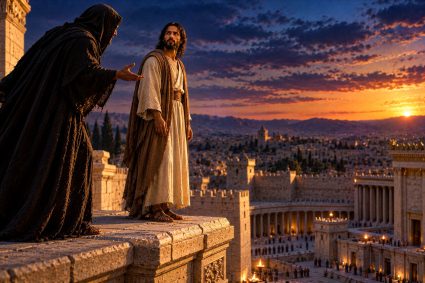
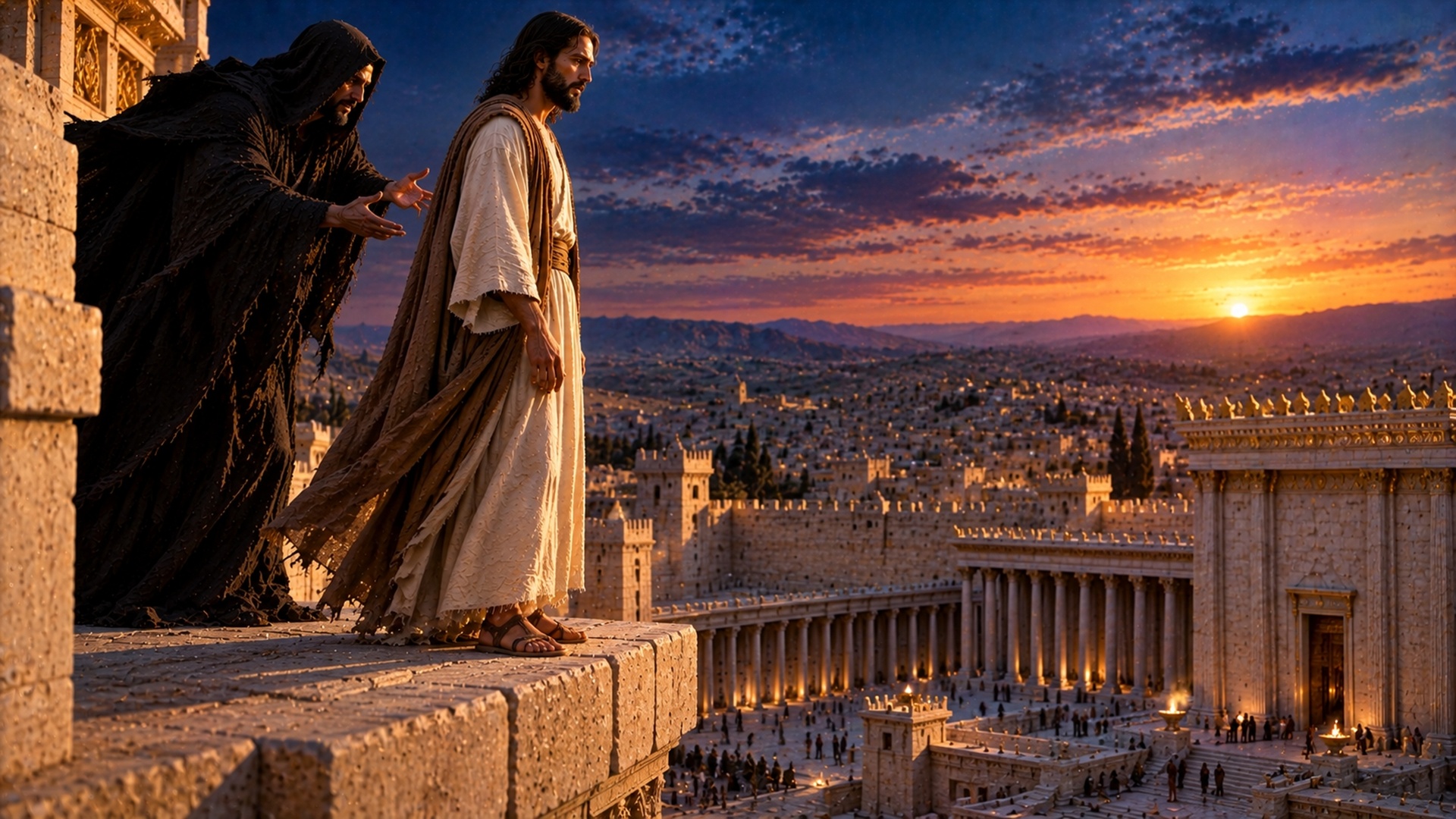
Yesterday, we saw how the tempter placed Jesus on the pinnacle of the temple and challenged Him to throw Himself down. Satan even used words from Psalm 91, attempting to turn a genuine promise of God into a justification for a wrong action. Jesus was supposed to force His Father to intervene through a miracle and publicly prove that He really was the Son of God. His response now shows us how genuine faith treats God’s promises: “You shall not tempt the Lord your God.”
Jesus answered once again with Scripture, this time with a statement from Deuteronomy 6. He was not setting one Bible verse against another, but showing that God’s Word must be understood as a whole. Psalm 91 promised God’s protection, but this promise gave no one the right to place themselves deliberately in danger and then demand a miracle. Genuine faith trusts that God is faithful; it does not manufacture a crisis in which God is forced to prove His faithfulness.
📖 “It Is Written Again”
These few words of Jesus are especially important for the way we approach the Bible. Satan had indeed quoted Scripture, but Jesus was not deceived by it. He knew not only individual verses, but also understood the broader message of God’s Word. He could therefore recognize that Psalm 91 was never intended to justify recklessness.
An individual Bible verse can also appear very convincing today. Sometimes a statement is taken out of context and applied in a way that makes it mean almost the opposite of what the entire passage teaches. It is therefore important to ask not only, “Does this sentence appear in the Bible?” but also, “What does it mean in its context, and how does this interpretation agree with the other teachings of Scripture?”
For example, if you want to make a decision and find a verse that seems to confirm your opinion exactly, you should not stop examining the matter immediately. Read what comes before and after it, compare it with other clear teachings of the New Testament, and ask honestly whether you are seeking God’s will or merely a biblical-sounding confirmation of your own desire.
Jesus shows us that knowing the Bible does not mean being able to quote as many isolated sentences as possible. It means becoming so familiar with God’s Word that we understand its meaning and can recognize false applications.
🛡️ Trusting and Testing Are Not the Same
At first glance, jumping from the temple might have appeared to be a great demonstration of faith. Jesus could have said, “I trust My Father so completely that I will simply jump.” Yet this would not have been genuine faith. It would have been an attempt to place God in a situation where, according to human expectations, He would be forced to intervene.
Genuine faith does not begin by imposing conditions upon God. It begins by trusting His character and His Word. When God has clearly promised something, we may depend upon it. However, we must not derive claims from His promises that He Himself has never given.
This makes a great difference. Trust says, “Father, I do not know how this situation will end, but I want to remain with You.” Putting God to the test, by contrast, would mean saying, “If You are really with me, You must do exactly what I expect right now.”
In the first case, we leave the guidance to God. In the second, we try to establish the conditions under which we are willing to trust Him.
🏜️ Jesus Recalls an Ancient Lesson from the Wilderness
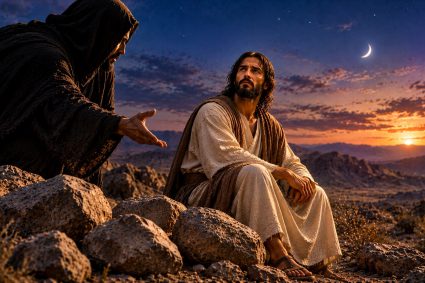
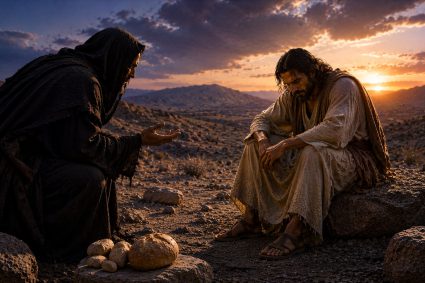
Through His answer, Jesus referred to an experience of Israel in the wilderness. In Deuteronomy 6, Moses reminded the people not to test God as they had done at Massah. At that time, Israel had asked in a difficult situation whether the Lord was truly among them. Although God had already guided and provided for His people, they demanded that His presence be proved again through a visible intervention.
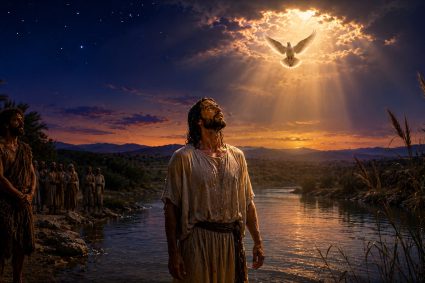
Satan now wanted to provoke precisely this attitude in Jesus. At the Jordan, the Father had only recently declared publicly, “This is My beloved Son.” Nevertheless, Jesus was now being tempted to act as though that declaration were insufficient. He was supposed to demand additional proof.
Jesus refused. His Father’s word was enough for Him.
We, too, can forget what God has already shown us as soon as a new difficulty arises. Yesterday, we may have been grateful for His guidance, but today a problem causes us to ask, “Are You still there at all?” One disappointed expectation can suddenly call into question everything we previously learned about God’s faithfulness.
God does not forbid us from asking questions. The Psalms and the New Testament show people who bring their distress before God very openly. Yet honest questions are different from demanding that God prove Himself according to our conditions.
❤️ You May Have Questions Without Imposing Conditions upon God
Perhaps there is something you do not currently understand. A prayer was not answered in the way you had hoped. A situation has continued longer than you expected. Perhaps you sincerely prayed for God’s guidance and still remain uncertain about which path to take.
You may tell your loving Father about this uncertainty. Faith does not mean suppressing difficult questions or pretending that everything is easy to understand. Jesus Himself later prayed in Gethsemane under tremendous inner pressure. The Bible does not reveal a God from whom we must hide our feelings.
However, there is an important difference between an honest question and a condition. You can pray, “Father, I do not understand why this is happening. Please help me to trust You nevertheless.” It would be different to say, “If You truly love me, You must solve this problem by tomorrow.”
In the first prayer, you seek God’s presence in the midst of your uncertainty. In the second, you attempt to measure His love by a condition you have established.
You may have questions. You may be disappointed. You may even say that you do not currently understand God’s actions. But you do not have to test His love anew every day.
🧪 “If God Really…”
Perhaps you are familiar with thoughts that begin with these exact words: “If God really…” If God really loves me, He should give me this relationship. If God truly hears my prayer, I should receive a sign now. If God is truly guiding me, this decision should not be so difficult. If God really is with me, I should feel stronger.
Such thoughts can be very convincing because they often connect with genuine desires and sincere questions. Yet they contain a danger: We first define for ourselves what God’s love or guidance must look like and then judge Him according to whether He fulfills our definition.
Jesus could have done the same. He could have said, “If the Father truly loves Me, He will catch Me.” Yet He already knew that the Father loved Him. He therefore had no need to invent a test.
You do not need to examine God’s love through an experiment of your own choosing. The clearest proof of His love is not that every desire is fulfilled, but Jesus Himself. When we want to know how serious God is about His love for us, the New Testament repeatedly directs us to Christ.
✝️ Jesus Is God’s Greatest Proof of Love
Sometimes we search for small signs even though God has already given us something far greater in Jesus. We may want a particular event as proof of His love, but the gospel shows us the Son of God, who came to humanity, served people, and ultimately gave His life for them.
This does not mean that God does not answer personal prayers or give us special experiences. He does. Yet our faith must not become completely dependent upon them. Experiences change, feelings fluctuate, and some prayers are answered differently from what we hoped. Jesus remains the same.
If you have a difficult day tomorrow, God’s love has not become smaller. If a prayer remains unanswered, the cross has not ceased to matter. If you do not feel His presence strongly, Jesus is no less your Savior.
Our assurance needs a foundation that reaches deeper than our changing experiences. That foundation is Christ.
🚦 God’s Protection Does Not Replace Your Responsibility
Jesus’ answer at the temple also concerns the way we deal with risks. Those who trust God do not have to act deliberately and unreasonably. God’s protection is not an insurance policy for decisions in which we consciously ignore wisdom and responsibility.
This applies to our bodies, relationships, finances, and also to temptation. If you know that a particular situation repeatedly leads you into trouble, you should not deliberately enter it and then pray that God will preserve you. His answer may consist precisely in giving you the wisdom beforehand to avoid that situation.
The same applies to decisions with foreseeable consequences. Prayer does not replace studying for an examination, driving responsibly, managing money wisely, or having necessary conversations in a relationship. We may ask God for help while also doing what lies within our responsibility.
Trust therefore does not mean passivity. It combines dependence upon God with responsible action.
🙏 Prayer Is Not a Method of Controlling God
Prayer is one of the most beautiful ways of speaking with our loving Father. We may express specific requests and explain very precisely what we desire. Jesus Himself taught His disciples to ask, and the New Testament encourages us to bring our concerns before God.
Yet prayer is not a technique through which we can force God to carry out our plans. Sometimes we unconsciously develop the idea that if we pray long enough, intensely enough, or with enough faith, God must do exactly what we ask.
Jesus demonstrates a different kind of trust. He knows that the Father is good without attempting to control Him. Later, in Gethsemane, He will even express a very specific desire while praying at the same time that the Father’s will be done.
We may pray in the same way. You can say, “Father, I truly desire for this matter to turn out in this way.” You can then add, “But I will also trust You if You see another way.”
This is not a weak form of prayer. It is a profound expression of trust.
🧭 Guidance Is More Than a Sign
When we face an important decision, we sometimes desire an unmistakable sign. Perhaps we ask God to make a particular event happen, cause someone to say a specific sentence, or open a door in a very particular way. We would then like the assurance of no longer having to weigh the options.
Yet God’s guidance often occurs less spectacularly. He has given us His Word, the ability to think, prayer, and the opportunity to seek advice from wise people. Sometimes He guides us through circumstances, but even these must be examined.
An open door is not automatically God’s will, and a difficulty does not necessarily mean that we are on the wrong path. Jesus Himself was led by the Spirit into the wilderness, even though that path was difficult.
If you are facing a decision, you do not have to search constantly for extraordinary signs. Examine whether the decision agrees with God’s Word. Pray for wisdom. Consider the possible consequences. If necessary, speak with a mature Christian whom you trust. When the time comes to act, you may then make a responsible decision without possessing complete knowledge of the future.
Faith does not mean that every uncertainty disappears. It means that we trust God even within the limits of our understanding.
📱 We Often Want Immediate Confirmation
We are accustomed to receiving quick responses. A message is read, a post receives reactions, and a search produces results within seconds. This can make it more difficult to deal with situations in which no immediate answer comes.
Perhaps we even transfer this expectation to God. We pray and, only a few hours later, begin looking inwardly to see whether anything has happened. When no visible change occurs, we begin to doubt.
Relationships, however, do not function like search engines. Trust also develops through times when we do not immediately know how something will turn out. Our faith can deepen precisely there because we learn not to respond only to immediate results.
This does not mean that waiting is pleasant. Some unanswered questions can be deeply distressing. Yet you can learn to live with an unresolved question without immediately turning it into an unresolved question about God’s character.
Perhaps today you do not know why something is happening. Nevertheless, you can know to whom you are entrusting your uncertainty.
🪞 What Would Happen If God Said No?
Sometimes it can be helpful to ask: “What would happen to my trust in God if His answer to my desire were no?” This question can reveal whether we are seeking God Himself or primarily what we want to receive from Him.
Of course, a no can hurt. If something is truly important to you, you do not have to pretend that God’s answer does not matter. In Gethsemane, Jesus Himself showed that submission to the Father’s will can involve a genuine inner struggle.
Yet if our entire relationship with God depends upon Him fulfilling our desires, trust can easily become a transaction: I believe, pray, and obey, and in return God is expected to give me what I want.
The gospel invites us into something deeper. We may love God because He is God and because we have come to know His character in Jesus. His gifts are good, but the Giver is greater than every individual gift.
Perhaps you have a desire about which you can say this evening: “Father, You know how important this is to me. I ask You for it, but I do not want to make my relationship with You dependent upon whether Your answer looks exactly as I hope.”
🌱 Trust Grows through Remembering
When a new difficulty arises, we easily forget how God has already guided us. It can therefore be helpful to remember deliberately. Perhaps there was a prayer that was answered, a Bible passage that helped at precisely the right time, a person whom God used, or a difficult period through which He carried you.
Such memories do not prove that every future situation will unfold in the same way. They can, however, remind us that our present fear does not tell the whole story.
Immediately before entering the wilderness, Jesus had heard the Father’s voice. When the tempter questioned His sonship, Jesus needed no new proof. The Father’s word remained true.
We, too, can learn not to begin again from zero whenever a new difficulty arises. God’s faithfulness yesterday does not give us the right to dictate how He must act tomorrow, but it gives us a reason to trust Him tomorrow as well.
🤍 You Can Trust God Even When You Do Not Understand Him
Trust does not mean that every question has been answered. If we could understand God completely, He would not be greater than our own minds. In the New Testament, we repeatedly meet people who did not immediately understand Jesus. Even His disciples had to learn that God’s way sometimes looked entirely different from what they expected.
You will probably also experience situations for which you cannot find a quick explanation. Some questions are resolved later, while others remain open for a long time. During such times, you may hold on to two truths simultaneously: “I do not understand this” and “Nevertheless, I want to trust God.”
These statements do not contradict each other. On the contrary, trust begins to acquire its true meaning precisely there. When we already see and understand everything, we hardly need trust.
Your loving Father does not require you to pretend that every difficulty is beautiful. He invites you to bring your questions to Him and remain with Him while you do not yet possess a complete answer.
🌙 Before You Fall Asleep Tonight
Perhaps there is something for which you desperately want a particular answer from God. Maybe you have been waiting for a long time and can feel your patience diminishing. You do not have to minimize that desire this evening. Tell your loving Father honestly what you want and why it matters so much to you.
Then ask yourself whether you have unconsciously turned your desire into a condition: “If God loves me, He must…” or “If God is guiding me, then this must happen…” If you recognize such a condition, you may tell Him about that as well.
At the temple, Jesus did not need additional proof of His Father’s love. He trusted the word that had already been spoken. You, too, can learn not to make your relationship with God dependent upon receiving a new sign.
Perhaps your prayer will be answered tomorrow. Perhaps you will have to keep waiting. Perhaps God will lead differently from what you imagined. In every case, you may remain with Jesus and know that God’s character does not have to be proved anew every morning.
💭 Think about It
Is there currently a prayer or desire for which you are unconsciously making your trust in God’s love and faithfulness dependent upon Him acting exactly as you expect? Also consider whether, when facing important decisions, you tend to search for spectacular signs or are willing to bring together God’s Word, prayer, careful reasoning, and wise counsel, trusting Him even when not every uncertainty disappears.
🌟 Thought for Tomorrow
If an unresolved question makes you restless tomorrow, do not immediately demand a new sign. Instead, remember something that the New Testament has already taught you with certainty about God, and bring your particular uncertainty to Him in prayer. Tell your loving Father honestly which answer you desire, but consciously entrust the manner and timing of His action to Him. If a practical decision must be made, also examine what lies within your responsibility, and do not act recklessly under the pretext that God will surely intervene.
🙏 Prayer
Dear Father,
Thank You that Jesus trusted You at the temple and did not demand additional proof of Your love. Thank You that He refused to use Your promises as the basis for a test of His own choosing.
You know my unanswered questions and the matters for which I have been waiting for a long time. You know which answers I desire and how difficult it sometimes is when Your guidance looks different from what I expected. Help me to tell You honestly about these desires without turning them into conditions for my trust.
Forgive me when I have thought that You must do something specific before I can believe that You love me or are with me. Help me increasingly to find my assurance in Jesus and in Your Word.
Give me wisdom in the way I understand Your promises. Protect me from using isolated Bible verses merely to confirm my own ideas. Help me understand Your Word in context and remain willing to let it correct me.
Also help me to accept responsibility. I do not want to act recklessly and then expect You to prevent every consequence. Show me what I can and should do, and at the same time give me trust concerning everything beyond my control.
If I do not receive a quick answer tomorrow, help me to wait. When I am uncertain, guide me through Your Word and Your Spirit. When my plans unfold differently, remind me that Your love has not become smaller.
I want to learn to trust You not only when I understand Your ways, but also to remain with Jesus when questions are still unanswered.
Amen.
🌙 Sleep well. Your loving Father does not need a test of your own invention in order to be faithful. You may entrust your questions, desires, and uncertainties to Him, act responsibly, and rely upon the fact that His love has already been revealed clearly in Jesus. See you tomorrow.
