🌱LIVING FAITH | 11.Living in the Land | 11.4 A gentle answer | 🗺️ LESSONS OF FAITH FROM JOSHUA
🗺️ LESSONS OF FAITH FROM JOSHUA
⛪ Lesson 11 : Living in the Land
📘 11.4 A gentle answer
✨ Responding with kindness – Unity instead of escalation
🟦 Introduction
Between misunderstanding and war, sometimes only a single word stands. In Joshua 22, the twelve tribes of Israel stand on the brink of civil war—triggered by an altar. What at first appears to be idolatry turns out to be a misunderstood act of faithfulness. The decisive turning point is: a gentle answer.
How important are patience, listening, and respectful communication? And what happens when we form judgments too quickly? This lesson shows how spiritual maturity and gentle words can save relationships.
…………………………….. 🗺️ ……………………………..
📖 Bible Study
A gentle answer – the power of spiritual communication
────────────────────────
🔍 1. Literary and historical context
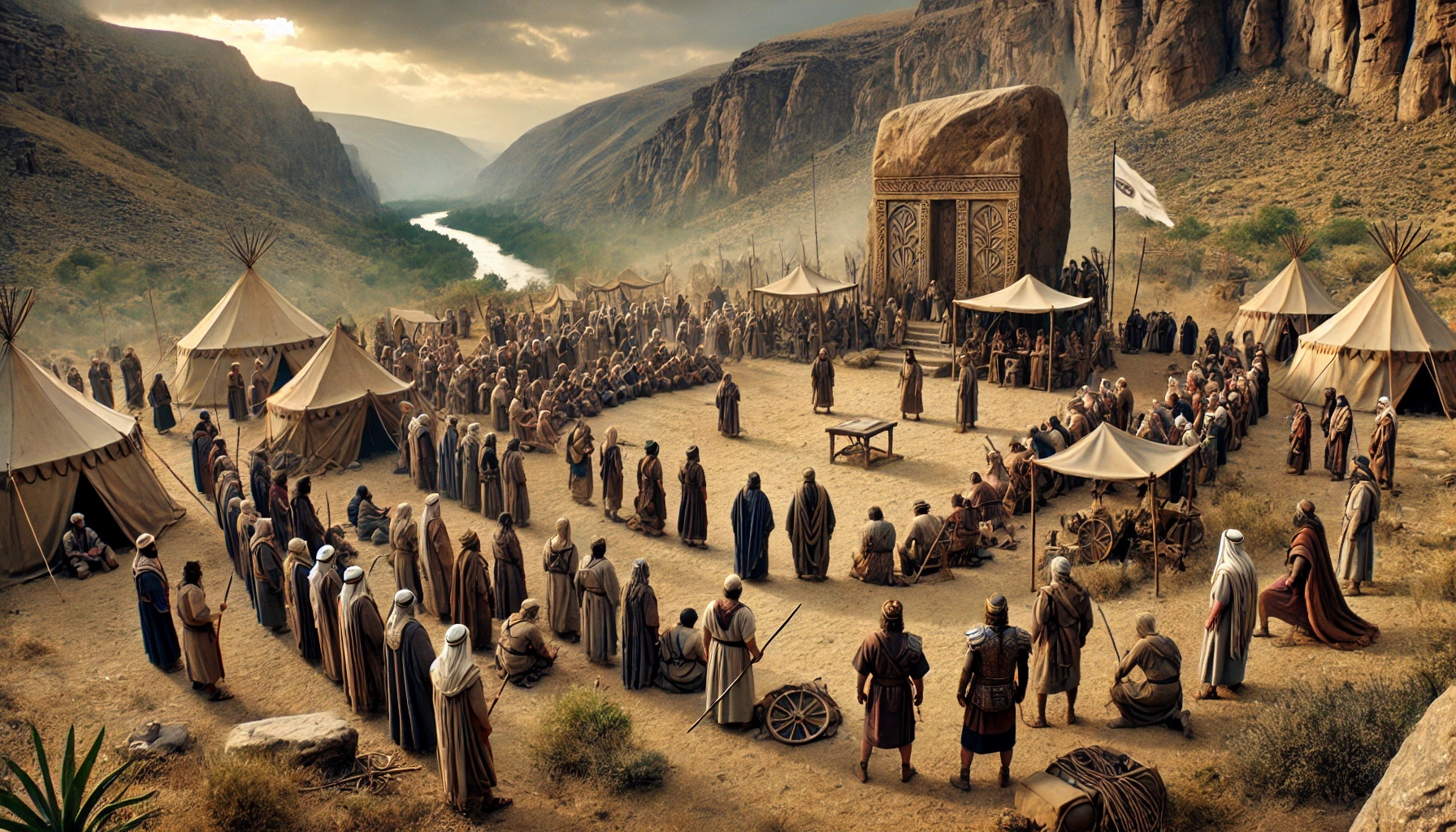
Joshua 22 describes a critical moment in Israel’s history. Hardly has the land been distributed when the nation nearly plunges into an internal war. The western tribes believe that the eastern tribes (Reuben, Gad, and the half-tribe of Manasseh) have abandoned their faith by building a large altar. In a culture where a second altar could automatically mean idolatry, the suspicion was serious.
After a delegation led by Phinehas confronts the eastern tribes, their detailed reply begins in verse 21. This response prevents bloodshed and becomes a model of how God’s people should resolve conflict.
────────────────────────
🧠 2. Analysis of the response – structure and meaning
A. The theological foundation of the response (v. 22)
The tribes do not begin defensively, but God-centered:
“The Mighty One, God, the LORD—He knows!”
They invoke three names of God in succession:
-
El – the Mighty One
-
Elohim – God above all gods
-
YHWH – the covenant God of Israel
This is intentional. It affirms their loyalty and makes clear that God Himself is witness to their motives. Before defending themselves, they place themselves under God’s authority. They seek no human justification, but appeal to the All-knowing.
B. The oath of innocence (vv. 22–23)
They appeal to God who sees the heart and essentially say:
“If we have truly rebelled, then let us bear the punishment!”
This shows:
-
They are not offended.
-
They are not defensive.
-
They submit themselves to examination.
Their conscience is clear; therefore, they can speak plainly.
C. The true purpose of the altar (vv. 24–25)
They reveal something surprising:
Their motive was not rebellion, but fear.
They feared that future generations of the western tribes might say:
“You have no share in the LORD.”
The geographical separation by the Jordan could divide future generations.
Thus, their altar was:
-
not a sacrificial altar,
-
but a witness altar,
-
a reminder of unity despite distance.
The outward action was misunderstood—but the heart behind it was pure.
D. The altar as a “witness” (vv. 26–29)
The altar is meant to testify visibly:
“We belong to the same God, the same worship, the same covenant.”
It is a symbol of unity—not of apostasy.
They conclude with a strong theological statement:
“Far be it from us to rebel against the LORD.”
They acknowledge the only legitimate altar for sacrifices—the one at Shiloh—demonstrating deep understanding of the Torah.
────────────────────────
🌄 3. Spiritual depth – what does this text reveal about God’s people?
✨ 1. Words can prevent wars
The eastern tribes could have retaliated, but instead chose gentleness.
This shows the power of Proverbs 15:1:
“A gentle answer turns away wrath.”
✨ 2. Unity is based not on location, but on the heart
Geography divides—faith unites.
This remains true for church, family, and Christian community today.
✨ 3. God examines hearts; people see actions
The western tribes saw only the altar.
God saw the motivation.
A guiding principle emerges:
What we see does not define what truly is.
✨ 4. Humility wins where pride destroys
The response of the eastern tribes models spiritual maturity:
No counteraccusation, no anger, no pride.
────────────────────────
🔥 4. Why the response worked – its structure
The response convinced and calmed because it:
-
Appealed to God’s authority → credibility
-
Showed openness and transparency → trust
-
Clearly explained motives → understanding
-
Sought peace, not being right → reconciliation
The western tribes realized:
The eastern tribes were not seeking distance, but fellowship.
────────────────────────
🧩 5. Key insights for Bible study today
-
Misunderstandings often arise from lack of information.
-
The first step is listening.
-
The response shapes the conflict more than the accusation.
-
God honors those who act spiritually in conflict.
-
The greatest divisions often arise not from sin, but from assumptions.
…………………………….. 🗺️ ……………………………..
🗣️ Answers to the questions
❓ Question 1: What can we learn from the response of the eastern tribes in Joshua 22:21–29, in light of Proverbs 15:1?
The response of the eastern tribes is a prime example of spiritual maturity under accusation. Instead of reacting with hurt, defensiveness, or aggression, they show:
1. Humility and respect
They listen fully before speaking—a rare but decisive step in conflict.
They embody Proverbs 15:1:
“A gentle answer turns away wrath.”
Their calm demeanor opens hearts.
2. Putting God at the center
They begin with the threefold name of God:
El – Elohim – YHWH.
Their identity is anchored in God, not emotion.
3. Openness instead of defensiveness
They clearly explain their motive:
The altar was not rebellion, but a witness of unity, so future generations would remember they belong to Israel.
4. Peace-oriented communication
Their goal was not self-defense, but reconciliation.
They wanted to be understood—not to win.
Thus, a looming civil war is prevented.
Their response proves:
Gentle, honest words have the power to prevent destructive conflicts.
────────────────────────
❓ Question 2: How can we deal with false accusations according to the principles of Psalm 37:3–6, 34, 37?
False accusations are emotionally painful, but Scripture offers a path that protects the soul and preserves relationships.
1. Remain calm—act in trust toward God
Psalm 37 calls us:
“Trust in the LORD and do good.”
This means:
-
Not reacting in anger.
-
Not slipping into self-defense mode.
-
Certainly not striking back.
2. Let truth come to light
“He will make your righteousness shine like the light.”
We do not need to force the truth—God reveals it in His time.
3. Do not become bitter
False accusations can breed bitterness—but bitterness destroys peace.
4. Leave timing to God
“Wait for the LORD.”
Not every situation must be resolved immediately.
Principle:
Those who allow God to be their defender can respond with gentleness.
…………………………….. 🗺️ ……………………………..
✨ Spiritual Principles
-
🕊️ Gentleness is not weakness—it is strength.
-
🤝 True unity is rooted in spiritual faithfulness, not proximity.
-
🧎 God knows our hearts—and He is our defender.
-
👂 Before judging: listen and discern.
-
💬 Peace is often only one conversation away.
…………………………….. 🗺️ ……………………………..
🛠️ Everyday Application
-
🗣️ When you are misunderstood, remain calm. Give people time—and God room to work.
-
💬 Shape your responses to de-escalate, not provoke.
-
🧎♂️ Pray for humility under pressure.
-
🤝 Recognize that conflicts often arise from misunderstanding—seek conversation before judgment.
-
🛡️ Trust God when you feel treated unfairly. He fights for you.
…………………………….. 🗺️ ……………………………..
🧩 Conclusion
The story in Joshua 22 shows that words can prevent wars. The eastern tribes could have defended themselves aggressively—but they chose gentleness and truth. This decision saved Israel from internal collapse.
We face similar situations today—in families, churches, and society. May God help us respond as they did: calmly, respectfully, and with firm trust that the Lord knows our cause.
…………………………….. 🗺️ ……………………………..
💭 Thought of the Day
🕊️ “A wise heart preserves peace—not through volume, but through love.”
…………………………….. 🗺️ ……………………………..
✍️ Illustration
“A Witness Between Us”
A conflict that almost destroyed a church—and how words became salvation
🕰 Chapter 1 – Fire on the Net
Berlin, 2023.
The church “Light of Hope” was a diverse, vibrant community. People from ten nations prayed side by side. Much was still developing, but God was clearly at work.
One day, a post appeared in the church WhatsApp group: just a picture—a newly built wooden cross, huge, standing in a garden allotment, with the words:
“Only here is the true gospel.”
Below it, the comment:
“They are dividing the church. How dare they?”
The message came from Jonathan, a long-time deacon—respected and passionate. Many saw him as the conscience of the church. The cross had apparently been built by members of the new small group “East Wind,” an offshoot meeting in a distant district.
The chat exploded.
“Sectarians!”
“How could you?”
“Just split off already!”
“This is idolatry!”
No one from the small group replied. Silence followed—for three days.
✦ ─────────────── ✦ ─────────────── ✦
🕊 Chapter 2 – The calm before the storm
Pastor David knew: if no one responded, the church would fracture. He invited both groups to a “peace evening.” No debates—just meeting. Some arrived angry, others confused. No one sat together.
When silence settled, Ruth stood up. She was one of the leaders of “East Wind,” quiet and reserved. She placed her Bible on the table and said:
“El, Elohim, the LORD—He knows.
If we have acted against the living God, may He judge us. But hear us.”
She then read from a paper:
“This cross was built so our children would know that we also belong to the body of Christ—even though we live far away and cannot be here every Sabbath.
We wanted a visible sign that we are not alone.
We did not want to replace you.
We did not want to divide.
We wanted a witness—so no one would ever say: ‘You do not belong to us.’
It was our altar of unity, not of division.”
Silence.
✦ ─────────────── ✦ ─────────────── ✦
🔥 Chapter 3 – The test
Jonathan stood up. Dark circles under his eyes revealed exhaustion mixed with anger.
“Why didn’t you tell us? Why not involve us? Why make it so public? Do you know how that looked? It felt like a slap in the face!”
His voice trembled.
Ruth replied softly:
“Because we thought it was obvious. Because we were afraid of being misunderstood. Because we did not want to fight.”
Pastor David stepped forward:
“The cross stands. Now we know what it means.
Let it remain—not as a sign of separation, but as a testimony for us all.
Let us pray there together. As one church.”
✦ ─────────────── ✦ ─────────────── ✦
🌄 Chapter 4 – A witness between us
Two weeks later, more than fifty church members stood beneath the cross. Children laughed. Elders embraced. It was a warm spring day.
Pastor David opened the Bible:
“The LORD, the Mighty One—He is witness.” (Joshua 22:22)
Then he said quietly:
“Sometimes peace is not found in argument, but in understanding.
Sometimes truth is not found in being right, but in listening.”
A new sign was placed on the cross:
“A witness between us—that the LORD is our God.”
Joshua 22:34
And so, a misunderstanding became the greatest testimony.
…………………………….. 🗺️ ……………………………..
✨ Final reflections
This true—or very possible—story could happen in any church today. In a world of quick judgments, mistrust, and digital misunderstandings, it shows:
-
A gentle answer calms anger.
-
Silence in anger can destroy—but speaking in love can save.
-
Unity is preserved not by closeness, but by spiritual loyalty to God.
If we learn to listen, discern, and speak gently, God can turn every conflict into an altar of testimony.

More Stories