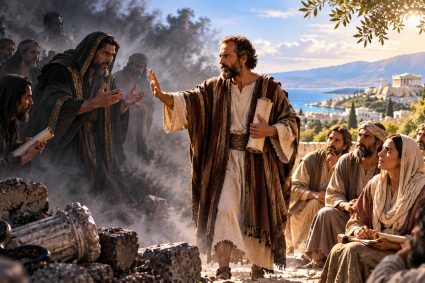


⛪ Lesson 2: The Burning Bush
📘 2.6 Summary
✨ God’s Call from the Fire – Calling, Name, and Commission
………………………………………………………………….
🟦 Introduction
Chapters Exodus 3 and 4 are among the Bible’s most central texts on calling. They show how God calls a person from obscurity into His service—not because of their abilities, but because of their heart. Moses, once a prince, then a shepherd in the wilderness, becomes an instrument of divine deliverance.
In this calling story, God reveals Himself in a unique way: as a burning bush that is not consumed, as the “Angel of the Lord,” and as the eternally present “I AM WHO I AM.” At the same time, we see the deeply human side of this divine encounter: doubt, excuses, failure—but also God’s patience, mercy, and seriousness.
This study invites us to look closely at the different stages of Moses’ encounter with God—not merely as a historical event but as a spiritual pattern that still applies to anyone today who hears God’s call. Because calling is not a myth of the past—it is God’s living invitation to become part of His story, right in the middle of our everyday life.
………………………………………………………………….
📖 Bible Study – The Calling of Moses (Exodus 3–4)
1. The Burning Bush – God’s Holy Call (Exodus 3:1–6)
-
Place of calling: The wilderness of Midian—a lonely place, far from power and attention.
-
The appearance: A bush that burns but is not consumed—a symbol of God’s presence in the ordinary and weak.
-
God’s holiness: God asks Moses to take off his shoes—an act of reverence before the Holy.
-
Turning point: The simple shepherd Moses becomes the chosen one. God meets him personally, not through power, but through signs.
Core principle: God works in weakness and meets us in the midst of everyday life.
2. The Angel of the Lord – Christ in the Wilderness (Exodus 3:2–10)
-
“The Angel of the Lord”: Theologically understood as an appearance of Christ in the Old Testament (a theophany).
-
God’s compassion: “I have seen the suffering of My people… I have come down.” – God is not distant.
-
The commission: Moses is to lead Israel out of Egypt—a mighty and humanly impossible task.
Core principle: God’s calling flows from His love for the suffering. Christ Himself sends us.
3. The Name of the Lord – “I AM WHO I AM” (Exodus 3:11–15)
-
Moses’ question: “Who are You?” – He wants to know who is sending him.
-
God’s answer: “I AM WHO I AM” (Hebrew: Ehyeh Asher Ehyeh) – an expression of God’s eternal nature, presence, and reliability.
-
Yahweh: The name reveals that God is not a concept, but a present and active reality.
Core principle: God’s nature is unchanging, eternal, and near. He is present—even now.
4. Four Excuses – Moses’ Inner Struggles (Exodus 4:1–17)
| Excuse | Bible Verse | God’s Response |
|---|---|---|
| “Who am I?” | 3:11 | “I will be with you.” |
| “What if they don’t believe me?” | 4:1 | God gives signs (staff to snake, hand to leprous hand). |
| “I am not a good speaker.” | 4:10 | “I made your mouth. I will help you speak.” |
| “Send someone else!” | 4:13 | God sends Aaron as help, but Moses remains responsible. |
Core principle: God is patient with our doubts—but He holds to His call.
5. Circumcision – Obedience in the Covenant (Exodus 4:24–26)
-
The crisis: Moses had failed to circumcise his son—a violation of God’s covenant with Abraham.
-
God’s reaction: Very serious—God intends to kill Moses.
-
Zipporah intervenes: She acts decisively and saves Moses. Her action shows how vital obedience is in serving God.
Core principle: God takes His covenant seriously. A calling without obedience is dangerous.
🔍 Summary of Bible Study Points
| Theme | Lesson for Today |
|---|---|
| The Burning Bush | God meets us in the midst of everyday life. |
| The Angel of the Lord | Christ Himself sends us out of compassion for suffering. |
| The Name of God | God is eternal, trustworthy, and present. |
| Moses’ Excuses | Our weakness is no obstacle for God. |
| The Circumcision | Calling requires obedience and holiness. |
………………………………………………………………….
✨ Spiritual Principles
These ancient verses from Exodus 3–4 contain eternal truths:
-
God calls in secret. Not through thunder and lightning, but through quiet, sacred encounters in daily life.
-
Christ Himself meets us—as the Angel of the Lord. He knows our suffering and calls us to participate in His deliverance.
-
The name of God means nearness. “I AM”—not “I was” or “I will be.” He is present, now.
-
Doubt and excuses are not obstacles. God does not respond with anger but with patience—as long as we are willing to follow.
-
Obedience matters. Whoever accepts God’s commission must not live in compromise. His holiness does not allow lukewarm faith.
………………………………………………………………….
🧩 Application for Daily Life
How often do we misinterpret our wilderness as wasted time—when perhaps it is God’s workshop? Maybe He is shaping our calling there.
How often do we feel like Elias—unworthy, overwhelmed, quiet? And yet God calls people like us—not because we’re perfect, but because we’re willing.
How often do we live in compromise—doing good, but neglecting vital things? But God wants our whole heart.
We must learn: Calling doesn’t happen at the edge of life, but right in the middle of it.
………………………………………………………………….
✅ Conclusion
Moses wasn’t a hero. He was a failed prince, a frightened man—and yet became God’s instrument.
Even today, God calls people out of obscurity: in city apartments, on construction sites, in offices, schools, and care homes.
God meets us in the burning bush of everyday life.
………………………………………………………………….
💭 Thought of the Day
“Calling doesn’t begin when we’re ready—but when we begin to trust God.”
………………………………………………………………….
✍️ Illustration – “Between Code Lines and the Burning Bush”
A modern calling in the wilderness of the 21st century
Chapter 1: The Desert of Berlin
Elias Berger was an ordinary man with a structured life—or so it seemed. He had a solid IT job, two children, a marriage wrapped in routine, and a calendar that rarely had a gap. His days were filled with meetings, code lines, daycare runs, and shopping lists.
And yet, Elias felt an inner dryness.
On weekends, he sometimes sat alone in the kitchen, staring at his phone, quietly asking himself, “Is this it? Is this my purpose—emails, software, and tired small talk?”
Chapter 2: The Burning Bush
One rainy Friday evening, his wife convinced him to go to a Bible study again. Reluctantly, Elias took a seat in the living room of an elderly church member—Mrs. Seidel. The group was small and kind. That evening’s topic: “The Calling of Moses.”
Mrs. Seidel read from Exodus 3. When she reached the part about the burning bush, she paused.
“God didn’t come to Moses with thunder or lightning,” she said gently. “He chose a burning bush—simple, but not consumed. That’s the moment when a shepherd becomes a prophet.”
Elias felt a knot in his stomach. His thoughts wandered. What if God still calls that way today—in moments everyone else overlooks?
“Moses takes off his shoes because the ground is holy,” she continued. “Sometimes you have to see the ground beneath your feet differently—not as routine, but as the place of calling.”
Elias swallowed hard. Was his wilderness the very place God wanted to meet him?
Chapter 3: The Voice Behind the Screen
In the following days, Elias couldn’t stop thinking about Moses. As he sat at his office desk, he felt like Moses in Midian—far from calling, but inwardly being prepared.
Then a strange email appeared. Sender: “Pray for our company.” Content: “Open meeting in the cafeteria this Friday. If you want to pray for your coworkers—come.” No signature. No name. Just a verse: “I have seen the misery of My people…”
Elias read the line five times. And something flickered in him. Like a spark.
Chapter 4: The Name of the One Who Calls
On Friday, Elias stood in front of the cafeteria door, hand on the handle, hesitating. “What if they look at me weird? What if I’m the only one?”
He remembered Exodus 3:13—“What should I say? Who sent me?”
And God answered: “I AM WHO I AM.”
Not “I was.” Not “I will be.”
But “I AM.” Now.
Elias took a deep breath—and opened the door.
Inside sat five people. One of them smiled, “You’re Elias, right? Come on in. We’re just praying for coworkers dealing with burnout.”
He sat down. And suddenly, he didn’t feel like an IT specialist anymore. He felt like a messenger.
Chapter 5: Four Excuses
After that meeting, God began to speak more clearly to Elias—not with a voice, but with thoughts that would not leave him.
“Start a weekly devotional for your team.”
Elias pushed back:
-
“Who am I?”
I’m not a pastor. Just a tech guy. -
“What if they reject me?”
My boss hates religious stuff. I’ll lose my position. -
“I don’t speak well.”
I stutter when I’m nervous. What if I embarrass myself? -
“Send someone else.”
There are more spiritual people than me. Why me?
But each time, a response came—in sermons, songs, conversations with his wife. Just like with Moses:
“I will be with you.”
“I made your mouth.”
“I’m sending you support.”
His quiet coworker David came up to him one day:
“If you really do that prayer meeting… I’d join. I’ve been praying alone for years.”
God had prepared an Aaron.
Chapter 6: The Moment of Decision – The Circumcision
Then came the moment of confrontation.
Elias was scheduled to present a key project—an opportunity for a big promotion. But the meeting was at the exact same time as his planned prayer launch. No rescheduling possible.
His manager said coldly,
“Either you present, or someone else will. This team needs leadership—not prayer groups.”
Elias stood on the edge of an inner cliff.
What was more important—obedience or career?
He remembered Exodus 4, when God nearly killed Moses for neglecting the circumcision. The lesson was severe: God takes obedience seriously.
That night Elias prayed silently:
“Lord, I’m afraid. But I want to belong fully to You. I’ll step back.”
He let his colleague take the spotlight—and led the first prayer meeting with a trembling voice but a burning heart.
Chapter 7: The Bush Still Burns
Two years later, much had changed.
The company now had an official prayer network with over 40 employees. People prayed for each other, shared healing, reconciliation, and hope. Elias led it—not for money, but with fire.
He often says now:
“I thought my life was a side note. But God was preparing me. The wilderness was His workshop.”