





🌍 WHEN THE WORLD APPROACHES ITS END
🕯️ Hope, Watchfulness, and Faithfulness in Matthew 24–25
🏛️ Part I – When Certainties Collapse
⚠️ Sermon 3: Take Heed That No One Deceives You
🔍 Why Jesus’ First Warning Concerns Not War, but Deception
📜 Main Text
“And Jesus answered and said to them: Take heed that no one deceives you. For many will come in My name, saying, ‘I am the Christ,’ and will deceive many.”
Matthew 24:4–5
🔦 Guiding Verse
“To the law and to the testimony! If they do not speak according to this word, it is because there is no light in them.”
Isaiah 8:20
🧭 Sermon Thought
When the disciples ask Jesus about the signs of His return, He does not begin His answer with wars, earthquakes, or political upheavals, but with a warning against spiritual deception. In doing so, Christ shows that the greatest danger to His church is not that it knows too little about world events, but that it may accept a religious-sounding message as truth even though that message leads it away from Him and His Word. The person who is preserved is not the one who has studied every deception in detail, but the one who knows Christ, is rooted in Holy Scripture, and has learned to test every voice by the revealed Word of God.
🌅 Welcome and Introduction
Dear congregation,
in the previous sermon we heard the disciples ask: “Tell us, when will these things be? And what will be the sign of Your coming and of the end of the age?” We might expect Jesus immediately to speak about wars, earthquakes, famines, or other visible upheavals. But His first answer is different: “Take heed that no one deceives you.” Before He speaks about military conflicts, He warns against spiritual deception. Before He describes outward crises, He directs the attention of His disciples to a danger that can arise in the very midst of religious life.
This order is not accidental. We usually recognize a war as a war, an earthquake as an earthquake, and a famine as a famine. Deception is more dangerous because it becomes effective precisely by not looking like deception. If a false teaching openly declared from the beginning that it intended to contradict God’s Word and lead people away from Christ, it would have little success. Spiritual deception therefore often works with familiar words, known truths, and religious longings. It may speak about Jesus, use Bible verses, and promise closeness to God while at the same time shifting the foundation at a decisive point.
Jesus also does not say that only a few people will be in danger. He announces that “many” will come and “many” will be deceived. His words therefore call neither for panicked suspicion nor for spiritual self-confidence. Christ desires a church that remains open to the genuine work of God and at the same time is able to discern. He desires people who do not reject every new religious claim out of fear, but who also do not accept every impressive message without examination. This spiritual discernment is one of the fundamental preparations for His return.
📜 Narrative Illustration: The Voice in the Darkness
The following story is a narrative illustration.
A young shepherd had tended a large flock of sheep together with his father for many years. From childhood he had learned how differently individual animals reacted, which paths between the hills were safe, and where water could still be found after long dry weeks. Yet something else impressed him especially: the sheep knew his father’s voice. When several flocks gathered at the same watering place, there was at first what seemed like an unmanageable confusion. But as soon as his father gave the familiar call, the sheep belonging to his flock began to separate themselves from the others and follow him.
One evening the young man was returning alone with the flock. Dusk had fallen more quickly than expected, and thick fog moved through the valley. At one point the path passed between two rock walls, and there he suddenly heard a call from some distance away. The words sounded similar to the call his father usually used. Some of the sheep lifted their heads, became restless, and began moving in the direction of the voice.
The young shepherd stopped and listened more carefully. The voice used the right words, but something was wrong. The rhythm was different, the emphasis unfamiliar, and the call came from a direction in which his father would never have led the flock. Behind the rocks there was no path toward the sheepfold, but a steep drop.
He called the animals back with the familiar call and slowly continued on his way. Later it became clear that two men had tried to lure individual sheep away from the flock. They had heard the shepherd’s call several times and learned to imitate his words. What they could not imitate was the familiar relationship between the shepherd and his sheep.
That evening the young man told his father what had happened. The old shepherd explained to him that the safety of the sheep did not lie in knowing every possible false voice. What mattered was that they had become so familiar with the voice of their true shepherd that an imitation could not permanently lead them away.
Jesus Himself uses precisely this picture when speaking about His relationship with His followers:
“The sheep follow him, for they know his voice. Yet they will by no means follow a stranger, but will flee from him, for they do not know the voice of strangers.”
John 10:4–5
The safest preparation against deception therefore does not consist in knowing every possible false teaching, every false movement, and every future fraud in complete detail. Our deepest security arises when we know the voice of Christ through His Word so well that we notice when another voice uses similar words but wants to lead us in a different direction.
1. ⚠️ Jesus’ First Warning Concerns Spiritual Discernment
The order in Matthew 24 deserves special attention. The disciples ask about the sign of the Second Coming, but Jesus does not begin with a visible sign in the heavens or a political event. His first appeal is directed immediately to their spiritual perception: “Take heed that no one deceives you.” In this way He makes clear that it is not enough merely to observe the right events. The observer himself must be spiritually prepared, otherwise he may interpret what he sees incorrectly.
Especially those who study prophetic subjects intensely can be tempted to believe that extensive knowledge automatically protects against deception. Yet the Pharisees in the time of Jesus knew many messianic texts and were waiting for God’s intervention. Nevertheless, many of them failed to recognize the Messiah when He stood before them. Their problem was not that they had no knowledge of Scripture at all, but that expectations, traditions, and spiritual pride influenced the way they perceived the Word.
Jesus therefore also warns us against the idea that belonging to the right church or knowing certain prophetic teachings automatically makes a person invulnerable. Truth can indeed be recognized and believed, but it must also shape our thinking, our character, and our relationship with Christ. A person can possess many correct answers and still become vulnerable when his confidence increasingly rests on his own knowledge rather than on Jesus.
Therefore Paul writes:
“Therefore let him who thinks he stands take heed lest he fall.”
1 Corinthians 10:12
This warning is not intended to produce insecure faith. Rather, it protects against that self-confidence which stops examining because it assumes it is already immune to every deception.
2. 🎭 The Most Dangerous Deception Often Bears a Religious Name
Jesus says explicitly:
“For many will come in My name.”
Matthew 24:5
With this He leads us to the true character of spiritual deception. Deception does not necessarily come through open rejection of Christ. It may use the very name of Christ. A person may speak about Jesus, use Christian terminology, and even claim to act under a special commission from God without therefore automatically proclaiming the Christ of the Bible.
Paul knew this danger and wrote to the church in Corinth:
“For if he who comes preaches another Jesus whom we have not preached, or if you receive a different spirit which you have not received, or a different gospel which you have not accepted—you may well put up with it!”
2 Corinthians 11:4
These words show that the name “Jesus” alone is not yet proof of truth. A Jesus may be preached who bears little resemblance to the biblical Christ. Jesus may be presented exclusively as a moral teacher while His substitutionary sacrifice is pushed aside. People may speak of His love while remaining silent about His call to repentance. His grace may be preached in such a way that obedience appears to be no longer important. Likewise, Christ may be turned into an instrument of human power interests while His humble, self-giving character is denied.
The true Jesus therefore cannot be reshaped according to our preferences. In Holy Scripture we encounter Him as the eternal Son of God who became human, overcame sin, died for us, rose again, ministers for us as High Priest, and will return visibly. Spiritual discernment begins when we do not allow our own ideas to determine who Jesus should be, but are willing to receive Him as God’s Word reveals Him.
3. 🐍 Deception Begins with Distrust of God’s Word
The first great deception in the Bible already reveals the basic pattern. In the Garden of Eden, the serpent did not begin with an open attack on the existence of God. It began with a question:
“Has God indeed said?”
Genesis 3:1
A little later came the direct contradiction of God’s warning:
“You will not surely die.”
Genesis 3:4
The temptation was therefore directed against trust in God’s Word and His character. Eve was led to believe that God was withholding something good from her and that a path outside His command would lead to greater freedom. Once this distrust had been accepted, disobedience no longer appeared as rebellion, but as a reasonable step toward supposedly higher knowledge.
This basic pattern has not changed. Spiritual deception often seeks to reshape God’s clear statements in such a way that human beings end up trusting their own perceptions more than the revealed Word. The first question is no longer, “What has God said?” but rather, “What feels right to me?”, “What does the majority accept?” or “Which message fits my expectations?”
This makes clear why Jesus places the warning against deception at the beginning of His discourse on the end times. The final crisis will not merely be a conflict over outward events. At its core, it will once again concern trust. The decisive question is whether God’s Word remains binding even when other voices appear convincing, religious, and socially powerful.
4. 🧪 Effective Deception Often Contains a Measure of Truth
A completely absurd claim is comparatively easy to reject. Far more dangerous is a message that combines what is familiar and true with one decisive distortion. This is precisely why false teachings can remain convincing for a long time. They take part of the truth, remove it from its larger context, and then connect it with conclusions that Scripture itself does not support.
Already in the temptation of Jesus in the wilderness, we see that Satan can even quote Holy Scripture. In the second temptation he cites words from Psalm 91 and attempts thereby to lead Jesus to act in a way that does not correspond to the Father’s will. Jesus responds not by rejecting the authority of Scripture, but by answering Scripture with Scripture and placing the misused text back into the larger context of God’s Word.
This event is of great importance for us. A Bible verse by itself does not automatically make a claim biblical. Texts can be taken out of context, emphasized one-sidedly, or connected with other statements in ways that alter their original meaning. Therefore, a church needs not merely people who know individual verses, but people who learn to understand the overall testimony of Scripture.
Paul urges Timothy:
“Be diligent to present yourself approved to God, a worker who does not need to be ashamed, rightly dividing the word of truth.”
2 Timothy 2:15
Spiritual discernment therefore does not grow through a collection of isolated proof texts. It grows through careful, connected Bible study that reads texts in their context and understands difficult statements in the light of clear biblical teaching.
5. 📖 The Word of God Remains the Binding Standard
The prophet Isaiah lived at a time when people sought guidance from spiritualistic and occult sources. His answer was unequivocal:
“To the law and to the testimony! If they do not speak according to this word, it is because there is no light in them.”
Isaiah 8:20
Here we find a basic principle that applies throughout the Bible. A message does not become true because it is new, fascinating, or supernatural. Nor does it become true because a famous personality proclaims it or a large number of people follow it. The decisive standard remains its agreement with the revealed Word of God.
The Christians in Berea show what this process of testing looks like in practice. When Paul came to them, they received his preaching neither with blind agreement nor with fundamental suspicion:
“They received the word with all readiness, and searched the Scriptures daily to find out whether these things were so.”
Acts 17:11
This combination is crucial. They were willing to listen, but equally willing to examine. Spiritual openness and biblical testing are therefore not opposites. A healthy church needs both: the willingness to be corrected and led by God, and the determination never to place a human message above Scripture.
Ellen White especially emphasizes the importance of thorough Bible study in connection with the final great deception. She writes that those will be protected who have “diligently studied the Bible and received the love of the truth.” In this way she links knowledge with inner attitude: it is not enough merely to possess information about truth; a person must love the truth and be willing to follow it.
6. ❤️ Love for the Truth Is More Than Knowing Correct Doctrines
Paul describes those who are deceived with a remarkable expression. He says that they “did not receive the love of the truth, that they might be saved”:
“And with all unrighteous deception among those who perish, because they did not receive the love of the truth, that they might be saved.”
2 Thessalonians 2:10
The Bible therefore distinguishes between merely knowing a truth and loving it. A person may know what Scripture teaches and yet inwardly resist that truth because it conflicts with personal desires, interests, or habits. In such a condition, an alternative message becomes especially attractive when it allows a person to believe what he already wants to believe.
Love for the truth, by contrast, is revealed in the willingness to accept God’s Word even when it corrects us. It does not merely say, “I love the truths that confirm what I already believe,” but is willing to pray, “Lord, if I am wrong, show me.” This attitude requires humility, because we acknowledge that our traditions, our experiences, and even long-held convictions must be tested by Scripture.
Precisely here lies an important protection against deception. Whoever has already inwardly granted God the right to correct him through His Word is less dependent on messages that simply confirm what he wants to hear.
7. 🐑 The Safest Protection Is to Know the Shepherd’s Voice
In John 10, Jesus describes the relationship between Himself and His followers with the image of a shepherd:
“My sheep hear My voice, and I know them, and they follow Me.”
John 10:27
This statement brings us back to our introductory illustration. Sheep are not kept safe because they analyze every possible strange voice. Their safety lies above all in their familiarity with the voice of their own shepherd. Applied to our life of faith, this means that studying false teachings must never replace studying Christ.
There are people who devote a large portion of their spiritual attention to false movements, false teachings, conspiracies, and dangers. They want to be prepared, yet paradoxically their entire thought world can gradually become dominated by error. Jesus shows us a better way. The more deeply we come to know His character, the more thoroughly we absorb His words, and the more closely we live with Him, the more clearly we recognize messages that contradict His nature.
Therefore the best preparation for a false Christ is a deep knowledge of the true Christ. We learn His voice in the Gospels; we see His holiness and mercy, His dealings with sinners and the self-righteous, His love for God’s law, His sacrifice on the cross, and His complete surrender to the Father’s will. Whoever carries this picture deeply in the heart becomes more sensitive to religious messages that use His name while distorting His character.
8. 🕊️ The Holy Spirit Never Leads in Contradiction to Scripture
Sometimes spiritual experience is placed in opposition to biblical teaching. People declare that they have experienced something so intensely or felt something so strongly inwardly that biblical examination is no longer necessary. But the Holy Spirit who works in our hearts is the same Spirit who inspired Holy Scripture. He will not contradict Himself.
Jesus says of the Holy Spirit:
“However, when He, the Spirit of truth, has come, He will guide you into all truth.”
John 16:13
And immediately afterward He explains:
“He will glorify Me, for He will take of what is Mine and declare it to you.”
John 16:14
The genuine work of the Holy Spirit therefore leads to Christ, deepens love for truth, convicts of sin, and changes character. It does not make people independent of Scripture or elevate personal impressions above God’s Word.
Paul brings openness and examination together in a short passage:
“Do not quench the Spirit. Do not despise prophecies. Test all things; hold fast what is good.”
1 Thessalonians 5:19–21
We are therefore to be neither spiritually closed nor gullible. The biblical attitude is to expect God’s work with gratitude while carefully testing everything.
9. 🪞 Spiritual Pride Makes a Person Especially Vulnerable to Deception
One of the most dangerous thoughts is: “No one can deceive me.” Precisely the person who thinks this way may stop examining himself. Peter was convinced that he would never abandon Jesus. He even declared that he was ready to die with Him. Only a few hours later, he denied his Lord three times.
His fall shows that sincerity and self-confidence are not the same as spiritual steadfastness. Peter was sincere, but he overestimated his own strength. Only after his collapse did he learn more deeply that his security did not lie in his determination, but in the grace of Christ.
The same applies to spiritual discernment. We are not preserved because we are more intelligent than other people. Nor are we automatically protected by our denominational affiliation. Our protection lies in remaining humbly with Christ, taking His Word seriously, and being willing to examine our own convictions again and again in its light.
Humility does not mean uncertainty about clear truth. A person can be firmly convinced and humble at the same time. He knows why he believes what he believes, but he does not equate his own person with the truth. Precisely this attitude makes correction possible and protects against clothing personal opinions with divine authority.
10. 🏠 The Church Also Needs a Culture of Examination
Spiritual discernment is not merely the task of individual Christians. It belongs to the life of the whole church. Paul writes concerning prophetic messages:
“Let two or three prophets speak, and let the others judge.”
1 Corinthians 14:29
The New Testament therefore assumes that even messages that sound spiritual may be tested. No preacher, teacher, or church leader stands above Holy Scripture. Spiritual authority is always derived authority and remains bound to Christ and His Word.
A healthy church therefore does not fear honest questions. It does not demand blind obedience to human beings and does not treat careful biblical examination as rebellion. At the same time, examination must not become an excuse for constant criticism and suspicion. The goal is not to make every statement seem questionable, but to become more deeply rooted together in the truth.
This is especially important in a time when religious messages can reach thousands of people within a very short time through videos, social media, podcasts, and digital platforms. Professional presentation, emotional impact, and large reach say nothing in themselves about whether a teaching is biblically correct. The old standard remains the same even in a digital world: What does Scripture say, and does this message truly lead to the Christ revealed in Scripture?
11. 🌱 Spiritual Discernment Is Practiced in Everyday Life
We should not expect suddenly to possess great spiritual clarity in some future deception if we barely develop it today. Character and spiritual perception develop gradually. Whoever today regularly reads God’s Word, studies its connections, prays, and responds to recognized truth is learning to understand God’s guidance more clearly.
Jesus says:
“If anyone wills to do His will, he shall know concerning the doctrine, whether it is from God.”
John 7:17
This verse connects understanding with willingness to obey. A person who is genuinely willing to do God’s will begins from a different position than someone who is merely searching for a justification for his own desire. Obedience does not replace Bible study, but it creates an inner openness to truth.
Therefore preparation against spiritual deception begins in very ordinary decisions. When God’s Word calls us to forgive, to be honest, to order our priorities, to keep the Sabbath holy, or to abandon a recognized sin, our obedience teaches us to take the Shepherd’s voice seriously. Whoever continually ignores that voice in small matters will not automatically hear it more clearly in a greater crisis.
12. ❤️ Truth Must Be Communicated in the Character of Christ
In the struggle against error, even a correct theological position can be presented in the wrong way. People may defend truth and yet become harsh, arrogant, or unloving. Paul therefore explicitly connects spiritual maturity with the call to speak “the truth in love”:
“But, speaking the truth in love, may grow up in all things into Him who is the head—Christ.”
Ephesians 4:15
This connection must not be broken. Love that declares truth unimportant ultimately does not help a person. Yet truth communicated without love misrepresents the character of the Christ whose truth we seek to defend.
People who follow false teaching are not automatically our enemies. Some were shaped by ideas before they were able to examine them for themselves. Others are searching for comfort, healing, assurance, or hope and encounter a message that appeals to their longing. Our task is therefore not to mock them or push them farther away through arrogance.
Paul writes to Timothy:
“And a servant of the Lord must not quarrel but be gentle to all, able to teach, patient, in humility correcting those who are in opposition.”
2 Timothy 2:24–25
The truth of Christ does not need human harshness in order to be strong. It can be spoken clearly while still being communicated in the spirit of the One who wept over Jerusalem.
🌄 Conclusion: The First Warning Remains Relevant
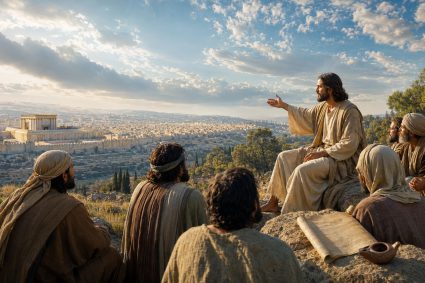
On the Mount of Olives, the disciples asked Jesus a question about the future. They wanted to know when the temple would be destroyed, what sign would precede His return, and when the end would come. Jesus could have begun His answer with a spectacular event. Instead, He said: “Take heed that no one deceives you.”
With this, He directs our attention to a truth that is easily overlooked. The future will not be decided only on battlefields, in political institutions, or through natural disasters. It reaches into the human heart and the question of which voice we trust. Before the visible upheavals are described, Christ calls His disciples to learn spiritual discernment.
The narrative illustration of the shepherd helps us understand this task correctly. The flock was not preserved because every sheep understood the intentions of the strange men. It was preserved because the animals were familiar with the voice of their shepherd. Likewise, we do not need to analyze every future deception completely in advance. Christ instead calls us to know His voice so well today that we will not confuse a message leading us away from His Word with His guidance.
Therefore our preparation does not consist in fear of deception. It consists in becoming ever more deeply rooted in Christ, in loving truth, in thorough Bible study, in prayer, and in daily obedience. When our thinking is shaped by the Word of God and our hearts are bound to Jesus, we possess a firm standard even when other voices become loud and convincing.
📣 Appeal
Dear congregation,
the words of Jesus first call us to personal examination. On what is what we believe founded? Do we believe something mainly because we have heard it since childhood, because a respected person teaches it, or because we ourselves have carefully examined whether it agrees with the whole testimony of Holy Scripture? Gratitude for our spiritual heritage is good, but above our heritage must always stand the authority of the Word of God.
A second question concerns our relationship with Christ. Do we merely know teachings about Jesus, or are we learning to know His voice personally? Bible study must not stop with information. Through Scripture we encounter the Lord, learn His character, and are changed by the Holy Spirit. The deeper this relationship becomes, the less dependent we are on spectacular voices, religious trends, and human authorities.
Finally, we should ask ourselves whether we love the truth even when it corrects us. It is easy to love Bible passages that comfort and affirm us. Spiritual maturity is also shown when we allow God’s Word to question our ideas, habits, and decisions.
If today you wish to say, “Lord Jesus, I want to know Your voice better and root my thinking firmly in Your Word,” then bring that desire to Him. Do not ask Him merely to preserve you from future deception, but ask Him today to create in you that love for truth which is willing to listen, examine, and obey.
🙏 Closing Prayer
Lord Jesus Christ,
we thank You that You do not allow Your church to enter the future unprepared. Even before You spoke to Your disciples about wars, earthquakes, and other upheavals, You warned them about spiritual deception. You know our hearts and know how easily people can be impressed by voices that sound religious and yet lead away from Your truth.
Forgive us when we have sometimes been too self-confident and believed that we could never be deceived. Preserve us both from gullibility and from a suspicious spirit that can no longer recognize Your genuine work. Give us that sober spiritual attitude which remains open to Your guidance while carefully testing every message by Your Word.
Give us a deep hunger for Holy Scripture. Help us not merely to know individual verses, but to understand the great context of Your revelation. Let us see Your character, Your gospel, Your commandments, and Your plan of salvation ever more clearly. When human voices contradict Your truth, give us courage to remain faithful to Your Word even when the majority chooses another path.
Give us especially a love for the truth. Preserve us from the desire to hear only what confirms our own ideas. Give us a humble heart that is willing to be corrected by Your Word and an obedient spirit that does not postpone recognized truth.
Holy Spirit, guide us into truth and glorify Christ in our lives. Help us not to confuse Your voice with our own desires. Let every spiritual experience, every sermon, and every new message be tested in the light of Scripture, and give us wisdom to hold fast to what is good.
We also pray for our churches. Make them places where Your Word possesses the highest authority, where honest questions may be asked, and where people seek truth together. Preserve preachers, teachers, and church leaders from pride and from the attempt to place human authority over the consciences of others. Give them humility, clarity, and the love of Christ.
Teach us at the same time to meet those who have been mistaken with patience and gentleness. Preserve us from using truth as a weapon. Let our words be clear, but our hearts merciful, so that even the way in which we communicate truth reflects Your character.
Lord Jesus, we want to know Your voice as sheep know the voice of their shepherd. Let us live daily near You so that no strange voice can permanently draw us away from You. When deceptions increase, root us more deeply in Your Word. When religious confusion grows, fix our eyes more firmly on You. When we feel too secure in ourselves, remind us that our strength lies in Your grace alone.
Prepare us for everything that will come before Your return. Let us not be ruled by fear, but by trust; not by sensationalism, but by truth; not by spiritual pride, but by the humble assurance that You Yourself are able to lead and preserve Your children.
In Your holy name we pray.
Amen.
