

🌾 Sabbath School Compact
Understand, deepen, and live the weekly lesson.
✉️ THE CORINTHIAN LETTERS
⚔️ Lesson 12. Dealing With False Teachers
Faithfulness to the Gospel with Gentleness and Spiritual Clarity
📅 Study Week: September 12–18, 2026
🕊️ Sabbath: September 19, 2026
🏛️ 3rd Quarter 2026: 1 and 2 Corinthians
The twelfth lesson takes us into the final major confrontations of the second letter to the Corinthians. Paul must deal not only with personal attacks but also with teachers who have gained influence in the church and threaten to lead the Corinthians away from their undivided faithfulness to Christ. For this reason, he speaks with unusual directness about spiritual warfare, false boasting, a distorted gospel, the distinguishing marks of true and false servants, and the necessity of personal self-examination. Yet his firmness does not stand in opposition to the gentleness of Christ. This is precisely the central emphasis of the lesson: truth must be defended, but with God’s weapons; error must be recognized without allowing human pride to dominate the conflict; and even the strongest correction should ultimately serve the purpose of restoration. The official weekly lesson focuses on 2 Corinthians 10–13 and consistently connects spiritual clarity with faithfulness to Christ.
💎 Memory Text
“For the weapons of our warfare are not carnal, but mighty through God to the pulling down of strong holds.”
2 Corinthians 10:4
Paul deliberately uses the language of warfare, yet he leaves no doubt that this battle must not be fought with the ordinary methods of human conflict. The church does not defend truth through manipulation, intimidation, personal attacks, or power politics. Its weapons come from God and are directed against thoughts, arguments, and spiritual deceptions that lead people away from Christ. Spiritual warfare therefore consists primarily in examining false ideas in the light of God’s Word and bringing the mind back under the authority of Christ.
This is exactly what makes the memory text an important warning. It is possible to fight for a right cause with wrong methods. Paul therefore explicitly connects his firmness with the “meekness and gentleness of Christ.” Truth requires courage, but Christian courage must never lose the character of Christ.
🧭 What Is It About?
Teachers had appeared in Corinth who belittled Paul, questioned his authority, and presented themselves as especially significant spiritual leaders. Apparently, they impressed others through their manner, self-recommendation, and rhetorical strength. Paul does not respond so firmly because his personal reputation has been wounded. His real concern is the church. He fears that the Corinthians may be led away from simple and exclusive devotion to Christ and may eventually accept another Jesus, another spirit, and another gospel.
This makes it clear why false teaching is never merely an academic question. Ideas about God, Christ, salvation, and the Christian life ultimately shape people’s faith and behavior. Paul therefore defends the gospel because he loves the people who are to be saved through it.
At the same time, the lesson shows that not everyone who uses religious language or mentions the name of Jesus is automatically a reliable teacher. The decisive question is not how impressive a teacher appears, but whether the message agrees with the apostolic gospel and leads people into greater faithfulness to Christ. Spiritual discernment is therefore one of the necessary characteristics of a mature church.
📖 The Lesson at a Glance
⚔️ 12.1 Spiritual Warfare
Fighting with the Gentleness of Christ and the Power of Truth
Paul begins 2 Corinthians 10 with a combination that may at first seem contradictory. On the one hand, he appeals to the meekness and gentleness of Christ; on the other hand, he speaks of warfare, weapons, strongholds, and tearing down false arguments. Yet this very combination reveals the character of Christian conflict. Gentleness does not mean weakness, and spiritual firmness does not mean harshness.
Paul was apparently portrayed by his opponents as bold in his letters from a distance but weak in personal encounters. His answer is not that he must now prove how severe he can be. Instead, he shows that Christian authority has a different character. It is intended to build up rather than destroy. Nevertheless, it must act decisively wherever people are being led away from Christ by false ideas.
The “strongholds” against which Paul fights are therefore not people, but systems of thought, arguments, and forms of arrogance that exalt themselves against the knowledge of God. People are to be won while error is rejected. This is a crucial distinction. Whoever declares a person to be the enemy can easily become hurtful and merciless; whoever recognizes that the real battle concerns thoughts, truth, and loyalty to Christ can firmly disagree while still loving the person.
This principle is especially important for today’s conflicts. Theological debates can quickly become personal, particularly when social media, public discussions, and strong polarization are involved. Paul reminds us that God’s truth does not need human aggressiveness. It requires clarity, biblical reasoning, prayer, and the character of Jesus.
👑 12.2 Boasting in the Lord
True Proclamation Seeks Not Self-Praise but the Honor of Christ
The false teachers in Corinth compared themselves with one another and recommended themselves. Paul calls such behavior unwise. Anyone who constantly measures spiritual significance by comparison with others has already chosen the wrong standard. Spiritual ministry is not a competition for influence, reach, recognition, or admiration.
Paul therefore quotes the principle: whoever boasts should boast in the Lord. Behind this statement stands Jeremiah 9, where God declares that a person should not boast in wisdom, strength, or riches, but in knowing God and understanding His character of love, justice, and righteousness. For Paul this means that if anything good happens through his ministry, the glory belongs to Christ.
This attitude protects Christian ministry from a dangerous mechanism. Even spiritual work can become a stage for one’s own ego. Preachers can be compared with one another, churches evaluated by size, and spiritual projects turned into personal proofs of success. Paul does not deny that fruit may become visible. He does, however, reject the idea that human greatness is the measure of God’s approval.
Authentic ministry therefore does not first ask, “How do I compare with others?” but rather, “Has Christ become greater through my ministry?” Where this question is taken seriously, relationships with fellow workers also change. Competition can give way to cooperation because the success of another person no longer needs to be perceived as a threat. If Christ receives the glory, the servant can rejoice that the gospel is advancing, regardless of whom God uses.
🎭 12.3 Identifying False Teachers
True Faithfulness to Christ Recognizes and Tests Every False Message
In 2 Corinthians 11 Paul becomes particularly direct. He compares the church to a bride who belongs to Christ and expresses concern that their minds might be deceived just as Eve was deceived by the serpent. The danger lies in the fact that deception can appear religious. The false teachers do not openly present themselves as enemies of Christ but as His servants. Paul therefore warns against equating outward piety or impressive appearance with divine authorization.
His most important test is the message itself. He speaks of “another Jesus,” “another spirit,” and “another gospel.” This makes clear that the name Jesus alone is no guarantee of truth. What matters is which Jesus is being proclaimed, how salvation is understood, and whether the message agrees with the apostolic testimony of Scripture.
This warning remains relevant. False teaching does not always consist of a complete denial of Christianity. More often, it arises through shifts in emphasis. Individual truths are exaggerated while others are pushed aside; human speculation is given the same authority as Scripture; personal experiences become the final standard; or biblical texts are interpreted in such a way that they merely confirm an already established opinion.
The church therefore does not need suspicion toward every new idea, but it does need spiritual testing. A mature church does not accept a message uncritically simply because it is emotionally persuasive, rhetorically impressive, or delivered by a well-known personality. It asks about Scripture, about Christ, and about the fruits.
Paul even goes so far as to say that Satan disguises himself as an angel of light. In this way he emphasizes that deception is dangerous precisely because it does not always look like deception. Spiritual vigilance therefore means knowing the truth well. The more deeply a person is familiar with the gospel, the easier it becomes to recognize when its center has been shifted.
⛓️ 12.4 Suffering for the Sake of the Gospel
Faithful Ministry Is Revealed in Suffering, Humility, and Dependence on God’s Power
After the false teachers had apparently boasted about their qualifications and importance, Paul also begins, in an unusual way, to “boast.” Yet he does so explicitly with reluctance and almost ironically. If human achievements are to become the standard, he could present an impressive list. His Jewish heritage is no less significant than that of his opponents, and his ministry for Christ has led him through extraordinary hardships.
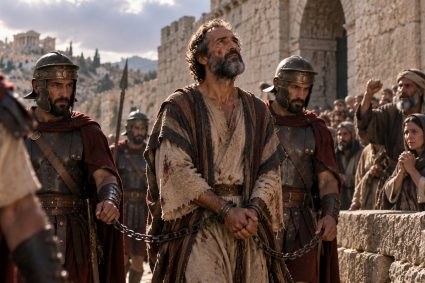
Paul mentions imprisonments, beatings, stoning, shipwrecks, dangerous journeys, hunger, thirst, sleeplessness, cold, and constant dangers. Added to these is his daily concern for the churches. This list is not an attempt to glorify suffering. Paul wants to show how fundamentally different his understanding of ministry is from that of his opponents. While they define themselves through strength and prestige, Paul bears the marks of a life spent for the gospel.
Yet even here he does not remain focused on his achievements. In 2 Corinthians 12 he brings the thought to its real climax: God’s power becomes visible precisely in human weakness. Paul does not need to prove that he is invulnerable. His dependence on God’s grace itself becomes a mark of his ministry.
In this way Paul also corrects a misunderstanding that is widespread today. Success, health, influence, and a trouble-free life are not automatically evidence of special spiritual authority. Likewise, suffering is not automatically a sign of insufficient faith. Paul’s life instead shows that faithfulness to Christ sometimes leads directly through hardship.
The difference lies in what these hardships do to us. Paul does not allow them to separate him from Christ. They lead him more deeply into dependence on God’s power and prevent him from making himself the center of his ministry.
🪞 12.5 Appeal to the Unrepentant
Love Calls to Repentance So That Christ May Renew the Church
At the end of the second letter to the Corinthians, Paul turns his attention once again to the church. He is preparing for his third visit and fears that he may still find quarrels, jealousy, anger, selfishness, slander, pride, disorder, and people who have not repented of impurity and sexual sin. His concern shows that false teaching and false behavior cannot be separated from one another. Wrong thinking can encourage wrong living, while a heart unwilling to confront certain sins can become especially receptive to teachings that minimize those sins.
Paul therefore announces church discipline if necessary, yet here too his real goal remains restoration. He explicitly writes that he is praying for their renewal. Christian correction does not find its purpose in punishing people or demonstrating authority. It is meant to help them recognize sin, repent, and live anew in the power of Christ.
For this very reason, 2 Corinthians 13:5 contains one of the most personal appeals in this lesson: “Examine yourselves, whether ye be in the faith.” Paul does not merely call the Corinthians to examine the false teachers. They must also examine themselves.
This is a crucial balance. Spiritual vigilance can become dangerous when it looks exclusively for the errors of others. A person may identify false teachings with precision and yet overlook pride, lovelessness, or unrepented sin in his or her own life. Biblical discernment therefore begins not only with the question “What is wrong with them?” but also with the question “Am I myself living in a vital, obedient relationship with Christ?”
Self-examination does not mean constantly searching anxiously for signs that God may have rejected us. It means honestly exposing our lives to the light of His Word. Where Christ truly lives in us, this will not mean perfection without struggle, but it will mean willingness to repent, growth, and the desire to obey Him.
✨ 12.6 Summary
Faithfulness to the Gospel in the Struggle Against Error and Spiritual Deception
The entire lesson leads to a balanced form of spiritual faithfulness. Paul is neither indifferent toward false teaching nor controlled by a combative spirit. He combines clarity with gentleness, authority with humility, correction with restoration, and vigilance toward others with honest self-examination.
False teaching becomes dangerous when it directs attention away from Christ, changes the gospel, or places human greatness in the position that belongs to grace. For this very reason, the church needs biblical education. Those who know Scripture only superficially can easily be moved by impressive new claims. Those who learn to read the Bible in context and recognize Christ as its center possess a much stronger foundation for discernment.
At the same time, Paul reminds us that truth is not protected by pride. A person can argue correctly in theological matters and still move spiritually in the wrong direction if pride, competition, or lovelessness governs his behavior. Faithfulness to the gospel therefore means not only holding correct doctrines, but also standing for that truth in the mind and spirit of Christ.
🔎 A Thought Deeper
The Most Dangerous Deception Often Looks Almost Like the Truth
Obvious errors are usually easier to recognize. The greater difficulty arises when a message contains many correct statements but is shifted at decisive points. This is precisely where the power of religious deception lies. Paul does not describe the false teachers as people who openly preach against Jesus. They appear as apostles of Christ.
It is therefore not enough to hear a few familiar terms. “Jesus,” “Spirit,” “gospel,” “grace,” or “truth” may all be used while being filled with very different meanings. The church must learn to ask about the larger context. What picture of Christ is being presented? What role does His cross play? How is sin understood? What does salvation consist of? What place does God’s Word hold? Where does this message lead in practical life?
In a time of countless sermons, videos, podcasts, and religious voices, this ability is especially important. Never before has spiritual content been so easily available, but easy availability does not automatically mean reliability. The Christian therefore does not need a spirit of permanent suspicion, but rather calm, biblically informed discernment.
The best protection against counterfeit money is not to memorize every imaginable forgery, but to know the genuine article extremely well. In the same way, spiritual discernment grows primarily as Christ and His Word become increasingly familiar.
🔗 The Bible Explains the Bible
Matthew 7:15–20 shows that Jesus Himself warned against false prophets. His instruction is not to accept every claim because of outward appearance, but to examine the fruits. A message must therefore be tested both by the truth and by its spiritual effect.
Galatians 1:6–9 shows the firmness with which Paul rejects a distorted gospel. Even if an angel from heaven were to proclaim a message contrary to the gospel already received, its supernatural appearance must not become the standard. Truth stands above religious sensation.
Acts 17:11 describes the Bereans as people who tested even Paul’s preaching by the Scriptures. Paul was not offended by this. On the contrary, their attitude is explicitly commended. Spiritual authority does not require blind allegiance.
Ephesians 6:10–17 finally adds to the picture of spiritual warfare. The armor of God consists of truth, righteousness, the gospel, faith, salvation, and the Word of God. There too, the battle is not against “flesh and blood,” but against spiritual powers. The church must therefore not turn people into enemies, but stand firm in God’s truth.
💬 Questions for Reflection
How can we be both gentle and firm in opposing false teaching? Paul shows that the two belong together only when Christ is more important than our ego. Firmness is directed against error, while gentleness does not lose sight of the person. Those who merely want to win can easily become harsh; those who want to save seek clarity while also looking for a way to reach the heart.
How can we recognize whether a Christian message is reliable? The most important standard remains Holy Scripture. Added to this are questions about the Christ being proclaimed, the understanding of the gospel, and the spiritual fruits. Popularity, charisma, extraordinary experiences, or great influence can never replace truth.
What does it mean to “boast in the Lord”? It does not mean denying achievements or pretending that human effort does not matter. It means placing the origin and purpose of ministry in their proper perspective. Gifts, fruit, and opportunities are gifts from God; therefore the final glory belongs to Him and not to the servant.
Why does Paul, after all his warnings about false teachers, call the church members to examine themselves? Because spiritual dangers do not exist only outside of us. Whoever defends truth must personally remain under the authority of that truth. The question “Am I in the faith?” protects us from speaking with great clarity about the faults of others while neglecting our own relationship with Christ. This self-examination is explicitly one of the central discussion questions of the official lesson.
🌱 Understand – Deepen – Live
Understand in this lesson means first recognizing that false teaching is not an insignificant difference of opinion when it changes the character of Christ, the gospel, or the way of salvation. Paul responds so seriously because people are at stake. At the same time, his attitude shows that truth must never abandon the character of Jesus.
Deepen means learning to distinguish between genuine spiritual authority and human self-promotion. Paul does not appeal to status, personality, or rhetorical impact, but to his calling, his faithfulness, his suffering, and above all to God’s power in his weakness. Spiritual credibility does not arise when someone makes himself great, but when Christ becomes credibly visible through that person’s life.
Live finally means practicing biblical discernment. We may examine sermons, books, videos, and religious statements without falling into a spirit of constant criticism. At the same time, we repeatedly place ourselves under the authority of the same Word. The safest attitude is therefore neither gullibility nor suspicion, but deep rootedness in Christ and Scripture.
📜 Ellen White on the Subject
The Friday lesson refers, among other things, to Ellen White’s statements about the Laodicean church as well as to Counsels to Writers and Editors. There she strongly warns against teachers who spread error in convincing and religiously appealing forms and therefore emphasizes the necessity of carefully testing every teaching by the Word of God. She also warns against the danger of treating a long-held personal opinion as virtually infallible and then interpreting the Bible in such a way that it merely confirms the position already held.
This second thought is especially important in dealing with false teachings. Spiritual examination must not take place only in relation to others. Our own convictions must also remain continually open to being tested by the Word of God. Whoever uses Scripture merely to prove a personal opinion has ceased allowing Scripture itself to bring correction.
Ellen White therefore connects truth with humility. A person who truly seeks God’s will does not approach the Bible with the attitude, “I already know what must be written here,” but with a willingness to be taught and, if necessary, corrected. It is precisely this humility that protects us from the same self-deception against which we may warn others.
✨ The Thought for This Sabbath
Dealing with false teachers is one of the most difficult responsibilities of a church because two dangers exist at the same time. One is to allow everything to pass in the name of a misunderstood tolerance and thus leave people spiritually unprotected against deception. The other is to defend truth so aggressively that the character of Christ can hardly be recognized anymore.
Paul chooses neither path. He can speak very clearly because the gospel and the people are too important to him for error to be treated with indifference. At the same time, he explicitly begins his confrontation with the meekness and gentleness of Christ. Truth and Christlikeness must never be separated from one another.
This also provides an important standard for us. Not every new religious voice deserves trust, but neither does every differing opinion automatically make someone a false teacher. We need a church that knows its Bible, tests carefully, observes spiritual fruits, and learns to discern without being controlled by fear or a quarrelsome spirit.
And Paul goes one step further. After warning extensively against false teachers, he turns the mirror toward every individual believer: “Examine yourselves, whether ye be in the faith.” In this way, he removes our ability to apply this lesson only to others.
Perhaps the best protection against spiritual deception does not actually consist in collecting more and more errors, but in knowing Christ more and more deeply. Those who understand His gospel, love His Word, seek His voice, and willingly allow themselves to be corrected by Him possess an inner orientation that is not lost with every new religious movement.
Faithfulness to the gospel therefore means more than the ability to recognize error. It means being so deeply rooted in Christ that we clearly uphold truth, reject human pride, test deception, endure suffering for the sake of the gospel, and at the same time repeatedly place our own hearts under the light of His Word.
