
👑 From Babylon to the Eternal Kingdom
📜 Historical, Spiritual, and Prophetic Poems from the Book of Daniel
🔥 Chapter 1 – Miniseries 4
📖 The Prophetic Preparation
✨ How God Shaped His Servants for Greater Tasks
🏛️ Poem 4 – Witnesses in the Royal Court
👑 God’s Light in the Heart of Babylon
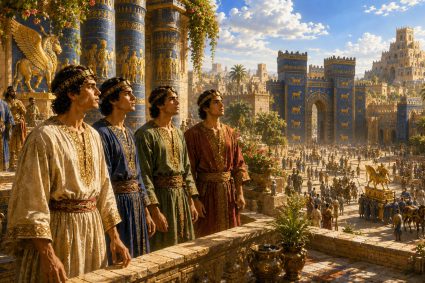
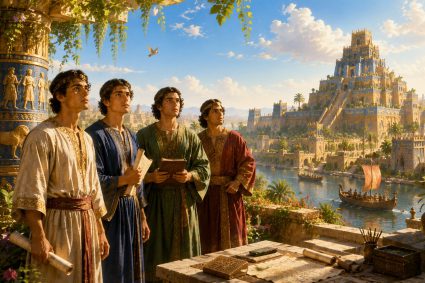
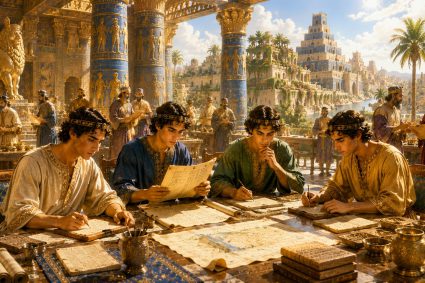
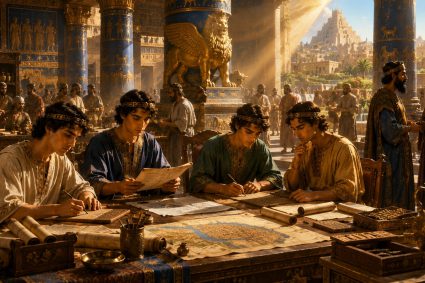
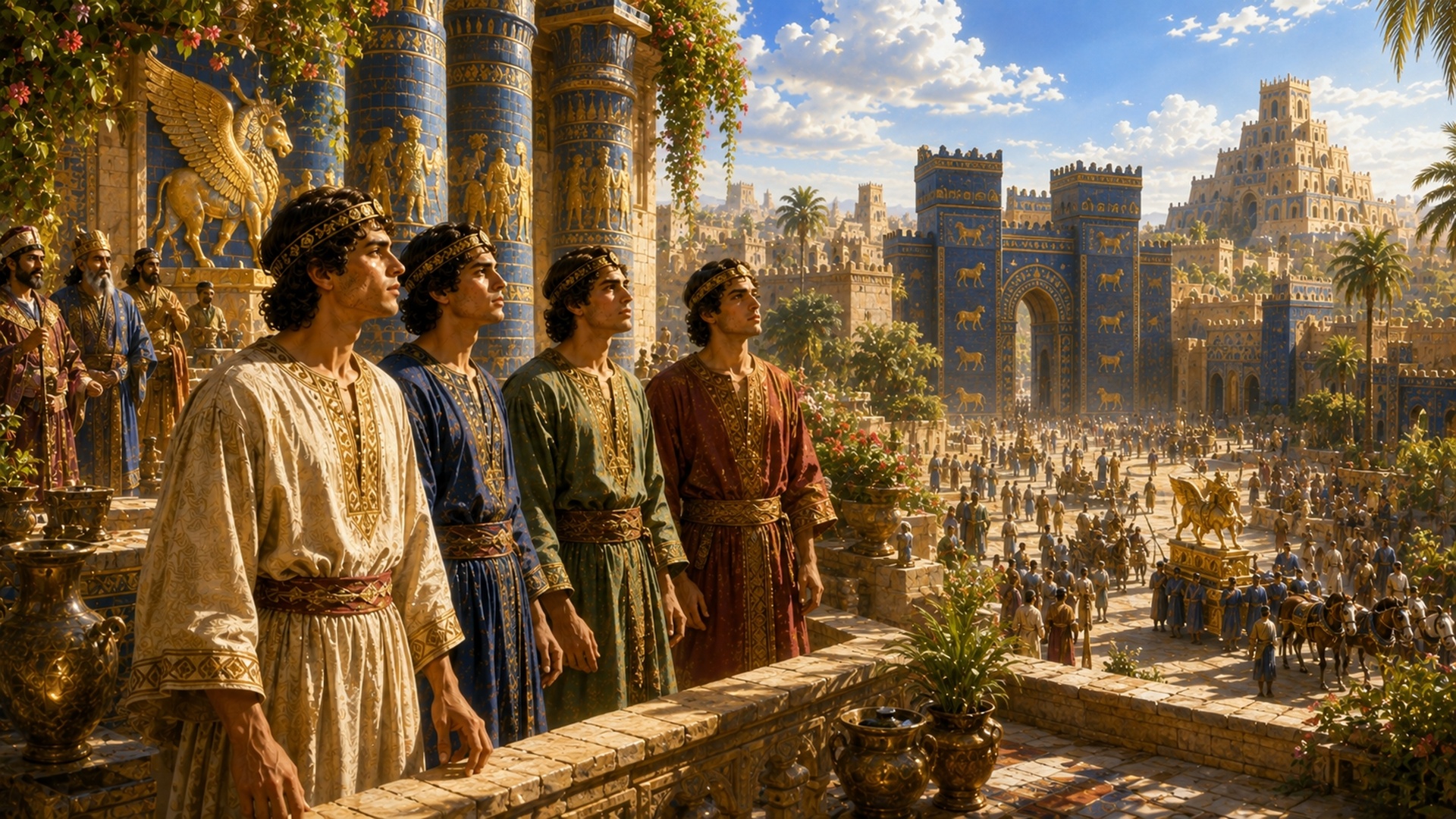
Amid the splendor of Babylon,
far from Jerusalem’s sacred throne,
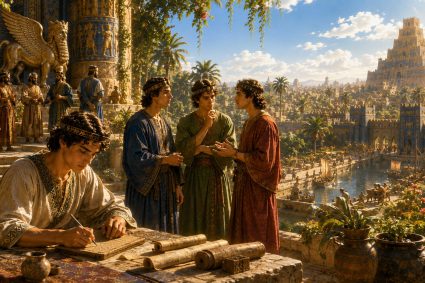
four men lived with quiet grace,
the Most High ruling in their hearts.
The walls rose proudly, broad and high;
each city gate inspired awe.
The temples gleamed with wealth and grandeur,
while people praised their lifeless gods.
The streets were filled with dazzling splendor,
with trade and wealth and human power.
The world admired this mighty kingdom,
and many longed to be like it.
Yet God possessed within that age
a witness to His glorious name—
not through armies, fierce and mighty,
but through lives that wholly belonged to Him.
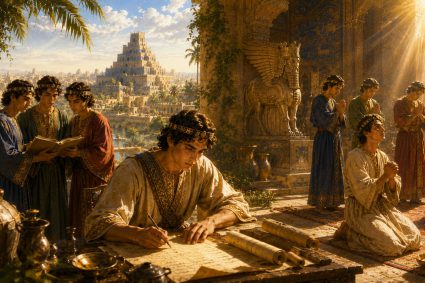
Daniel stood within the palace,
yet God’s own light shone through his life.
Hananiah walked the selfsame pathway
that God’s own truth had placed before him.
Mishael remained faithful to
the truth revealed within God’s Word.
And Azariah stood prepared
for faith and steadfast constancy.
They were not rulers of the land,
nor princes of exalted rank.
And yet through them the Lord accomplished
what mighty armies could not do.
For witness does not only begin
when someone performs a mighty deed.
It often shines through daily living—
through conduct, attitude, word, and action.
The servants in the palace watched them
day after day and year by year.
They saw their honesty and diligence,
while others sought their own advantage.
The officials carefully observed
how Daniel acted with calm trust.
They gladly listened to his words,
for truth resounded through his counsel.
The world gives honor to success,
to influence, status, and human splendor.
Yet God makes far more brightly visible
the light that rises from a faithful character.
Thus these young men became
living witnesses before the kingdom—
not through preaching only,
but through the lives they lived each day.
Babylon knew well where they came from,
and some perhaps regarded them with scorn.
Yet no one could ignore the blessing
that visibly rested upon their lives.
Heaven had sent them forth
as witnesses within a foreign land.
There their lives were meant to show
that God’s truth never needs to yield.
The years continued passing onward,
yet their faith remained unchanged.
Neither power, glory, nor great honor
altered the purpose of their hearts.
For those who serve God only when it is easy
have not yet learned His steadfast ways.
True faithfulness continues standing
when every wind of trial blows.
Daniel often thought about
the way his journey had begun.
He had arrived there as a captive,
yet God’s own purpose was far greater.
The Lord had not preserved him
merely to give him ease and comfort.
He placed him in the midst of Babylon
as light within a darkened world.
God continues working in this way
wherever someone follows Him.
He does not first seek multitudes,
but faithful hearts that choose His will.
A single light within the darkness
can wield astonishing power.
One faithful person in the right place
can carry God’s truth farther on.
The angels watched with joy to see
how God’s own purposes unfolded.
For soon it would become apparent
why their witness mattered so deeply.
They still would stand before great kings
and see the mysteries of heaven.
Yet even now they faithfully fulfilled
the calling God had given them.
They stood as witnesses without fear,
protected by God’s mighty fortress.
Not perfect through their human strength,
but upheld by His sovereign power.
And still this picture shines today
for God’s own people in every age.
The Lord seeks those who firmly stand
when others merely follow the crowd.
For in the midst of today’s world,
God still calls His people forth.
He seeks His witnesses in every place,
who live according to His eternal Word.
Thus Daniel and his three companions
stood firmly with the Most High.
And Babylon began to see
how God’s own light can shine through human lives.
🌟 Prophetic Reflection
🏛️ God did not place Daniel and his friends outside Babylon, but in its very midst. He did not lead them to a place where their faith would never be challenged. Instead, He allowed them to live and serve at the center of the most powerful empire of their age. There, where idolatry, human pride, and political power shaped daily life, they were to represent the living God. What many saw only as captivity became, in God’s hand, a mission field.
🌍 Babylon was not merely a geographical city, but also a spiritual symbol. It represented human self-exaltation, religious confusion, trust in human wisdom, and the attempt to take the place that belongs to God. It was precisely within this environment that God positioned His faithful servants. He desired to show that His light can shine even where the darkness appears greatest.
👑 Daniel and his friends received positions of responsibility at the royal court. They worked conscientiously, served loyally, and treated their superiors with respect. Yet inwardly, they never allowed Babylon to define them. Their loyalty to the king had a clear boundary: wherever human demands contradicted God’s will, their allegiance remained undivided toward the Lord. They demonstrated that one may serve a government without accepting its false religious claims.
🙏 True witness therefore begins not primarily with words, but with a life shaped by the Spirit of God. Daniel first influenced those around him not through great speeches, but through integrity, honesty, wisdom, humility, and reliability. His companions could find no corruption in him. This harmony between faith and life made his testimony credible. His words carried weight because his life confirmed them.
🌱 God’s light shines most brightly through people whose character has been shaped by Christ. Kindness in a harsh world, honesty in the midst of corruption, purity in a time of moral confusion, and hope during dark hours are often the strongest sermons a Christian can preach. People may debate religious convictions, but a life reflecting God’s love is not easily refuted.
📖 Daniel did not attempt to change Babylon through Babylonian methods. He sought no political power, personal greatness, or glory for himself. His purpose was to honor God. For that very reason, the Lord could use him to reach kings, officials, and entire nations with His truth. God often works not through outward power, but through the quiet influence of a faithful life.
🔥 This truth runs throughout the entire history of salvation. Joseph became God’s witness in Egypt. Esther served within the Persian royal court. Nehemiah worked in the palace of a pagan king. The first Christians lived in the midst of the Roman Empire. Jesus Himself did not pray that His disciples should be taken out of the world, but that they should be kept while living within it. God’s people are not to avoid the world, but to serve within it as the salt of the earth and the light of the world.
🕊️ From a Seventh-day Adventist perspective, Babylon acquires an even deeper prophetic meaning in the Book of Revelation. There Babylon represents a worldwide system of religious confusion, human traditions, and false worship. In such a time, God calls forth a people who remain faithful to Him with undivided hearts. They are not to be recognized by pride or harshness, but by the visible revelation of God’s character in their lives.
✨ God’s end-time people are therefore called to shine brightly in the midst of a world filled with uncertainty, confusion, and spiritual deception. They will not influence the world by conforming to the spirit of the age, but through firm attachment to God’s Word. Their strength lies not in political methods or human influence, but in the presence of the Holy Spirit. Just as Daniel reflected God’s character in Babylon, the church of Christ is to reveal the character of her Lord.
🌾 Faithfulness does not mean withdrawal from society, but a clear inward orientation. Christians work, learn, serve, and live among their fellow human beings. They carry responsibility, seek the good of others, and treat every person with love and respect. At the same time, they remain firm in their convictions and refuse to be shaped by the standards of this world. This union of love and steadfastness makes their witness credible.
💛 Daniel reminds us that God places His witnesses exactly where they are needed. The workplace, school, family, neighborhood, or church are not accidental locations. God has placed each of His children where His light is meant to become visible. We may not yet understand the significance of our influence. Yet the Lord can use one faithful life to touch hearts and draw people to Himself.
👑 In the end, Daniel’s story reveals an enduring truth: Babylon does not have to transform the character of a person who wholly belongs to God—through one faithful person, God can even transform Babylon. Therefore, the Lord still calls His church not to receive the spirit of the world, but to reveal the character of Christ through holy, loving, and credible lives.
“Let your light so shine before men, that they may see your good works, and glorify your Father which is in heaven.” (Matthew 5:16)
