
🌱LIVING FAITH | 11.Living in the Land | 11.6 Summary | 🗺️ LESSONS OF FAITH FROM JOSHUA
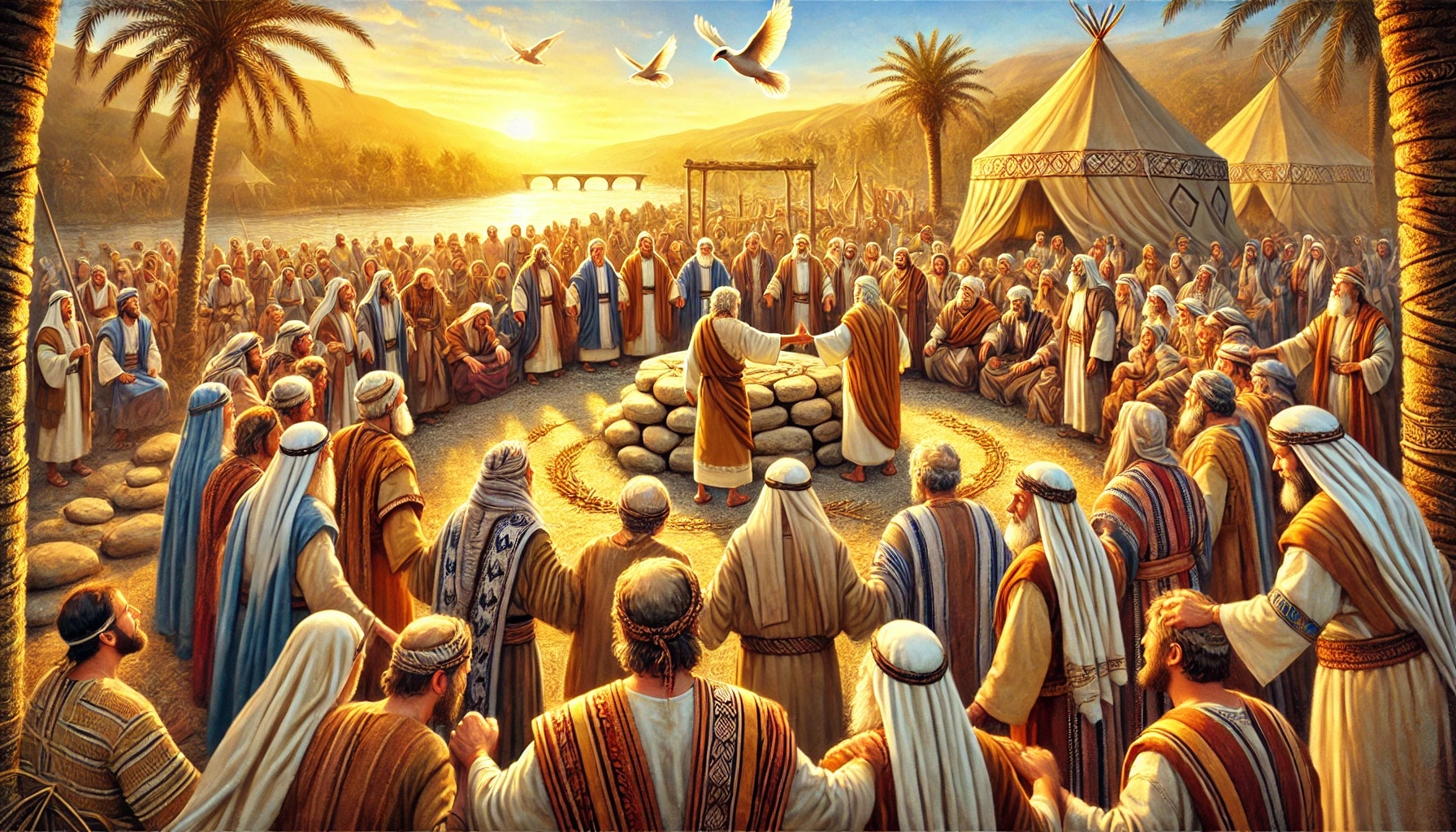
🗺️ LESSONS OF FAITH FROM JOSHUA
⛪ Lesson 11 : Living in the Land
📘 11.6 Summary
✨ Preserving unity – Despite boundaries and misunderstandings
🟦 Introduction
In Joshua 22 we find a surprisingly modern story: misunderstandings, hasty judgments, courageous explanations, and in the end—reconciliation. This chapter shows us that spiritual unity is not maintained by proximity, but by a shared orientation toward God—a message that is more relevant than ever in today’s fractured communities.
This lesson invites us to examine our attitude:
How quickly do we judge others?
How willing are we to listen and clear up misunderstandings?
And how strong is our commitment to unity—even across distances?
…………………………….. 🗺️ ……………………………..
📖 Bible Study
Theme: Spiritual unity despite physical separation
🔹 1. Historical background: The Promised Land has been taken
After Israel conquered and distributed the land of Canaan (chapters 13–21), a decisive turning point arrives: the eastern tribes—Reuben, Gad, and the half-tribe of Manasseh—are allowed to return home. Their inheritance lies east of the Jordan, outside the central regions of Canaan. Although they had received their land earlier (see Numbers 32), they remained faithful for years, fighting alongside their brothers.
🧭 Reflection question:
What does this decision reveal about the priorities of the eastern tribes—and what does it mean for our service in the church today?
🔸 Application:
• Faithfulness to the shared mission mattered more to them than personal comfort.
• Today as well, local or personal interests should never outweigh God’s common mission.
────────────────────────
🔹 2. The building of the altar – an act of testimony (v. 10)
On their way back, the eastern tribes build a large and conspicuous altar by the Jordan. Without explanation, this looks like a violation of the Torah (see Deuteronomy 12:13–14), which clearly states that sacrifices are to be offered only at the place God chooses (at that time, Shiloh).
⚠️ The conflict begins with an optical observation, without dialogue.
The western tribes see only the external structure and conclude:
They have turned away from the true faith.
🧭 Reflection question:
How often do we draw conclusions about people, churches, or movements based only on appearances?
🔸 Adventist relevance:
• Even within the Adventist Church, misunderstandings arise through music styles, church structures, or new ideas.
• The key question is: What are the motives? Is God being honored? Does unity grow—or division?
────────────────────────
🔹 3. The reaction of the western tribes – determined, yet wise (vv. 11–20)
The western tribes prepare for war—but before acting, they send a delegation led by Phinehas, the son of the high priest. This decision is crucial: they choose conversation over violence.
Phinehas’ role is remarkable:
• He had once been a decisive defender of true worship during the crisis at Baal Peor (Numbers 25).
• This time, however, he comes not with a spear—but with words.
He speaks with clarity and deep concern: apostasy by the eastern tribes could bring God’s wrath upon all Israel (see Joshua 7, the sin of Achan). Yet he does not condemn them immediately—he allows room for explanation.
🧭 Reflection question:
Am I willing to talk with people before mentally “writing them off”?
🔸 Lesson for the church today:
• Spiritual responsibility means not only defending truth, but also mediating peace.
• Conflict resolution is not a sign of weakness, but of spiritual maturity.
────────────────────────
🔹 4. The response of the eastern tribes – humble, clear, brotherly (vv. 21–29)
The eastern tribes explain:
“The altar is not for sacrifices. It is a WITNESS—that we too belong to the people of God!”
They emphasize:
• We are not rebelling against God.
• We fear that future generations might exclude us.
• The altar is a visible reminder: We also serve the Lord.
Their response is calm, thoughtful, and deeply spiritual. Though accused, they answer not in anger, but with respect.
🧭 Reflection question:
How do I respond when I am misunderstood or falsely accused?
🔸 Connection to Jesus:
• Jesus Himself was often misunderstood—yet He remained gentle (see 1 Peter 2:23).
• As followers of Christ, we are called to respond not with retaliation, but with gentleness and truth.
────────────────────────
🔹 5. The outcome: reconciliation and praise to God (vv. 30–34)
The delegation recognizes its mistake—and instead of stubbornly clinging to suspicion, they rejoice over the clarification. They praise God and avert the threat of a war between brothers.
The altar is not destroyed—it remains as a memorial: not of division, but of unity in faith despite geographical differences.
🧭 Reflection question:
Am I willing to rejoice when it turns out that I was wrong?
🔸 Spiritual maturity is shown by:
• Rejoicing in clarification rather than insisting on being right.
• Focusing on reconciliation instead of blame.
• Valuing unity more than having the last word.
────────────────────────
🧭 Summary and theological significance
Joshua 22 is a rare chapter—it tells no battle, no miracle, but of a near rupture that was prevented through wisdom, gentleness, and dialogue.
Key themes:
• Spiritual unity is not bound to place or structure, but to alignment with God.
• Misunderstandings often arise without bad intentions—and can only be resolved through honest communication.
• Spiritual leadership requires wisdom, experience, and a willingness to listen.
────────────────────────
🌍 Unity in a global church
The Adventist Church is active worldwide—cultures, music styles, languages, and traditions differ. Yet the common foundation remains:
• The Bible as the standard
• The commandments of God
• Faith in the soon return of Jesus
• The mission of the church in light of the Three Angels’ Messages
Joshua 22 reminds us: even if we live “on different sides of the Jordan,” we are united by the same faith and mission.
────────────────────────
📌 Application for today
1️⃣ Recognize misunderstandings and don’t ignore them
• When confusion arises, choose conversation over rumors.
2️⃣ Leadership with wisdom
• Elders, pastors, and leaders are called to guide conflicts spiritually—with clarity and patience.
3️⃣ Celebrate unity
• Unity is a gift brought about by the Holy Spirit. It must be nurtured, not forced.
…………………………….. 🗺️ ……………………………..
✨ Spiritual principles
-
Faithfulness across distance – The eastern tribes were spiritually part of Israel because they remained faithful in service.
-
The danger of hasty judgments – Actions without context often lead to false conclusions.
-
Open dialogue heals – Gentleness, respect, and honesty pave the way to reconciliation.
-
Leadership with spiritual maturity – Phinehas responds with wisdom shaped by past experience.
-
Unity is not automatic – It must be protected and cultivated.
…………………………….. 🗺️ ……………………………..
🛠️ Practical application in daily life
• In the church: When conflicts arise, speak directly and respectfully—don’t talk about one another through third parties.
• In personal faith: When others misunderstand us, a calm heart and clear explanation are often the best response.
• In service: Faithfulness is not limited by geography or emotions—it is proven especially when it is difficult.
• In relationships: Clarify misunderstandings early—talk before positions harden.
…………………………….. 🗺️ ……………………………..
🧩 Conclusion
Joshua 22 is a masterpiece of biblical conflict resolution. It shows how quickly community can fracture—but also how powerfully gentleness, dialogue, and reverence for God can create peace. If we learn to judge less quickly and ask more questions, we can help build true unity.
…………………………….. 🗺️ ……………………………..
💭 Thought of the Day
“Talking instead of judging, listening instead of condemning—this is how spiritual community grows.”
────────────────────────
✍️ Illustration
Boundaries of Light
A story about misunderstanding, mission, and reconciliation
Chapter 1 – The Separation
In a small country called Viera, two Adventist churches existed: Eastlight and Westlight. They had once been one thriving community, until five years earlier a group from Westlight moved out to plant a church in the underdeveloped east—where few wanted to go: less infrastructure, greater social need, little church presence.
They were officially blessed—but quietly people whispered: “They just want to do their own thing… modern music, different structures, no respect for order.”
So Eastlight was born. Not rebellion, but mission. The small church began welcoming refugees, offering Bible studies on the streets, and hosting house groups in difficult neighborhoods. The focus was mission—not perfection.
But contact with Westlight faded.
✦ ─────────────── ✦ ─────────────── ✦
Chapter 2 – The Altar
One day, images appeared on social media: Eastlight had unveiled a large art project in front of the church—a glowing stone sculpture with three flames, symbolizing faith, hope, and love. Engraved at its base: “Sign of the Covenant.”
At Westlight, emotions flared.
“An altar?!” exclaimed a long-time elder. “Biblically forbidden! Are they offering sacrifices now?”
Soon the conclusion was clear: “This is the apostasy we were warned about.”
✦ ─────────────── ✦ ─────────────── ✦
Chapter 3 – The Call for Clarification
But Pastor Lea, new to Westlight, asked calmly:
“Have you spoken with them?”
“The pictures say enough!” someone replied.
Lea insisted: “Let’s send a delegation—with questions, not accusations.”
Reluctantly, they agreed.
✦ ─────────────── ✦ ─────────────── ✦
Chapter 4 – The Encounter
On a cool Sabbath afternoon, the delegation arrived. Children played around the sculpture. Someone prayed quietly nearby. A young man greeted them warmly: “Shalom—welcome!”
In conversation, the explanation was simple:
“We didn’t want to separate—we wanted to connect. Many of our new members don’t know Adventist history. This sculpture reminds us daily: we belong to you. Even if we work differently. We stand in the same covenant.”
✦ ─────────────── ✦ ─────────────── ✦
Chapter 5 – Tears and Realization
Silence filled the room. One sister, who had said “They left us,” began to cry.
Suddenly she understood: they had not left—they had been sent.
“You didn’t build an altar,” someone whispered. “You built a testimony.”
✦ ─────────────── ✦ ─────────────── ✦
Chapter 6 – Returning with Light
Back in Westlight, the report changed everything. Joint Sabbaths were planned. Preachers were exchanged. Youth camps and shared Bible studies followed.
The sculpture became a symbol of renewed unity—not a dividing line, but a reminder of covenant and mission.
…………………………….. 🗺️ ……………………………..
🕊️ Final thoughts on the story
Inspired by Joshua 22 and real church experiences, this story reminds us:
• Unity does not mean uniformity.
• Misunderstandings can build walls—but conversations tear them down.
• Adventist identity lives not only in structure, but in lived mission and brotherly love.
• It takes courage to listen—and even more courage to admit we were wrong.
…………………………….. 🗺️ ……………………………..
💬 Thought of the Day
“When light seems divided, it is not the shadow of a brother—but our perspective that deceives us. Let us learn again to see in His light.”

More Stories