
🟦 Introduction
Lesson 7 takes us into the heart of Israel’s wilderness journey, where God faithfully provided for His people despite their weaknesses and unbelief. Water, bread, and even meat became signs of His power and love. Each event—from the bitter waters at Marah, to the manna, to the water from the rock—contains spiritual lessons for us today. God wanted Israel to learn that true life depends not only on material provision, but on connection with Him. Even through rebukes and tests, He was preparing them for trust, obedience, and gratitude. These experiences are prophetic pointers to Jesus Christ, our true “Bread of Life” and “Living Water.”
🌊 THE SECOND BOOK OF MOSES
⛪ Lesson 7 : The Bread and Water of Life
📘 7.1 Bitter Waters
✨ From Bitter Waters to Sweet Trust
🟦 Introduction
The story of the bitter water at Marah is more than an account from the distant past. It is a mirror of our own journey of faith. Israel had just witnessed God’s supernatural intervention—the Red Sea parted, they walked through, and their enemies were destroyed. Yet only three days later, their faith began to waver. This teaches us that our trust in God is often tested in everyday life, not only in spectacular moments.
…………………………….. 🌊 ……………………………..
📖 Bible Study
1.Historical and Geographical Background
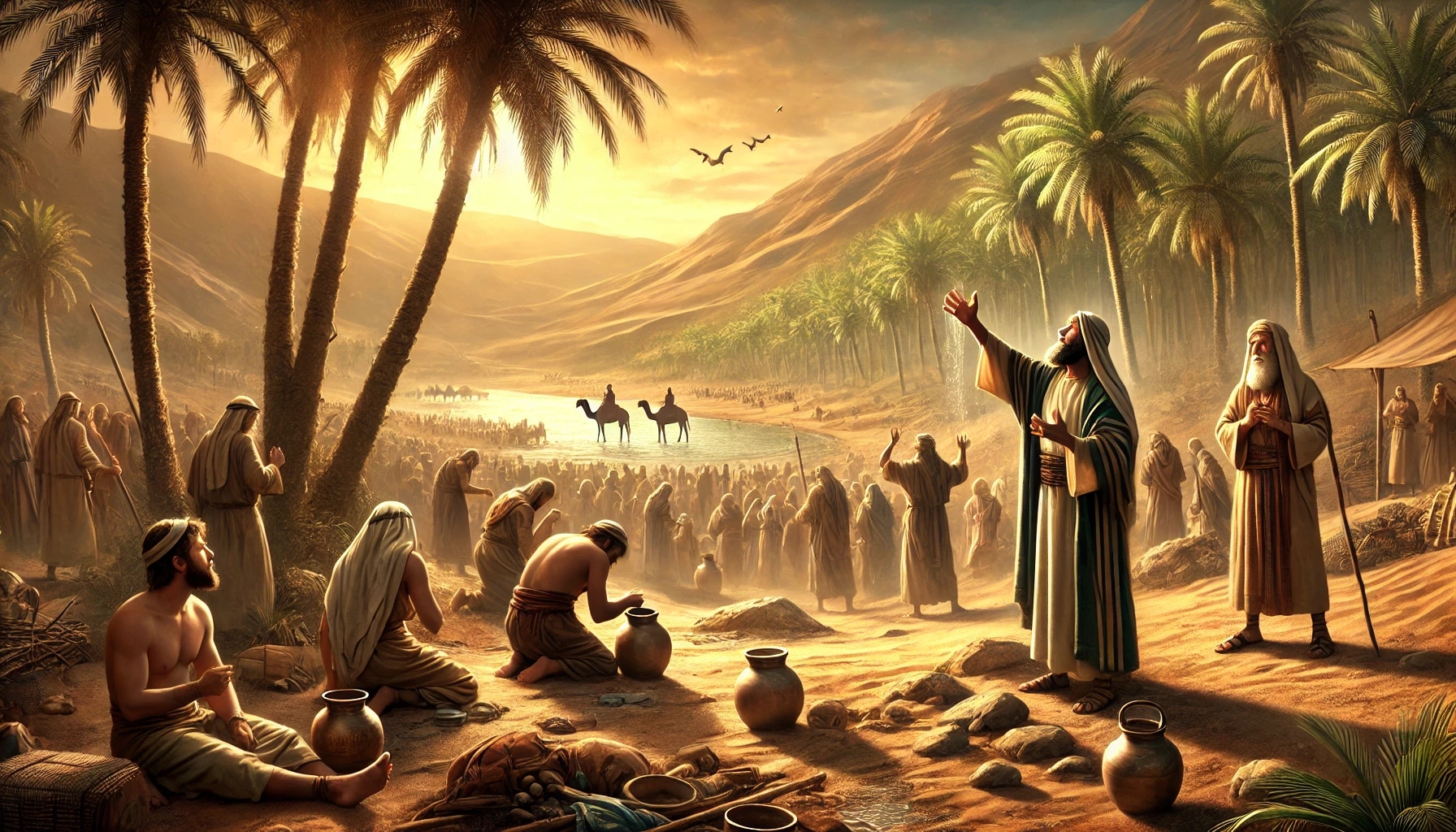
After the triumphant crossing of the Red Sea (Exodus 14–15:21), the people of Israel stood at the beginning of their wilderness journey. The euphoria of victory quickly faded as the reality of the hot, dry desert set in. From the shore of the Sea of Reeds, God led them through the wilderness of Shur (Exodus 15:22)—a region of sparse vegetation, blazing sun, and few natural water sources. Daytime temperatures could exceed 40°C (104°F). Three days without water here was a matter of life and death.
2.The Crisis at Marah
When they finally came to water, joy surged—only to vanish quickly. The water was “Marah”—bitter, undrinkable, likely due to mineral contamination or high levels of sulfur and salt. Physical disappointment became a spiritual test: would the people trust God’s past guidance or give in to fear and grumbling? Sadly, they chose the latter (Exodus 15:24).
3.The People’s Reaction and Moses’ Role
The people complained to Moses instead of turning to God. This reveals a pattern: rather than praying, they sought a human “culprit.” Moses responded differently—he cried out to God (Exodus 15:25). God showed him a piece of wood to throw into the water, and immediately the water became drinkable.
4.The Spiritual Meaning of the Wood
The wood had no magical power. It was a sign: God can turn bitterness into sweetness. Many see here a foreshadowing of the cross of Christ—where God took the bitterest thing (sin, death) and turned it into the sweetest (salvation, eternal life).
5.God’s Lesson and Covenant
At Marah, God gave a lesson in trust and obedience: “If you listen carefully to the LORD your God… I will put none of the diseases on you that I put on the Egyptians” (Exodus 15:26). This reaffirmed the covenant: health, protection, and blessing depended on faithfulness. God revealed Himself as “the LORD, your healer” (Yahweh-Rapha).
6.From Testing to Refreshment
After Marah, God led them to Elim (Exodus 15:27)—an oasis with twelve springs and seventy palm trees. The message: beyond the test lies refreshment. But Elim comes after Marah; the road to abundance often passes through the valley of testing.
7.Practical Lessons for Today
-
God often tests our faith in the area of our most urgent needs.
-
Remembering past miracles should strengthen trust, not fade away.
-
Bitter experiences can become sweet blessings when we let God act.
-
Obedience is the key to protection and healing.
…………………………….. 🌊 ……………………………..
📖 Answers to the Questions
Question 1: Read Exodus 15:22–27. What was the background for the first miracle after the crossing of the Red Sea?
After the great victory at the Red Sea, God led Israel into the wilderness of Shur. There began three difficult days without drinking water. The people were physically exhausted, emotionally strained, and likely dehydrated. When they finally found water, it was bitter and undrinkable. The place was named “Marah.”
This situation was no accident—it was a divinely allowed first test of faith following their deliverance. God wanted to see whether they would trust in His past faithfulness or fall back into fear and grumbling. Sadly, they chose the latter, accusing Moses. Moses, however, responded in faith: he prayed to God and followed His instruction to throw a piece of wood into the water. God transformed the water, proving that He is the source of provision even in the harshest circumstances.
This miracle revealed God’s patience, power, and willingness to help, even when His people were unbelieving. At the same time, it was a lesson in obedience, as God linked the promise of His healing power to the condition of faithfulness to His commandments.
Question 2: Which of your own trials and struggles have you caused yourself? What comfort can you take from the fact that God will still work for your good if you cooperate with Him?
Often, our greatest difficulties do not come from external enemies but from our own decisions—born of impatience, unbelief, or misplaced priorities. Some financial problems, broken relationships, or emotional crises are direct consequences of not trusting God to act in His time, and instead forcing our own solutions.
The comfort is this: God’s love does not end when we make mistakes. Just as with Israel—who worsened their situation through grumbling and forgetfulness—God meets us with grace. If we turn back to Him, seek His help in prayer, and are willing to act according to His principles, He can transform even the bitterest situations.
The promise “I am the LORD, your healer” means that He wants to heal not only physical illnesses but also emotional and spiritual wounds. His willingness to work “with” us shows that He does not act instead of us, but alongside us. When we do our part—trust Him, obey Him, and wait patiently—He opens the way to resolution.
…………………………….. 🌊 ……………………………..
✨ Spiritual Principles
-
God is the problem-solver—He steps into situations that seem impossible.
-
Trust must grow—past miracles do not guarantee present faith.
-
Obedience opens blessing—God’s promises are tied to faithfulness.
-
Training through trials—God turns bitter into sweet, often through faith-shaping processes.
…………………………….. 🌊 ……………………………..
🛠️ Practical Life Application
-
Expect God’s help in both great crises and daily matters.
-
Recall past answers to prayer and blessings.
-
Respond to challenges with prayer rather than complaints.
-
Work with God in small steps, even when you don’t understand the “wood” He gives you.
…………………………….. 🌊 ……………………………..
✅ Conclusion
The Marah experience shows: God can transform even the bitterest moments of life—in the desert and in our modern world. Trials are not signs of His absence but opportunities to know Him more deeply.
…………………………….. 🌊 ……………………………..
💭 Thought of the Day
“God’s plans are never late—but often come exactly when our faith is tested.”
…………………………….. 🌊 ……………………………..
✍️ Illustration – Marah in the Kalahari
When Bitter Water Awakens Hope
Chapter 1 – The Burning Road
The sun blazed mercilessly on the dusty track, stretching like an endless ribbon through the Kalahari. Amina felt her headscarf soaking with sweat. She had been on the road for three days with a small relief team—two rusty jeeps loaded with medicine, blankets, and a few jerrycans of water.
Their destination was a remote village called Mabuto, whose people had been suffering from a devastating drought for months. Rain had become a distant rumor, and the nearest working well was over sixty miles away.
“How much water do we have left?” Amina asked, wiping the dust from her face.
“Only half a jerrycan,” replied Joseph, the driver, his voice hoarse. “If we don’t find anything today, it’s going to be tight.”
✦ ─────────────── ✦ ─────────────── ✦
Chapter 2 – Hope on the Horizon
By afternoon, a shimmering strip appeared on the horizon.
“Water!” cried Samira, one of the younger helpers, her voice breaking with relief.
The convoy sped up; everyone summoned their last reserves of energy. When they reached the spot, the team ran to the edge of a small pond. The sunlight danced on its surface, and just the sight of it eased the torment of thirst. Joseph knelt, scooped water into his hands, and drank greedily—only to spit it out at once.
“Bitter… undrinkable!” he exclaimed. “As salty as seawater.”
Hope burst like a soap bubble, and the mood plummeted.
✦ ─────────────── ✦ ─────────────── ✦
Chapter 3 – The Shadow of Unbelief
They sat in silence under a gnarled acacia tree. Some stared blankly; others cursed under their breath. Samira broke into tears. “We’ve suffered for three days—for this? For poison?”
Amina felt her faith wavering. Memories of her childhood came back—times when she had praised God in church, singing songs of trust and provision. But here, in the scorching heat with a parched mouth, those memories felt distant, almost unreal.
✦ ─────────────── ✦ ─────────────── ✦
Chapter 4 – The Stranger Appears
Just as discouragement threatened to overwhelm them, a figure appeared at the edge of the water. An elderly man in a simple robe, carrying a long staff, approached. On his back was a bundle of dried plant stems.
“You’ve come far,” he said in a calm, deep voice. “I saw your dust cloud from a distance.”
“We’re looking for drinking water,” Amina replied curtly.
The man gave a faint smile. “The water here is bitter. But it doesn’t have to stay that way.”
✦ ─────────────── ✦ ─────────────── ✦
Chapter 5 – The Simple Remedy
The stranger asked for a bucket of water. Hesitantly, they handed him one they had filled. He placed a few dried stems into the water and stirred. “Wait a moment,” he said.
After a few minutes, he handed the bucket to Amina. “Try it now.”
She took a cautious sip—and her eyes widened. The water was fresh, cool, clear. “How… how is that possible?”
“This plant grows only in certain places,” he explained. “It takes away the bitterness. But remember—the plant is only a tool. The help comes from God.”
✦ ─────────────── ✦ ─────────────── ✦
Chapter 6 – Lesson at the Water
As they drank and refilled their jerrycans, the man told them the story of his people. They too had known drought, fear, and even quarrels among themselves. “But every time we trusted the Creator, He did not fail us.”
Amina listened silently. Something in his words reminded her of the biblical account of Marah—how God had shown Moses a piece of wood to sweeten the water. Here in the Kalahari, it was a plant, but the message was the same: God can turn bitterness into blessing.
✦ ─────────────── ✦ ─────────────── ✦
Chapter 7 – Arrival in Mabuto
The next morning, they reached the village. Children shouted with joy; parents expressed heartfelt thanks. The clean water was distributed at once, and the villagers held a small celebration despite the ongoing drought.
Amina stood aside, watching a little girl drink the water slowly, as if it were liquid gold. She felt a quiet resolve forming in her heart: never again would she underestimate God’s care—even when the road was dry and dusty.
✦ ─────────────── ✦ ─────────────── ✦
Chapter 8 – The Message Remains
Before they left, the old man gave Amina a bundle of the plant. “So you will remember,” he said. “Not me—but the One who is the source of all life.”
On the drive back, Amina stared out the window. The Kalahari lay silent under the midday sun. In the distance, a bright shimmer appeared—perhaps a mirage, perhaps a new path. She knew only one thing: the God who could make bitter water sweet would provide for her all the way.
Lesson of the Story:
Even in the bitterest moments of life, God can bring forth springs of refreshment and hope. He sometimes uses humble, unexpected means—people, encounters, or small opportunities—to make the impossible possible. What matters is that we trust Him, even when circumstances seem hopeless. Those who give God first place will see Him turn deserts into blooming landscapes.
…………………………….. 🌊 ……………………………..