
🟦 Introduction
The story of Moses does not begin with a miracle, but with oppression. At a time when God’s people seemed forgotten and were brutally enslaved by a new Pharaoh, the Bible lays the foundation for one of the greatest acts of redemption in human history. The transition from blessing to slavery in Egypt is not merely a historical shift—it reflects the reality of many people today who ask: Where is God in the midst of suffering? Yet it is precisely in the darkness that God’s light begins to shine. This lesson invites us to read the beginning of the book of Exodus with open eyes and a searching heart—and to recognize: when people forget us, God does not. In the birth of a child, hope begins to grow anew.

⛪ Lesson 1: Oppression: The Background and the Birth of Moses
📘 1.1 God’s People in Egypt
✨ From Blessing to Oppression: God’s People Under Foreign Rule
………………………………………………………………….
🟦 Introduction
The story of Moses doesn’t begin with a miracle, but with oppression. At a time when God’s people seemed forgotten and brutally enslaved by a new Pharaoh, the Bible lays the foundation for one of the greatest works of redemption in human history. The shift from blessing to slavery in Egypt is not just a historical turn—it reflects the reality of many today who wonder: Where is God in the midst of suffering? Yet it is precisely in the darkness that God’s light begins to shine. This lesson invites us to read the beginning of Exodus with open eyes and seeking hearts—and to realize: when people forget us, God does not. In the birth of a child, hope begins to grow anew.
………………………………………………………………….
📖 Bible Study – Exodus 1:1–11
1. Blessing Amid Oppression
Exodus doesn’t open with spectacle but with a remembrance: “These are the names” (Ex. 1:1). Names are more than data—they represent people with stories, faith, and dreams. God begins where people often stop seeing: in the unseen. The 70 who once came with Jacob to Egypt (Gen. 46:27) have multiplied into a great nation—carried by God’s blessing.
Verse 7 uses five expressions for growth:
“fruitful, swarmed, multiplied, became mighty, and filled the land.”
This abundance echoes Genesis 1:28—“Be fruitful and multiply.”
→ Israel is not just an ethnic group; it’s the bearer of God’s original blessing, even in a foreign land.
2. New Power, New Problem (vv. 8–11)
Then comes the pivot: “A new king arose in Egypt who knew not Joseph.”
The blessing Joseph brought was forgotten. History was ignored—and with it, trust was lost.
What do we learn?
➡ Good relationships and blessings should never be taken for granted.
What is goodwill today can quickly turn to suspicion, envy, or control.
Pharaoh saw Israel not as a blessing, but a threat: “They are numerous… What if they turn against us?”
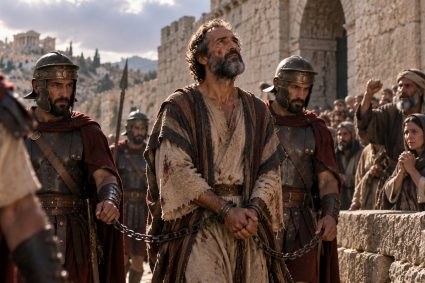
Fear replaced gratitude. And fear gave way to oppression: forced labor, exploitation, dehumanization. Hebrew men were made to build foreign cities—likely Pithom and Rameses.
Note: This pressure was not economic development—it was control. An attempt to crush identity through labor.
………………………………………………………………….
📖 Answers to the Questions
📌 Question 1: What key truth is found in Exodus 1:1–7?
Answer:
These verses show that God’s promises persist even in unfavorable conditions. Israel had no land, no status, no cities, no freedom—and yet they multiplied.
The use of creation language emphasizes: even in chaos, God brings life. Growth is a sign of His presence—not the surrounding conditions.
➡ Key Truth: God’s blessing is not tied to political stability or external freedom—it works in hidden places, in suffering, in exile.
📌 Question 2: What was the situation of the Israelites in Exodus 1?
Answer:
The Israelites were enslaved—forced into labor, restricted in movement, attacked in identity. It was not just physical oppression, but psychological warfare:
-
Their fertility became a threat.
-
Their work a tool of control.
-
Their history was erased—Joseph was “forgotten.”
But: the text offers a divine reversal. Oppression did not weaken them—it led to further growth.
➡ It’s as if God was saying: “No Pharaoh can stop My plans.”
📌 Question 3: What does the rise of a new Pharaoh teach us about good circumstances?
Answer:
The new Pharaoh represents a shift in time—regimes change, attitudes shift, favor turns to suspicion. Joseph, once Egypt’s savior, was erased from memory.
This reminds us:
-
Good circumstances are temporary.
-
Gratitude can fade.
-
Safety is not permanent.
➡ We learn:
If your faith rests in politics, society, or success—you’re on shaky ground.
Only God’s promises remain—even in hostile surroundings.
………………………………………………………………….
✨ Spiritual Principles
-
God’s faithfulness exceeds human forgetfulness.
-
Growth often happens in secret—and in pain.
-
Blessing is not always visible.
-
Darkness can mark the beginning of deliverance.
-
Faith anticipates God’s movement—even when it seems delayed.
…………………………………………………………………
🧩 Application for Daily Life
-
Family: Build your home on God’s promises, not external stability.
-
Work: Be faithful, even in injustice—God sees you.
-
Faith: God’s silence is not absence. Wait—He is working in the unseen.
-
Church: If you’re growing amid resistance—you’re on the right path.
………………………………………………………………….
✅ Conclusion
The story starts in darkness. But God is already writing light into it. Moses hasn’t been born, Pharaoh rules unchecked—but heaven is not silent. This lesson shows: God prepares deliverance long before people even cry out for it.
………………………………………………………………….
💭 Thought of the Day
Don’t lose heart when life darkens—perhaps that’s where God begins His greatest work.
………………………………………………………………….
✍️ Illustration– A New Exodus Story
He was just an ordinary man. Quiet. Humble. His family had fled a war-torn country over a decade ago. They arrived in Europe with nothing—except their names, their faith in God, and the hope of belonging.
In the beginning, the new land was full of promise. Authorities were kind. Neighbors helpful. People said: “You can start over here.”
And they believed it.
The family grew. They opened small businesses, attended school, pursued trades. Every Friday, they gathered to pray, singing in their mother tongue to the God who had carried them through.
But then—change.
A new government. Different laws. A colder tone in the media. Suddenly the feeling: You don’t really belong here.
Those who once helped stepped back. Now came questions:
“How many of you are there?”
“Why are you still here?”
He watched his brother lose his job for refusing to work on a holy day. His cousin was mocked at school—“the girl with the headscarf.” His mother wept quietly when their citizenship was denied again.
They kept living—but no longer free.
An invisible pressure now shaped their days.
And yet—the more they were pressed, the more they grew.
Their church overflowed on Sundays. Young people volunteered, helped the elderly, tutored kids in forgotten neighborhoods. Their children won academic prizes; their parents fasted and prayed for a country that never fully embraced them—but that they still loved.
It was a paradox:
The more their identity was attacked, the deeper it rooted.
They were called “foreigners”—but became a blessing.
Just like long ago in Egypt, when a new king forgot Joseph.
When God’s people were oppressed, forced, exploited.
And yet: “The more they were oppressed, the more they multiplied and spread” (Exodus 1:12).
Because behind the story stood an invisible God—faithful, patient, and certain of the future.