






🤩 Bible Stories to Marvel At
Where God’s miracles become great – for little and big children
⚡ Job Chapter 37 – Elihu Marvels at God’s Voice in the Thunder
🌨️ When Thunder, Snow, and Wind Speak of God
🌅 Introduction
In the previous chapter, Elihu had increasingly directed attention toward the sky. He had spoken about God’s power, rain, clouds, light, thunder, and lightning. His words sounded like the beginning of a storm. It was as though all nature were slowly becoming still and waiting for God’s voice.
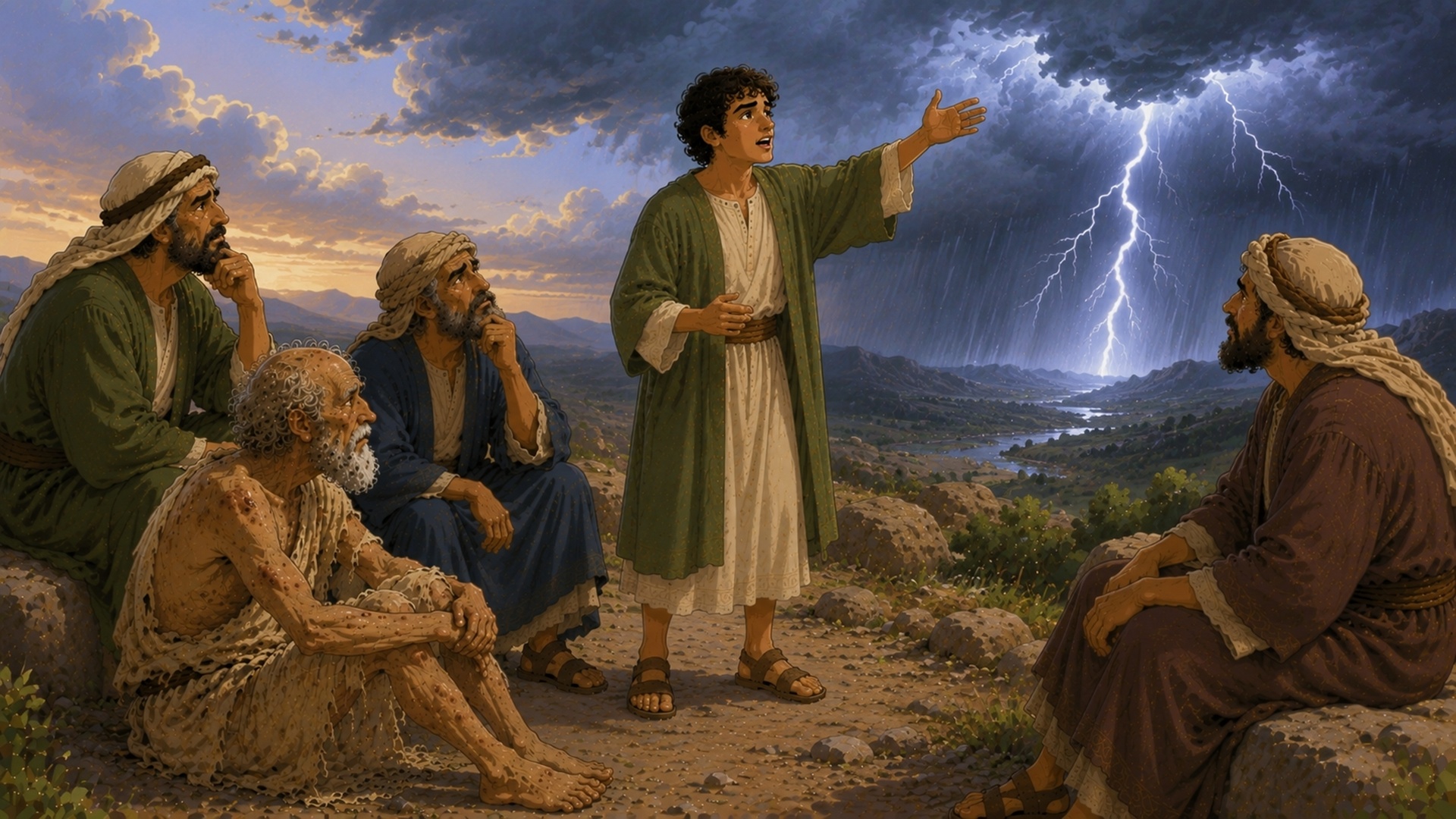
Now Elihu continues speaking. His heart trembles when he thinks about God’s thunder. He sees lightning flashing across the sky, hears the rolling thunder, and marvels that God reveals His power through creation. To Elihu, the weather is not merely weather. It is a great sign that God is mightier than human beings.
He also speaks about snow, rain, storms, and cold. Human hands must cease their work when God’s weather comes. Animals withdraw into shelter. Clouds move according to God’s guidance. Everything in creation reminds us that human beings cannot control everything.
For Job, this chapter is a preparation. He has asked many questions. His friends have tried to give many answers. Elihu has spoken at length. But now everyone stands just before the moment when God Himself will speak.
This chapter tells how creation leads human beings to marvel and become still. Thunder, snow, wind, and clouds reveal that God is great, unsearchable, and glorious. Human beings can observe many things, but God’s ways remain higher than their understanding.
📖 The Biblical Story
💓 Elihu’s Heart Trembles before God’s Power
Elihu begins with deeply emotional words. He says that his heart trembles before God’s power and leaps from its place. He is not cold or indifferent when he thinks about God’s greatness. Something within him becomes fully awake.
He hears the thunder like a mighty voice. The sound rolls across the sky, deep and powerful. Anyone who has ever experienced a severe thunderstorm knows this feeling: We become quiet because something greater than human beings can be heard.
For young and grown-up hearts, this is easy to imagine. When a loud clap of thunder suddenly sounds outside, conversations often stop for a moment. People look toward the window. Children may move closer together. Nature reminds us that we are not the greatest.
Elihu sees in the thunder a sign of God’s majesty. His heart trembles not only from fear, but also from reverence. He senses that God is mighty and that His voice is greater than every human word.
🌩️ The Thunder Rolls beneath the Whole Heaven
Elihu says that God’s voice travels beneath the whole heaven and that His light reaches to the ends of the earth. He sees lightning and thunder as signs of a power far beyond humanity.
A flash of lightning can illuminate the dark sky in an instant. Then thunder follows, rolling across mountains, valleys, fields, and houses. To Elihu, this event speaks of God’s greatness.
People can see lightning, but they cannot hold it in their hands. They can hear thunder, but they cannot lock it inside a small box. God’s creation reveals forces that human beings cannot control.
Therefore, Elihu becomes reverent. He realizes: If thunder and lightning are already so mighty, how great must the God be who rules over them?
⚡ God Does Great Things We Cannot Understand
Elihu says that God thunders wonderfully with His voice and does great things that we cannot understand. This is one of the most important thoughts in the chapter.
Human beings can learn many things. They can observe the weather, study clouds, and think about rain. But they cannot fully comprehend God’s power. A mystery remains that is greater than every human explanation.
For children, we could say: You can look at a beautiful painting and say many things about it. But when the artist explains what was in their mind, you often discover that much more lies behind it. It is the same with God’s creation. We see something, but God knows its entire depth.
Elihu wants to remind Job that human beings cannot immediately understand everything God does. This does not mean that God acts wrongly. It means that God’s wisdom is greater than our perspective.
❄️ God Speaks to the Snow
Elihu then speaks about snow. He says that God commands the snow: Fall upon the earth. This is a beautiful image. Snow does not enter Elihu’s thoughts by accident. It is a sign of God’s rule over nature.
Snow falls quietly. Unlike thunder, it is neither loud nor frightening. It gently covers the earth, turns paths white, and transforms the landscape. Elihu sees God’s power in this as well.
God is not great only in the loud storm. He is also great in the silent snowfall. His voice can shake through thunder, but His hand can also quietly cover the earth.
This shows us that God’s greatness has many aspects. Sometimes it is loud like thunder. Sometimes it is quiet like snow. Yet it always reminds us that creation obeys God’s command.
🌧️ God Sends Rain in His Strength
Elihu also speaks about rain. He mentions gentle rain and heavy rain. Sometimes rain falls softly and lightly. At other times, it comes powerfully, beats against rooftops, fills streams, and soaks the ground.
Rain can water fields, cause plants to grow, and provide people with water. Yet it can also make roads difficult and remind people that they do not control everything.
For young and grown-up hearts, rain is a familiar image. When the ground is dry, rain becomes a blessing. When we are traveling outdoors, rain can be uncomfortable. Both reveal that we are dependent upon God’s order in creation.
Elihu sees God’s hand in the rain. God sends it, restrains it, makes it gentle or strong. Even the raindrops declare that God rules.
✋ Human Beings Must Cease Their Work
Elihu says that God seals the hand of every person so that all people may recognize His work. This means that when God’s weather comes, human beings sometimes have to stop working.
A farmer can make plans, but when heavy rain comes, he cannot simply continue working in the field. A traveler may begin a journey, but a storm can force them to stop. Nature reminds human beings of their limitations.
This is not only frustrating. It can also be beneficial. Sometimes people must be stopped so that they recognize: I am not lord over everything. My life depends upon God.
For children, we could say: When there is a thunderstorm outside, you cannot play in the same way as on a sunny day. You have to wait. This waiting can teach us caution and humility.
🐾 The Animals Also Withdraw
Elihu describes how animals enter their shelters and remain in their dens. When God’s weather moves across the land, human beings are not the only ones who feel it. Animals respond as well.
We can imagine birds becoming quieter, animals seeking shelter, and the landscape growing still beneath dark clouds. Creation seems to know that this is a time for hiding and waiting.
This image makes God’s rule very vivid. Not only human beings stand under God’s power. Animals, forests, mountains, clouds, and winds also belong to His world.
When animals withdraw from storms and cold, we are reminded that all creation lives under God’s order. Nothing exists outside His sight.
🌬️ Wind and Cold Come from God’s Chambers
Elihu speaks about a storm coming from its chamber and cold being brought by the winds. This sounds poetic and mysterious. It is as though God possesses storehouses for wind, frost, and weather.
The wind can be gentle and move leaves. But it can also be strong and bend trees. Cold can freeze water and make the earth hard. All these forces are felt by human beings, yet they cannot control them.
For children, we can imagine a cold winter morning when our breath becomes visible and water has turned to ice. We can see that something has changed, although no human hand made it happen.
Elihu says that God’s power is at work even here. By the breath of God, ice is formed, and broad waters become frozen. Nature is filled with wonders that invite us to marvel.
☁️ God Loads the Clouds with Water
Elihu then describes the clouds. God loads them with moisture and scatters His bright clouds. Clouds are mysterious: They appear soft but can carry enormous amounts of water. They float high above and change the land beneath them.
Sometimes clouds bring shade. Sometimes they bring rain. Sometimes they shine brightly when touched by sunlight. Sometimes they become dark and announce a storm.
Elihu does not see chance in all of this, but God’s guidance. The clouds do not move independently of God. They accomplish what He commands them to do.
This helps us not to see nature as merely ordinary. Even a cloud can point us toward this truth: God is wise. God orders. God acts in ways greater than our planning.
🧭 The Clouds Move according to God’s Guidance
Elihu says that the clouds turn according to God’s direction so that they may do everything He commands them upon the face of the earth. The image is beautiful: The clouds are like servants carrying out God’s commission.
People see clouds move and often do not know exactly why they bring rain here and continue onward there. Elihu, however, says that God knows. He directs them according to His wisdom.
This can remind us of Job’s life. Job sees his path and does not understand why pain has come specifically upon him. Elihu points toward the clouds and says: You do not understand everything there either, but God directs them.
Of course, this does not immediately answer every question. But it broadens our perspective: God’s ways are not accidental, even when they remain hidden from human beings.
🌍 God Sends Weather for Correction, for the Land, or for Mercy
Elihu says that God causes the clouds to come, sometimes for correction, sometimes for His land, and sometimes as an expression of mercy. This means that God’s weather can serve different purposes.
Rain can be a warning, a correction, a blessing for the land, or a sign of God’s goodness. Human beings may see only that it is raining. God, however, knows the deeper purpose.
For young and grown-up hearts, this is an important thought. The same event may mean more than we first recognize. Through nature, God can provide, teach, and remind.
Yet, as always in Job’s story, we must be careful. We should not immediately claim that we know exactly why God sent every storm. Elihu reveals God’s greatness, but God’s specific ways often remain hidden.
👂 Elihu Calls Job: Listen and Marvel
Elihu turns directly toward Job once more. He says: Listen to this, Job. Stand still and consider the wonders of God. This is an important invitation.
Job has spoken, questioned, and lamented a great deal. Elihu now invites him to become still and look at God’s works. Not because Job’s questions are unimportant, but because God’s wonders are greater than human words.
Sometimes wonder helps when the heart has become narrow. Those who look only at their own pain may eventually see nothing else. A glance at God’s creation can remind the heart: My distress is great, but God is greater still.
Yet genuine wonder must not suppress pain. It should not say, “You are not allowed to be sad.” It should say, “Even in your sadness, there is a God who is greater than everything.”
⚡ Can Job Direct the Lightning?
Elihu asks Job whether he knows how God commands the clouds and causes the lightning of His cloud to shine. Can Job direct the lightning? Can he explain how everything in the heavens works together?
These questions reveal Job’s limitations. Job is a human being. He can see many things, but he cannot understand everything. He can seek God, but he cannot control Him.
For children, we could say: You can watch a thunderstorm, but you cannot tell the lightning where to go. You can look at the clouds, but you cannot move them with a command.
Elihu wants to lead Job toward humility. If human beings cannot fully understand the clouds, how could they completely understand all of God’s ways?
☁️ Who Understands the Balancing of the Clouds?
Elihu asks whether Job understands the balancing of the clouds, the wonders of the One who is perfect in knowledge. Clouds appear light, but they carry water. They move across the earth and change the weather. They are ordinary and yet full of mystery.
God is described here as perfect in knowledge. This means that God’s knowledge has no gaps. He does not need to learn anything. He forgets nothing and overlooks nothing.
Human beings learn step by step. Today they understand something, and tomorrow they understand more. But God knows perfectly. Therefore, His works are orderly even when they remain mysterious to us.
This image is meant to remind Job that God understands even what Job does not. His wisdom sustains both the clouds and human paths.
🔥 When the Air Becomes Still and Hot
Elihu describes how a person’s clothes become warm when the earth is still beneath the south wind. This is an image of heat and stillness. The power of the weather can be felt upon the body.
Sometimes nature is not loud, but heavy and oppressive. Before a change in the weather, the air may become still, the heat presses down, and everything waits for movement.
Elihu sees God’s hand in this as well. Thunder is not the only thing that speaks of God. Heat, stillness, cold, and clouds also reveal that the world is greater than human power.
Human beings live in the midst of this creation. They feel it upon their skin, in their work, and in daily life. They live in God’s world, not in a world of their own invention.
🔨 Can You Spread Out the Sky?
Elihu asks Job whether he can spread out the sky with God, hard as a cast metal mirror. This is a mighty image. The sky appears vast, firm, and shining.
Of course, Job cannot do this. No human being can spread out the heavens. No human being can hold, fasten, or rebuild them. The sky stands above us as a sign of God’s creative power.
For children, we could say: You may be able to spread out a cloth or smooth a sheet of paper, but no human being can spread out the sky. Only God can do that.
Elihu’s question leads once again toward humility. Human beings can build houses, cultivate fields, and make tools. But heaven and earth remain in God’s hands.
🤐 Human Beings Do Not Know How to Speak before God
Elihu says, in essence: Teach us what we should say to God, for because of our darkness we cannot present our case. This is an honest thought. Before God’s greatness, human words become small.
After all the long speeches in the book of Job, a question suddenly stands before us: What can human beings truly say to God? How can they stand before the Creator? Which words are sufficient?
Job has asked many questions. His friends have given many answers. Elihu has offered many explanations. But before God’s true greatness, we recognize that human words are limited.
This prepares the next great moment. Soon human beings will no longer speak about God. God Himself will speak.
🌞 Sometimes the Light Is Not Immediately Visible
Elihu speaks about light that cannot be seen when it is hidden behind the clouds until the wind passes and clears the sky. This image fits Job’s experience deeply.
The sun can still be present even when clouds conceal it. The light has not disappeared; it is merely hidden. When the wind drives away the clouds, it becomes visible again.
For Job, God often appears like hidden light. He seeks God and cannot find Him. He calls out but hears no answer. Yet Elihu’s image reminds him: Hidden does not mean extinguished.
This is a gentle comfort. Even when God’s presence seems concealed, God has not disappeared. Clouds can hide the light, but they cannot destroy it.
🌟 God’s Splendor Comes from Afar
Elihu speaks of golden splendor coming from the north and of awesome majesty surrounding God. He sees God’s glory like a mighty light that overwhelms human beings.
God’s majesty is not small or harmless. It is beautiful, but also awe-inspiring. Those who truly see God do not remain standing proudly, but become humble.
For young and grown-up hearts, we can imagine a sunrise after a storm. At first everything was dark, but then light breaks through, strong and golden. We sense that the light is greater than the night.
Elihu prepares Job not to think too small of God’s glory. God is not a human being whom we can fully understand or control.
👑 The Almighty Is Unreachably Great
Elihu says that the Almighty is beyond our reach. He is great in power, rich in justice, and full of righteousness. He does not oppress.
This is an important summary. God is powerful, but not unjust. He is exalted, but not evil. He is unsearchable, but not arbitrary. His power and His justice belong together.
Job has often asked why he cannot understand God’s actions. Elihu answers: God is higher than you, but He is not unjust. His greatness should not drive you away from Him, but lead you toward reverence.
This truth remains difficult and precious at the same time. Human beings do not always understand God’s ways. Yet God’s character remains righteous.
🙏 Therefore, Human Beings Should Fear God
At the end, Elihu says that human beings should fear God. This means reverence: a heart that takes God’s greatness seriously, becomes humble before Him, and does not proudly pretend to know everything.
God does not regard those who consider themselves wise. Pride makes people blind. Those who believe they already know everything can no longer learn. But those who become reverent open their hearts to God’s wisdom.
This is Elihu’s final great thought. After many words, he leads Job and the listeners toward reverence. Human beings should become still before the God who holds thunder, snow, wind, clouds, and light in His hands.
And now the story is ready for the next step. Elihu has spoken. The friends are silent. Job waits. The sky is filled with storm. Now God Himself will answer.
🌅 What This Chapter Shows
This chapter shows Elihu marveling at God’s power in nature. Thunder, lightning, snow, rain, wind, cold, and clouds remind us that God rules creation and that human beings cannot control everything.
This chapter also shows that God’s greatness calls human beings to reverence. Human beings do not understand all of God’s ways, but God remains great in power, justice, and righteousness.
🟣 Summary
In Job chapter 37, Elihu speaks with wonder about God’s power in nature. His heart trembles at God’s thunder, and he describes lightning, snow, rain, storms, cold, and clouds as signs of God’s rule. God speaks to the snow, sends rain, causes human beings to cease their work, and directs the clouds according to His will. Elihu calls Job to stand still and consider the wonders of God. He asks whether Job can explain or control the clouds, lightning, sky, and weather. At the end, Elihu emphasizes that the Almighty is unreachably great, rich in justice and righteousness, and that human beings should honor Him with reverence. This chapter prepares the moment when God Himself will answer out of the storm.
💚 Message for Young and Grown-Up Hearts Today
Nature can lead us to marvel. Thunder, snow, rain, wind, and clouds remind us that God is greater than we are. We can observe many things, but we cannot control everything.
We also learn that when we do not understand God’s ways, we may remain reverent and humble. God is great in power, justice, and righteousness. Even when clouds hide the light, the light has not disappeared.
💭 Questions for Reflection
🔸 Why does Elihu’s heart tremble when he thinks about God’s thunder?
🔸 Which things in nature reveal God’s power and wisdom?
🔸 Why does marveling at God help us when we do not understand everything?
🧒 👧 👦
💌 Invitation to Job Chapter 38
🌪️ God Answers out of the Storm
Elihu has spoken his final words. He has directed Job’s attention toward thunder, snow, wind, clouds, and God’s unsearchable greatness. All creation now seems prepared for God’s voice.
Now the great moment arrives: God Himself will speak. Neither Eliphaz, Bildad, Zophar, nor Elihu will have the final word. The Lord answers Job out of the storm.
What will God say when He meets Job?
Come along and discover the next chapter!
🔔 Teaser for Job Chapter 38
🌌 When God Leads Human Beings to Marvel
God speaks out of the storm and asks Job questions about the earth, the sea, the morning, the stars, and the order of creation.
👉 Why does God ask, “Where were you when I laid the foundations of the earth?”
👉 What do God’s questions reveal about His wisdom?
👉 And why does God lead Job first to wonder rather than to an explanation?
✨ In the next chapter, God’s great answer begins—filled with the wonders of creation, majesty, and holy reverence.
