

🟦 Introduction
Lesson 6 focuses on the spiritual gifts that God gives to His church through the Holy Spirit. Paul shows that these gifts were not given for self-promotion or comparison, but for building up the body of Christ. Although the gifts are different, they all come from the same Spirit, the same Lord, and the same God. Love is especially important, because without love even impressive gifts lose their spiritual value. Gifts such as speaking in tongues and prophecy must also be used intelligibly, in an orderly manner, and in harmony with Holy Scripture. This lesson invites us to use our gifts humbly, faithfully, and for the glory of Christ.
✉️
✉️ FIRST AND SECOND CORINTHIANS
🎁 Lesson 6: Spiritual Gifts
✨ 6.1 A Variety of Gifts
🤲 Different Gifts, One Spirit, and a Common Ministry
📖 1. Introduction
In 1 Corinthians 12, Paul begins an important new subject: spiritual gifts. The church in Corinth was rich in gifts, but it was not always mature in the way it used them. Some gifts were apparently given more attention than others, resulting in comparison, pride, and disorder. Paul wants to remind the church that spiritual gifts do not arise from human ownership or personal achievement, but are given by the Holy Spirit. Every gift has its place, purpose, and task. What matters is not who possesses the most noticeable gift, but whether Christ is honored through every gift and whether the church is built up.
📜 2. The Biblical Foundation
Paul writes:
“Now concerning spiritual gifts, brethren, I would not have you ignorant.” 1 Corinthians 12:1
He then reveals the foundation of genuine faith:
“No man can say that Jesus is the Lord, but by the Holy Ghost.” 1 Corinthians 12:3
Paul continues:
“Now there are diversities of gifts, but the same Spirit.” 1 Corinthians 12:4
“And there are differences of administrations, but the same Lord.” 1 Corinthians 12:5
“And there are diversities of operations, but it is the same God which worketh all in all.” 1 Corinthians 12:6
These verses show that the gifts are different, but their source is the same God.
🌍 3. Connection to Our Time
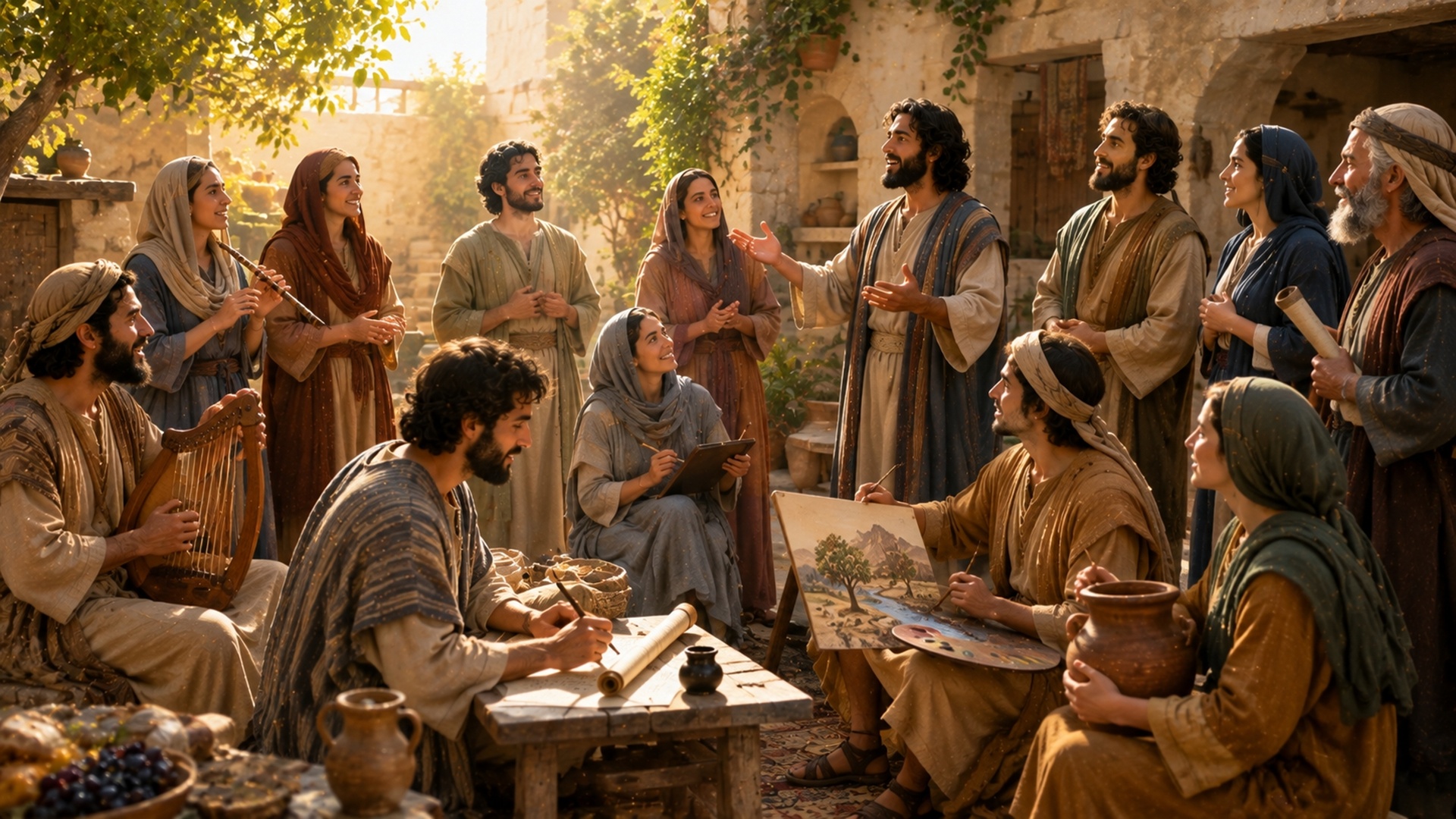
The church today also contains many different abilities, ministries, and spiritual gifts. Some people are gifted in teaching, while others are able to encourage, organize, pray, serve, provide pastoral care, make music, preach, help, or reach people personally. Yet, as in Corinth, there is still a danger of valuing certain gifts more highly than others. Visible ministries often receive recognition more quickly than quiet, hidden tasks. Paul reminds us that God uses not only what is noticeable, but also what is small, faithful, and unseen. A healthy church recognizes that diversity is not a problem, but a gift from God.
💡 4. Central Message of the Lesson
👉 Spiritual gifts come from the Holy Spirit, are given to every believer according to God’s will, and are intended not for self-promotion, but for shared ministry and the building up of the church.
✝️ 5. Theological Focus
The theological focus of this lesson is that spiritual gifts have their origin in God. Paul does not speak merely of natural talents, but of gifts given and sanctified by the Holy Spirit. God can, of course, also use natural abilities, but spiritual gifts are more than human talent. They are instruments of God for ministry within the body of Christ.
It is especially important that Paul describes the gifts in connection with the triune God. He speaks of the “same Spirit,” the “same Lord,” and the “same God.” In this way, he shows that spiritual gifts are not separate, independent powers, but expressions of God’s work within His church. The Holy Spirit gives the gifts, Christ is the Lord of the ministry, and God works through everything in everyone.
This means that no gift belongs to a person in a selfish sense. No one can say, “This gift belongs to me so that I may appear important.” Every gift remains God’s gift and God’s possession. Human beings are merely stewards of what God has entrusted to them.
Therefore, a spiritual gift must never become a reason for pride. Those who receive a gift have not earned it; they have received it. A gift is grace. The very expression “gift of grace” shows that it comes from God’s undeserved goodness. Every gift should therefore lead to humility, not arrogance.
Paul also begins this subject with the confession: “Jesus is Lord.” This is decisive. The first and most fundamental work of the Holy Spirit is not a spectacular gift, but the confession of Christ. Those who truly recognize Jesus as Lord place themselves under His authority, guidance, and truth.
In that time, this confession was very powerful. To say, “Jesus is Lord,” meant that no human power possessed the highest claim over one’s life—not the emperor, society, culture, or the self, but Christ alone. This confession was courageous and could be dangerous. It was itself a work of the Holy Spirit.
This shows that spiritual gifts must never be separated from the lordship of Jesus. A gift is used in a truly spiritual way only when it is submitted to Christ. When a gift draws attention to the person using it but does not lead others to Jesus, it fails to fulfill its purpose.
Paul speaks of different gifts, ministries, and activities. These three terms reveal different aspects of the same work of God. Gifts emphasize what is given. Ministries emphasize the task. Activities emphasize God’s power working through people. Together, they show that God gives, God sends, and God works.
The diversity of gifts is not accidental. God distributes them “as He wills.” This means that we do not need to envy another person’s gift. God knows what His church needs. He also knows which task He has entrusted to each person. Therefore, every believer may gratefully accept their gift and use it faithfully.
The theological core is this: The one God works through many gifts so that the church may grow in unity. Diversity does not oppose unity, but serves it. When all gifts are submitted to Christ, the result is not disorder, but harmonious ministry for the building up of the body of Christ.
🌟 6. Spiritual Deepening
This lesson helps us understand spiritual gifts correctly. Many people ask, “What is my gift?” That is a good question. But an even more important question is: “Whom does my gift serve?” If the answer is not Christ and His church, even a genuine gift can be misused.
The Corinthians possessed many gifts, but they struggled with pride, comparison, and disorder. This shows us that gifts are not a substitute for spiritual maturity. A person can be gifted and still behave immaturely. Therefore, gifts must always be joined with humility, love, and obedience.
The Holy Spirit gives gifts not so that we may set ourselves apart from one another, but so that we may serve one another. There are no useless members in God’s church. Every Christian has a place. Every ministry can be important. Not everyone stands at the front, but everyone can contribute to the building up of the church.
Some gifts are visible, while others remain hidden. A sermon is heard, a song is noticed, and leadership is seen. Yet a prayer offered in private, a visit to someone who is ill, an encouraging message, faithful service in the background, or practical assistance can be just as much the work of God’s Spirit. God does not judge according to the stage, but according to faithfulness.
This truth frees us from envy. We do not need to possess another person’s gift in order to be valuable. God does not give everyone the same gift because the church is not made up of identical parts. Diversity is necessary. If everyone only taught, who would comfort? If everyone only organized, who would listen? If everyone only preached, who would serve?
At the same time, this truth also frees us from feelings of inferiority. Some Christians believe that they have nothing important to contribute. Yet Paul shows that everyone receives something from God. Your gift may be quiet, but it is not worthless. It may receive little attention, but God sees it. It may appear small, but in God’s hands it can bring great blessing.
Another important point is spiritual responsibility. Those who have received a gift should not bury it. Gifts are not given merely for personal enjoyment, but for ministry. God entrusts something to us so that we may strengthen others. Therefore, we should ask: Where can I serve? Whom can I build up? How can Christ become visible through me?
The declaration “Jesus is Lord” places all gifts under a clear order. The gift does not rule the person; Christ does. Feelings do not determine the ministry; God’s will does. Personal honor is not the goal; the glorification of Jesus is.
This is especially important because spiritual gifts can be misused. A person can use a gift to seek attention, impress others, feel superior, or gain influence and power. Paul leads the church back to the center: Everything comes from God and should serve God.
The Holy Spirit does not work chaotically, but Christ-centeredly. He does not lead into pride, but into humility. He does not lead into division, but into unity. He does not lead into self-glorification, but to the confession: Jesus is Lord.
This lesson invites us to surrender our abilities to God anew. Perhaps we have not used our gifts because of fear. Perhaps we have used them too much for ourselves. Perhaps we have envied others or regarded our own task as insignificant. God calls us to renewed and humble service.
True spiritual diversity is beautiful when it is carried by love. A church in which different people with different gifts work together reflects something of God’s wisdom. There it becomes visible that God does not build His church through one person alone, but through many members who serve Christ together.
🔧 7. Application in Daily Life
Practical Steps:
- Ask God in prayer to show you your gifts more clearly.
- Do not compare your gift with the gifts of others.
- Use your ability not for self-promotion, but for service.
- Value quiet and unnoticed ministries within the church.
- Ask where your gift can concretely build others up.
- Consciously submit every gift to the lordship of Jesus.
- Serve faithfully even when your contribution receives little recognition.
- Thank God for the diversity within the church.
❓ 8. Reflection Question
Which gift or ability has God entrusted to me, and how can I use it more intentionally to build up the church and glorify Christ?
🌟 9. Closing Thought
Paul shows that spiritual gifts are diverse but come from the same source. The Holy Spirit gives them, Christ directs them toward ministry, and God works through them to build up the church. Therefore, no one should be proud of their gift, and no one should despise their gift. What matters is not how noticeable a gift is, but whether it is used with humility, love, and faithfulness. The first and most important expression of the Spirit remains the confession: Jesus is Lord. When every gift stands under His lordship, diversity becomes a blessing and the church becomes a living witness for God.
“Now there are diversities of gifts, but the same Spirit.” 1 Corinthians 12:4 ✨🤲🕊️🙏
