




🤩 Bible Stories to Marvel At
Where God’s Wonders Become Great – for Young and Old Hearts
🤲 Psalm 31 – Into Your Hands I Commit My Spirit
🪨 When God Is Rock, Fortress, and a Safe Hand
🌅 Introduction
Psalm 31 is a prayer filled with distress and trust. David experiences fear, enemies, slander, weakness, and deep inner anguish. At times he feels forgotten like a dead man and broken like a damaged vessel. Yet in the midst of this darkness, he holds firmly to God.
In Psalm 30, David had sung that God turned his mourning into joy. There, the morning of rejoicing after a night of weeping stood at the center. Psalm 31 now shows another difficult time, but also a very strong trust: David places his life in God’s hands.
The psalm begins with refuge: David flees to the Lord, his rock and his fortress. He asks God not to let him be put to shame, but to rescue him, guide him, and pull him out of the net that has secretly been set for him.
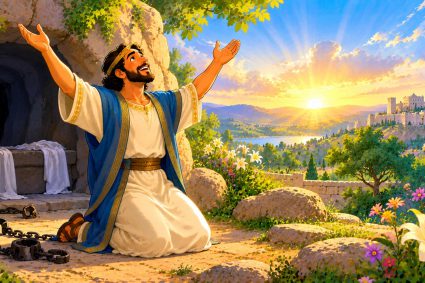
At the heart of the psalm are words that Jesus later spoke on the cross: Into Your hands I commit my spirit. These words express deep trust. David is saying: My life belongs to You. My soul, my future, my fear, and my time are in Your hands.
For young and old hearts, Psalm 31 is an invitation to trust God even in difficult days. When people disappoint us, when words hurt, when fear grows, and when the path becomes dark, God remains our rock, fortress, Savior, and safe hand.
📖 The Biblical Story
🛡️ David Seeks Refuge in the Lord
David begins with the words: Lord, I trust in You. He takes refuge in God. This means that he does not first run to his own strength, to human praise, or to revenge, but to God.
We need refuge when danger is present. Anyone seeking protection knows: I am not secure enough in myself. I need a place that is stronger than the threat.
For young and old hearts, this is an important beginning. When fear, conflict, worries, or hurtful words come, we may flee to the Lord. He is not an uncertain place, but a faithful shelter.
David shows us that trust often does not begin when everything is easy, but when, in the midst of distress, we say to God: I trust in You.
😔 Do Not Let Me Be Put to Shame
David asks God not to let him be put to shame. He does not want his hope in God to become an object of mockery. His enemies should not be able to say: His trust did him no good.
Being humiliated is painful. When others laugh at us, despise us, or speak falsely about us, the heart can suffer deeply. David knows this distress.
Yet he brings his fear of shame to God. He does not try to rescue his honor by himself. He says: Lord, You are righteous. Deliver me in Your righteousness.
For young and old hearts, this means: When you feel misunderstood, mocked, or ashamed, you may ask God to hold you. He knows the truth.
👂 Incline Your Ear to Me
David asks: Incline Your ear to me; hurry to rescue me. This image is very tender. It is as though David were saying: Lord, bend down toward me and listen carefully.
God is great and holy, yet David believes that the Lord turns toward a distressed person. He does not merely listen from far away. He inclines His ear.
For children we can say: When a child speaks quietly, a loving father or mother bends down to hear. This is how David imagines God’s nearness.
Psalm 31 shows us that the great God is not too high to hear a cry for help. He can bend down toward the weak.
🪨 Be My Strong Rock
David asks God to be a strong rock for him. A rock is firm, secure, and immovable. When everything else shakes, the rock remains.
David needs precisely this stability. People can be uncertain. Feelings can change. Circumstances can shift. But God remains firm.
A heart that stands on God has a different foundation from a heart that builds only on people, possessions, or its own strength.
For young and old hearts, this means: You need a firm foundation. God can be that rock when everything else seems uncertain.
🏰 The Lord Is a Fortress and a Place of Protection
David also asks God to be a fortress for him. A fortress was a safe place against enemies. Walls, gates, and high places provided protection.
David knows: I need not only a rock beneath me, but also protection around me. God is both: a firm foundation and a safe refuge.
When David calls God his fortress, he is saying: With You I am not helplessly exposed. You can shelter me even when danger is near.
For young and old hearts, this is comforting: God is not merely an idea. He is like a shelter for the soul.
🧭 Lead and Guide Me for Your Name’s Sake
David asks God to lead and guide him. He needs not only rescue from danger, but also direction for the next step.
God’s guidance comes for His name’s sake. This means: God leads faithfully because He is faithful. He acts according to His own character.
David knows: If I lead myself, I may go astray. If God leads me, my life follows a better path.
For young and old hearts, this is a good prayer: Lord, do not only rescue me from difficulties. Continue to lead me on Your way.
🪤 Pull Me Out of the Net
David speaks of a net that has secretly been set for him. A net is a trap. It is hidden so that someone falls into it without noticing in time.
Sometimes dangers are obvious. Sometimes they are hidden: false words, secret plans, temptations, or situations that want to hold us captive.
David asks God to pull him out of this net. He knows: The Lord sees the trap even when it is hidden.
For young and old hearts, this means: God can free you from things that hold you captive. He also sees what you yourself do not yet fully recognize.
🤲 Into Your Hands I Commit My Spirit
Then David speaks one of the deepest sentences in the psalm: Into Your hands I commit my spirit. This is a prayer of complete trust.
David places his life into God’s hands. He is saying: Lord, I belong to You. My inner being, my future, my fear, my breath, and my life are safe with You.
Hands can hurt or protect. God’s hands are faithful. In them David is more secure than in his own plans.
For young and old hearts, this is a powerful prayer for difficult hours: Lord, I place myself into Your hands. Hold me securely.
✝️ Jesus Spoke These Words on the Cross
These words from Psalm 31 were later spoken by Jesus on the cross: Father, into Your hands I commit my spirit. This gives the psalm a special depth.
Jesus was surrounded by pain, mockery, and darkness on the cross. Yet He placed His life trustingly into the hands of the Father.
Therefore Christians may read Psalm 31 with special comfort. Jesus knows suffering, distress, and what it means to entrust oneself completely to God.
For young and old hearts, this means: When we place our lives into God’s hands, we walk a path that Jesus Himself walked.
💚 You Have Redeemed Me, Lord, Faithful God
David calls God the faithful God who has redeemed him. Redemption means liberation, rescue, and being brought out of danger.
David does not trust a changeable God who helps today and forgets tomorrow. He trusts the faithful Lord. God’s faithfulness is the foundation of his hope.
Even while David is still distressed, he speaks of God’s rescue. His trust looks beyond the trouble of the present moment.
For young and old hearts, this means: God’s faithfulness is stronger than your uncertainty. He is the God who can save.
🚫 David Does Not Trust False Securities
David says that he does not want to follow those who cling to worthless idols. False securities can deceive people. They promise protection, but they cannot save.
In David’s time these could be literal idols. Today they may be other things: money, success, recognition, control, power, or our own selves.
David chooses differently. He trusts in the Lord. He knows: Only God is truly faithful.
For young and old hearts, this raises a question: What do I rely on when I am afraid? Things that pass away, or the living God?
🎉 David Rejoices in God’s Goodness
David says that he wants to rejoice and be glad in God’s goodness. Even in the midst of distress, he remembers God’s faithful love.
God’s goodness is not merely a beautiful word. David has experienced that God has seen his misery and known his soul in distress.
That is comforting. God does not only see our outward circumstances. He also knows the soul in anguish. He understands what others may not see.
For young and old hearts, this means: Your distress is not hidden from God. He sees your suffering and knows your soul.
🌤️ God Sets His Feet in a Spacious Place
David thanks God that He did not hand him over to the enemy, but set his feet in a spacious place. Spaciousness is the opposite of confinement.
Fear makes things feel narrow. Distress makes things feel narrow. Guilt, conflict, and danger can squeeze the heart. But God can give spaciousness.
A spacious place means freedom, breath, light, and new possibilities. David experiences: God does not leave me trapped. He makes room.
For young and old hearts, this means: God can lead you out of inward and outward confinement. He can give your heart room to breathe again.
😢 David Is in Fear and Sorrow
Then the psalm becomes very honest again. David asks: Be gracious to me, Lord, for I am in distress. His eyes are dim with sorrow, and his soul and body suffer.
Distress often affects the whole person. When the heart suffers, the body feels it too. When the soul is burdened, the eyes, strength, and breathing become heavy.
David does not hide this weakness. He brings it before God and asks for grace.
For young and old hearts, this is important: You may tell God when fear and sorrow make you tired. He sees both soul and body.
💔 Life Is Filled with Sighing
David says that his life passes away in grief and his years in sighing. These are heavy words. He is experiencing a long period of burden.
Some pains do not last only one day. There are troubles that continue for a long time. David knows this long weariness of the heart.
Yet even these words are spoken in prayer. David does not remain alone with his sighing. He brings it to the Lord.
For young and old hearts, this means: Even long sighing may be brought before God. He does not grow weary when His children are weary.
🦴 Strength Fades Away
David says that his strength is failing because of his guilt or distress and that his bones are wasting away. He feels exhausted inwardly and outwardly.
Sometimes a person is not only sad, but powerless. He knows what would be right, but lacks the strength. He wants to stand, but feels weak.
David shows us that this kind of weakness also has a place in prayer. God does not demand that we pretend to be strong before Him.
For young and old hearts, this means: When your strength is small, come to God. He understands weak people.
🙈 David Becomes an Object of Mockery
David describes how he has become an object of ridicule to his enemies, a burden to his neighbors, and a terror to his acquaintances. People avoid him when they see him outside.
This is very painful. Not only his enemies trouble him; even people near him turn away. Loneliness becomes an additional burden.
When a person suffers and others withdraw, the heart can feel deeply abandoned. David knows this feeling.
For young and old hearts, this is comforting: God remains even when people distance themselves. He knows loneliness.
🏺 Forgotten Like a Dead Man, Broken Like a Vessel
David says that he is forgotten like a dead man and has become like a broken vessel. These are very strong images of loneliness and brokenness.
A broken vessel appears useless. People may throw it away. David feels as though he no longer has value in the eyes of others.
But before God, a broken heart is not worthless. God can heal, gather, and make new.
For young and old hearts, this means: Even when you feel broken, you are not lost to God. He does not throw you away.
🗣️ David Hears Slander
David says that he hears the whispering of many. Terror surrounds him. People conspire together against him and plan to take his life.
False words and secret plans can wound deeply. David lives under pressure because people are not only speaking against him, but also trying to harm him.
Yet he brings this slander before God. He knows that God hears what people say in secret.
For young and old hearts, this means: When others speak falsely, God knows the truth. He hears not only the loud voices, but also your quiet prayer.
🛡️ But I Trust in You
In the midst of this distress David says: But I trust in You, Lord. This “but I” is powerful. It means: Despite everything people do, I hold on to God.
David does not say: I understand everything. He does not say: I feel no fear. But he does say: I trust.
Trust is sometimes a decision made in the midst of pressure. It means bringing the heart back to God again and again.
For young and old hearts, this is a sentence to hold on to: But I trust in You, Lord.
👑 You Are My God
David confesses: You are my God. This is personal, simple, and deep. God is not only the God of the people, not only the God of earlier times, but David’s God.
In difficult times the heart needs this personal confession. Not merely: God is somewhere. But: You are my God. I belong to You. You know me.
For children we can say: David holds on to God as to someone who truly belongs with him and will not leave him.
For young and old hearts, this means: Make God’s truth personal. Say in prayer: Lord, You are my God.
⏳ My Times Are in Your Hands
David says: My times are in Your hands. This is one of the most beautiful sentences in the psalm. Not only his spirit is in God’s hands, but also his time.
Our time includes past, present, and future. Days, years, seasons of waiting, difficult hours, and unanswered questions all lie before God.
David knows: My enemies do not ultimately determine my time. My fear does not determine it. My future is in God’s hands.
For young and old hearts, this is a great comfort: Your life does not slip out of God’s hands. Your time is in His hands.
🌟 Let Your Face Shine
David asks: Let Your face shine upon Your servant. God’s shining face means nearness, favor, kindness, and blessing.
When God’s face shines upon a person, the heart becomes bright. Not because all problems immediately disappear, but because God’s nearness becomes more clearly visible.
David asks for rescue through God’s goodness. He knows: God’s gracious gaze is his hope.
For young and old hearts, this means: Ask God to let His face shine upon you. His nearness makes dark paths brighter.
🤐 Let Lying Lips Be Silenced
David asks that lying lips be silenced—those that speak proudly and arrogantly against the righteous. He has experienced the destructive power of words.
Lies can wound, shame, and endanger people. Proud words can make others small while making oneself appear great.
David brings this before God as well. He asks the Lord to set limits to falsehood.
For young and old hearts, this is an important lesson: Words are not harmless. Therefore our lips should be truthful, humble, and loving.
🎁 How Great Is God’s Goodness
After his request concerning lying words, David marvels at God’s goodness. He says how great the goodness is that God has prepared for those who fear Him and take refuge in Him.
God’s goodness is not small, scarce, or uncertain. It is abundant. It is like a treasure God keeps for His children.
Whoever fears the Lord and seeks refuge in Him does not stand empty-handed. God sees, protects, and blesses.
For young and old hearts, this means: God’s goodness is greater than you can see. Trust Him even when you do not yet understand everything.
🛖 God Hides His People in the Shelter of His Presence
David says that God hides His people in the shelter of His presence from human plots. God’s nearness is described here like a hiding place.
When people plot, speak, and try to harm, God can hide His child. Not always in the sense that every difficulty immediately disappears, but in the sense that the soul is sustained.
God’s face is not only bright, but also protective. His nearness is a safe place.
For young and old hearts, this means: Your heart may hide with God when people are harsh.
🏕️ God Protects from Quarreling Tongues
David says that God shelters His people in a dwelling from the strife of tongues. Words can be like a storm: loud, hurtful, and restless.
But God can protect His child in His presence. He can give peace even while others are speaking. He can preserve the heart so that evil words do not destroy it.
For young and old hearts, this means: You cannot always control what others say. But you can go to God, who protects your heart.
The Lord is a shelter in the storm of words.
🏙️ God Shows Wonderful Goodness in a Besieged City
David praises the Lord because He has shown him wonderful goodness, as in a fortified or besieged city. The image shows protection in the midst of danger.
A city under pressure needs strong walls and a faithful defender. David experiences God’s goodness like a place of protection when distress is near.
God’s goodness is not only for peaceful days. It is revealed especially where danger and pressure are great.
For young and old hearts, this means: Even in distressed times, God can show wonderful goodness.
😟 David Thought: I Am Cast Away
David remembers that in his alarm he thought: I am cut off from before Your eyes. In his fear he felt separated from God.
That was his feeling, but it was not the final truth. Sometimes fear says things that are not true. It says: God no longer sees you. God no longer hears you.
But David realizes: Yet God heard the voice of my supplication.
For young and old hearts, this is very comforting: Your fear may be loud, but God is faithful. Even when you feel abandoned, He can hear you.
👂 God Heard His Plea
David confesses that God heard him when he cried out to Him. This is the answer to his earlier fear.
He thought he had been cut off. But God had not ignored his prayer. God’s ear was open even when David could not feel it.
This strengthens the heart. Feelings are real, but God’s faithfulness is greater than feelings.
For young and old hearts, this means: Keep holding on in prayer. God hears more deeply than you sometimes feel.
❤️ Love the Lord, All His Faithful Ones
Now David calls to others: Love the Lord, all His faithful ones. Whoever has experienced God’s faithfulness wants to invite others to love God.
David speaks not only of fear and obedience, but of love. God is worthy of love because He is faithful, good, holy, and saving.
Love for the Lord is shown when we trust Him, listen to Him, and seek His presence.
For young and old hearts, this means: Faith is not merely duty. God invites your heart to love Him.
🛡️ The Lord Protects the Faithful
David says that the Lord protects the faithful. God sees people who hold on to Him even when things are difficult.
Faithfulness does not mean never being weak. Faithfulness means not running away from God, but returning to Him again and again.
The Lord preserves such people. He knows their struggles, their prayers, and their trust.
For young and old hearts, this is an encouragement: Stay with the Lord. He protects those who trust Him.
⚖️ God Opposes the Proud
David also says that God fully repays the proud. Pride sets itself against God. It says: I need no one. I know better. I am my own master.
God takes pride seriously because pride makes the heart hard. A proud heart does not want to listen, repent, or depend on anyone.
Therefore David warns against pride. God’s way is the way of trust, humility, and love.
For young and old hearts, this means: Pride makes the heart hard, but humility opens the heart to God’s help.
💪 Be Strong and Let Your Heart Take Courage
The psalm ends with encouragement: Be strong, and let your heart take courage, all you who wait for the Lord. David speaks to all who are waiting, hoping, and holding on.
Courage does not mean that fear is completely gone. Courage means holding on to the Lord despite fear. Strength grows from God’s nearness.
Whoever waits for the Lord is not waiting in emptiness. He is waiting for the faithful God whose hands are secure.
For young and old hearts, this is a powerful ending: Wait for the Lord. Let your heart take courage. God holds your time in His hands.
🌅 God’s Hands Hold Time
Psalm 31 leads us through fear, slander, weakness, loneliness, and distress. Yet again and again trust shines through: You are my rock. You are my fortress. Into Your hands I commit my spirit. My times are in Your hands.
This is the great message of the psalm. A person is not ultimately in the hands of his enemies, not in the hands of fear, and not in the hands of chance. Whoever trusts God may know: My life is in God’s hands.
These hands are strong enough to save and gentle enough to hold. They guide, shelter, protect, and carry.
For young and old hearts, the invitation remains: Place your fear, your future, and your time into God’s hands. He is faithful.
🌅 What This Psalm Shows
Psalm 31 shows that David seeks refuge in the Lord during severe distress. He calls God his rock and fortress, asks for guidance, rescue, and protection, and places his life into God’s hands.
The psalm also shows that trust does not mean never experiencing fear. David speaks openly of sorrow, weakness, loneliness, slander, and threat. Yet in the midst of it all he confesses: You are my God; my times are in Your hands. At the end, he calls everyone who hopes in the Lord to courage and strength.
🟣 Summary
Psalm 31 is a prayer of David filled with distress and trust. David seeks refuge in the Lord and asks not to be put to shame. He calls God his rock and fortress and asks Him to lead him and pull him out of the net that has secretly been set for him. Then he speaks the profound words: Into Your hands I commit my spirit. David trusts the faithful God who has redeemed him. At the same time, he describes great fear, sorrow, physical weakness, mockery, loneliness, and slander. Yet in the midst of everything he says: But I trust in You, Lord; You are my God. My times are in Your hands. He asks for God’s shining face and marvels at the great goodness God has prepared for those who fear Him. At the end he confesses that the Lord protects the faithful and encourages all who hope in the Lord: Be strong, and let your heart take courage.
💚 Message for Young and Old Hearts Today
We learn: God is a rock and fortress for distressed hearts. When fear, sorrow, mockery, or false words strike us, we may flee to Him and seek protection with Him.
We also learn: Our life is safe in God’s hands. David says: Into Your hands I commit my spirit, and: My times are in Your hands. Whoever prays like this entrusts past, present, and future to God.
And we learn: Feelings of abandonment do not have the final word. David thought he was cast away from God’s sight, but God had heard his plea. Therefore all who wait for the Lord may be strong and take new courage.
💭 Thought for Reflection
🔸 What does it mean for me to place my life into God’s hands?
🔸 What fear or worry may I bring to God today with the words: My times are in Your hands?
🔸 Where do I need courage while I wait for the Lord?
🧒 👧 👦
💌 Invitation to Psalm 32
💛 Happy Is the Person Whose Guilt Is Forgiven
Psalm 31 has shown us how David places his life into God’s hands. He experiences fear, sorrow, and distress, yet he trusts that his time is in God’s hands.
Psalm 32 now leads us to another deep joy: the joy of forgiveness. David describes how heavily hidden guilt weighs on the heart and how freeing it is to confess sin before God.
What happens when a person stops hiding his guilt and receives God’s forgiveness?
Come along and discover the next psalm!
🔔 Teaser for Psalm 32
🕊️ When Forgiveness Sets the Heart Free
Psalm 32 is a psalm about guilt, confession, and liberation. David says that the person is happy whose transgression is forgiven and whose sin is covered.
👉 Why does hidden guilt make the heart heavy?
👉 How does a person change when he confesses his sin before God?
👉 And why can the Lord surround the forgiven person with grace?
✨ In the next psalm we learn: Forgiveness is not merely a word, but a deep liberation that makes the heart joyful again.
