

🌾 Sabbath School Compact
Understand, deepen, and live the weekly lesson.
✉️ THE CORINTHIAN LETTERS
🌍 Lesson 11 – Stewardship and Mission
📅 Study week: September 5–11, 2026
🕊️ Sabbath: September 12, 2026
🏛️ 3rd Quarter 2026: 1 and 2 Corinthians
The eleventh lesson takes us into 2 Corinthians 8 and 9 and to a subject that Paul connects surprisingly deeply with the gospel: giving. The immediate background is a collection for needy fellow believers in Judea. Yet Paul does not treat this collection as a mere financial campaign. He speaks about the grace of God, the example of Jesus, gratitude, love, intentional planning, voluntary generosity, and the unity of the church. In this way, stewardship and mission become inseparably connected. God entrusts His church with material resources, time, strength, abilities, and influence so that His grace may reach other people through them. The central question, therefore, is not simply how much a Christian gives, but from what kind of heart he gives, to whom his life belongs, and what purpose his gifts serve.
💎 Memory Verse
“For you know the grace of our Lord Jesus Christ, that though He was rich, yet for your sakes He became poor, that you through His poverty might become rich.”
2 Corinthians 8:9
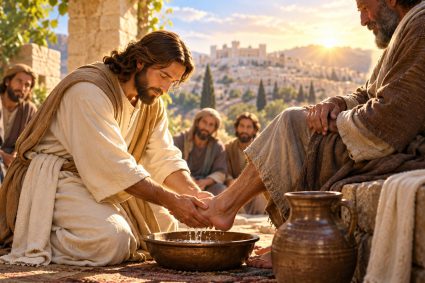
Paul does not begin his theology of giving with the human wallet, but with Christ. Before he urges the Corinthians to complete the collection they had promised, he reminds them of what Jesus has done for them. Christ possessed glory with the Father, yet He humbled Himself, became human, lived in our fallen world, and finally went all the way to the cross. His self-giving had a clear purpose: that people might receive through Him the riches of salvation. That is precisely why this verse is the key to the entire lesson. Christian generosity does not begin with the question of what God wants from us, but with the recognition of what God has already given us in Christ.
Whoever understands the gospel in this way no longer sees giving primarily as loss. We give because we ourselves have received. Grace comes first from God to us and is then meant to flow through our lives to others. Stewardship is therefore not a method of earning God’s favor, but a response to His grace already received.
🧭 What Is It About?
The churches in Judea were experiencing economic hardship, and Paul organized a collection among the Gentile churches for their fellow believers. The Corinthians had already agreed earlier to take part, but the tensions between them and Paul had delayed the completion of the collection. After Paul dealt extensively with their strained relationship in the first seven chapters of 2 Corinthians, he now returned to the collection and encouraged them actually to complete what they had begun.
What is remarkable, however, is the way Paul argues. He does not put the church under financial pressure and does not try to produce the highest possible amounts through guilt. Instead, he repeatedly directs the Corinthians back to grace. He reminds them of the surprising generosity of the poor churches in Macedonia, and above all of Jesus Himself. Then he speaks about personal decision, appropriate planning, a joyful attitude, and shared responsibility.
This means that biblical stewardship is far greater than a discussion about money. It asks how a person handles everything God has entrusted to him. Our possessions, our time, our strength, our abilities, and our opportunities all belong to life with God. When Christ wins our hearts, the question also becomes important of how these gifts can serve His kingdom and the good of others.
📖 The Lesson at a Glance
✝️ 11.1 The Example of Jesus
Paul begins with the churches in Macedonia, whose behavior seems almost paradoxical. They themselves lived under severe economic hardship and yet were extraordinarily generous. Their poverty did not automatically make them self-centered. Instead, they pleaded for the privilege of taking part in helping others. Yet Paul does not present even this impressive generosity as the highest standard. Behind their behavior stands an even greater example: Jesus Christ.
In 2 Corinthians 8:9, Paul compresses the entire history of salvation into a single sentence. Christ was rich and became poor for our sake. His “poverty” refers to far more than His simple lifestyle on earth. The eternal Son of God left the glory He had with the Father, took on human nature, and finally humbled Himself to the point of death on the cross. His entire mission is marked by self-giving.
Stewardship therefore receives a Christ-centered foundation. Jesus did not merely give something; He gave Himself. His self-giving was also not without purpose; it took place so that lost people might be saved. This is exactly where stewardship and mission meet. What God gives serves His saving purpose.
For us, therefore, discipleship means more than occasional generosity. The question is whether the self-giving character of Jesus shapes our relationship to possessions, time, abilities, and other people. We can never imitate or repay His gift, but His grace can produce in us a new attitude in which we do not merely hold on to what we have received, but pass it on as a blessing.
❤️ 11.2 Motivation
Generosity grows out of grace, gratitude, and genuine love
2 Corinthians 8 and 9 are permeated with the language of giving and grace. Paul names several motives that sustain Christian generosity: gratitude for God’s grace, the example of Jesus, the willingness to share blessings received, and sincere love. The decisive point is that giving does not begin with external compulsion. It arises from an inward response to God’s action.
The order is important. God gives first. He gives grace, Christ, forgiveness, hope, and everything that belongs to life. Human beings give afterward in response. Whoever reverses this order can easily turn stewardship into a religious achievement by which one tries to prove something to God. Paul thinks in exactly the opposite way: We are generous because God has been generous to us.
That is why Paul can also view giving as a test of the genuineness of love. Love does not remain merely in kind words or warm feelings. Where it is real, it becomes willing to invest time, strength, attention, and material resources for another person. This does not mean that the size of a donation automatically proves the depth of love. The poor Macedonians show precisely the opposite: What mattered was not the absolute amount, but a heart that had first given itself to the Lord.
This statement from 2 Corinthians 8:5 is perhaps one of the most important principles in the entire lesson. They first gave themselves to the Lord. Everything else followed from that. True stewardship therefore does not begin with a financial decision, but with surrender. If God receives only a small portion of our possessions while our heart still belongs exclusively to ourselves, we have not yet understood the core. But where a person entrusts himself to Christ, his priorities gradually begin to change as well.
🗓️ 11.3 Planning
Planned giving as an intentional response to God’s grace
Generosity is not presented by Paul as merely a spontaneous emotion. In 2 Corinthians 9:7, each person is to give what he has previously decided in his heart. The lesson points out that the Greek verb used carries the idea of a prior decision. Giving may therefore be thoughtful and planned. Paul likewise emphasizes the principle of proportionality: the gift is according to what a person actually has, not according to what he does not have.
This thought protects against two extremes. On the one hand, it prevents carelessness. Whoever gives only when a strong spontaneous feeling arises will easily forget good intentions. Planning turns a wish into a concrete decision. On the other hand, the principle of proportionality protects against unhealthy pressure in which people are made to compare themselves with others or to give resources they do not actually possess.
Paul therefore does not demand an identical gift from every person. People have different possibilities, and God does not expect artificial uniformity. What matters is that each person consciously examines his responsibility before God. The amount of a gift thus becomes a personal matter of conscience, while generosity as a basic attitude applies to everyone.
Here too, planning has a spiritual dimension. God’s own plan of salvation was not an improvised emergency measure. The self-giving of Christ belongs to the great plan of redemption. When we also plan our giving intentionally, we express that God’s mission has a fixed place in our priorities and does not depend merely on what happens to be left over.
😊 11.4 Attitude
Giving cheerfully out of surrender, freedom, and love for God
Paul is interested not only in that people give, but also in how they give. The Macedonians are described as people whose great affliction and poverty were joined with an astonishing abundance of joy and generosity. They gave voluntarily, regarded their participation as a privilege, and had first given themselves to the Lord. Later Paul summarizes this thought in the well-known statement that God loves a cheerful giver.
Biblical stewardship therefore contradicts the idea that giving is mainly a burdensome religious duty. Of course, even a cheerful giver needs discipline and planning, but the deeper attitude is different. He does not see the opportunity to give merely as a reduction of his possessions, but as an opportunity to participate in God’s work.
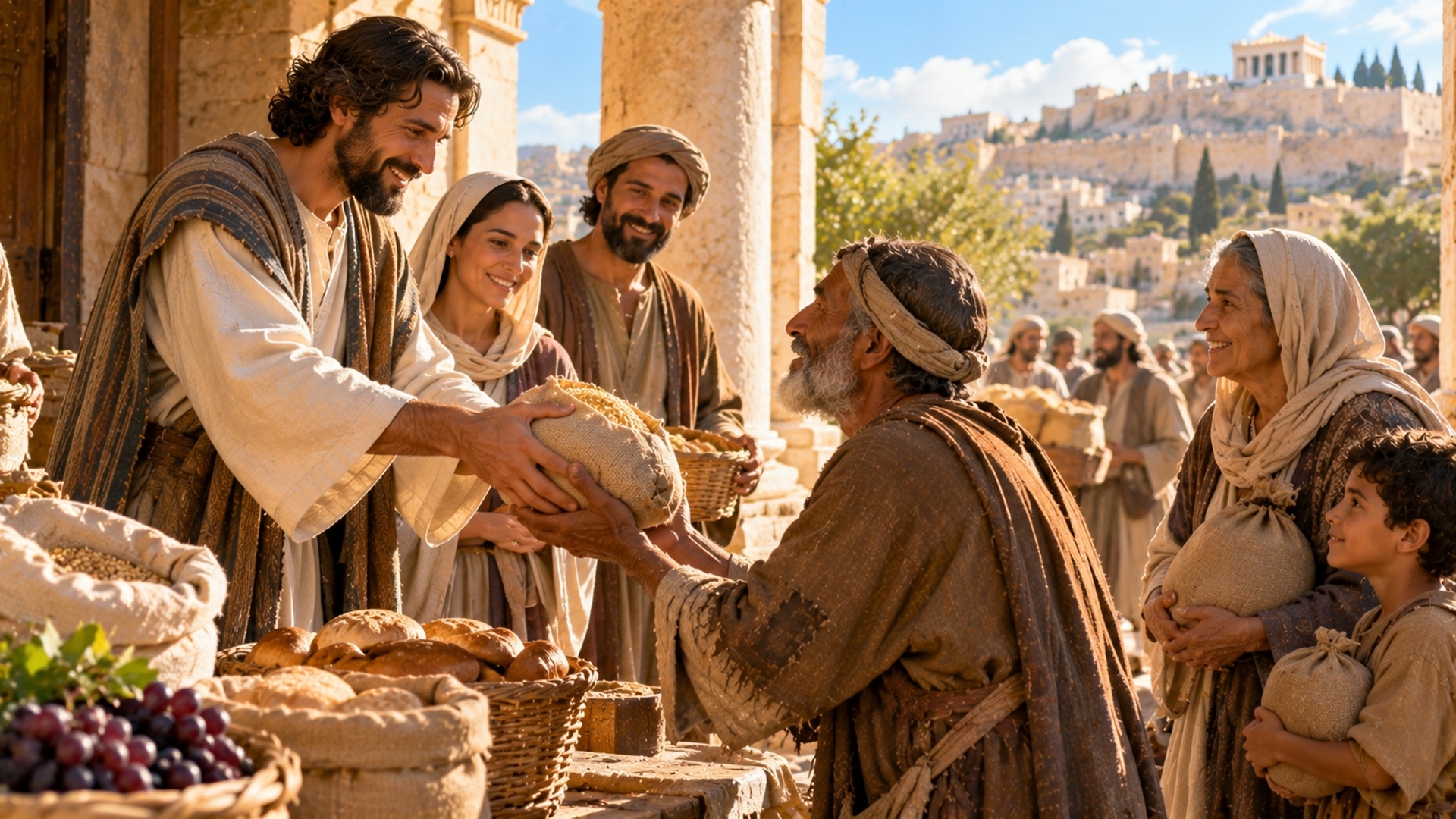
Especially remarkable is the willingness of the Macedonians. Paul did not have to pressure them. They themselves asked to be allowed to participate. This shows how deeply the gospel had changed their perspective. In spite of their own limited means, they did not see themselves only as recipients of help, but also wanted to become givers themselves.
There is an important dignity in this. Mission is not carried only by a few wealthy people while everyone else remains a spectator. Everyone can participate according to his possibilities. Some give money, others time, hospitality, practical skills, prayer, influence, or personal service. Stewardship includes the whole person.
The joy of giving therefore does not come from the fact that sacrifice is always pleasant. It grows from the knowledge that what we place in God’s hands can become part of a greater work. A gift can relieve need, make mission possible, reach people with the gospel, and strengthen churches. The giver may share in that.
🤝 11.5 Unity
Giving connects the church in shared love and mission
The collection for Jerusalem had not only an economic significance but also an ecclesiological one. Gentile churches collected for Jewish Christians. People who were culturally and historically far apart and who once might even have viewed one another as opponents were to experience visibly that through Christ they belonged to the same family. Paul therefore also wanted the collection to strengthen the unity between Jewish and Gentile Christians.
Giving thus becomes an expression of spiritual fellowship. When a church stands by fellow believers in another place, it is saying in practice: Your need is not indifferent to us. We belong together. This is precisely where the worldwide mission of the church also has special significance. People who may never meet personally can participate together in the same mission through prayer, offerings, and mission projects.
At the same time, Paul was careful about transparency. Titus and other brothers recognized by the churches were entrusted with administering the collection. The funds were not simply to be handed over to one individual without accountability. Paul wanted to act carefully and honorably both before God and before people. Especially in financial matters, responsible administration is itself part of Christian stewardship.
This point remains important today. Money can promote fellowship, but when transparency is lacking and motives are wrong, it can also produce distrust and division. That is why generosity, trust, and accountability belong together. A church that responsibly manages mission funds protects not only finances, but also relationships and credibility.
Finally, Paul describes the collection with terms that go far beyond a financial transaction: service, grace, blessing, fellowship, and expression of love. An offering can therefore truly make spiritual unity visible when it comes from a heart that loves Christ and His church.
🔎 A Deeper Thought
God does not need our money – but He wants our heart
One of the most important insights of this lesson is not to understand stewardship as though God were financially dependent on us. Everything already belongs to Him. Our giving does not make God richer, nor does it make up for any divine shortage. Why then does God invite us to give at all?
Because giving does something to our heart. Possessions have the unusual ability to bind security, attention, and loyalty to themselves. That is why Jesus spoke so often about the human relationship to material things. Not because money is fundamentally evil, but because the way we handle it reveals what we love and what we trust.
When we consciously pass on something of what God has entrusted to us, we practically acknowledge that we are not absolute owners but stewards. In doing so, we declare that God’s kingdom is more important than complete control over everything we possess. This is precisely why Paul connects financial generosity so closely with grace, surrender, and love.
Yet this applies not only to money. Our time can also become so completely claimed by us that hardly any room remains for others. Abilities can serve only our own success, and influence can be used mainly for our own recognition. Stewardship asks the same question everywhere: What am I doing with what God has given me?
The answer of the gospel does not begin with a table, but with Christ. Because He gave Himself for us, we too may learn to use our gifts in such a way that others are blessed through them.
🔗 The Bible Explains the Bible
John 3:16 summarizes God’s attitude with one simple verb: God loved, and therefore He gave His Son. Love and giving belong directly together here. God’s gift also has a missionary purpose: people are not to perish but to receive eternal life. Thus we find the same connection as in 2 Corinthians 8 and 9 – giving serves salvation.
Philippians 2:5–8 deepens the example of Jesus. Christ did not selfishly cling to His position, but humbled Himself and took the form of a servant. His self-giving becomes a pattern for Christian thinking. The follower of Jesus therefore should not merely ask what he is entitled to, but how he can serve others.
Acts 4:32–35 shows how this attitude became visible in the early church. The unity of the believers led them not to regard material need simply as the private problem of the individual. Fellowship took on a concrete social dimension.
Romans 15:26–27 finally connects the collection for Jerusalem explicitly with fellowship between Gentile Christians and Jewish believers. The Gentile churches had received spiritual blessings and now wanted to respond through material support. Mission, gratitude, and unity are intertwined here as well.
💬 Questions for Reflection
Why is the example of Jesus more decisive for stewardship than any financial rule? Because Christian giving does not arise first from a regulation, but from grace. Christ shows us a God who gives Himself. Rules can bring order to our giving, but only the experience of this grace can make the heart truly generous.
How can I recognize whether my giving is mainly motivated by duty or by gratitude? Duty and discipline are not automatically negative, but Paul goes deeper. If giving is constantly experienced only as loss, it is worth looking again at what we ourselves have received. Gratitude does not necessarily change the amount of a gift immediately, but it changes its inner meaning.
Why is planning spiritually meaningful in giving? Because it gives God’s work a conscious place in our priorities. Whoever decides beforehand what resources he regularly wants to devote to God’s cause and to others does not leave generosity to chance. At the same time, Paul preserves individual freedom and calls for a gift according to actual means.
How can giving promote the unity of the worldwide church? It connects people across geographical, cultural, and economic boundaries. When churches take responsibility for one another and carry mission together, it becomes visible that the body of Christ is greater than one local congregation.
🌱 Understand – Deepen – Live
Understand in this lesson means first of all not separating stewardship from mission. God entrusts resources to His church so that His gospel may be carried forward, people may be supported, and churches may be built up. Giving is therefore not merely an administrative matter, but part of participation in God’s mission.
Deepen means looking beyond the gift to the heart. Paul speaks about grace, gratitude, love, planning, willingness, and joy because the outward action alone is not enough. A person can appear generous outwardly and still seek recognition or act under pressure. The gospel wants to go deeper and produce an attitude that grows out of surrender to Christ.
Live finally means reexamining our own understanding of possessions. What God has given us may be used responsibly for our needs, but it should not revolve exclusively around ourselves. We can plan intentionally, give regularly, support mission work, notice people in need, and also make our time, abilities, and influence available. The decisive movement remains the same as with the Macedonians: first give ourselves to the Lord and from there learn to be there for others.
📜 Ellen White on the Subject
For further study, Friday’s lesson points to Ellen White’s chapter “A Liberal Church” in The Acts of the Apostles. There she connects Christian generosity directly with the love of Christ and the mission of the gospel. According to her description, people whose hearts are filled with Christ increasingly view money, time, influence, and other gifts received from God as opportunities to advance His work.
Another important thought is that God does not need to be enriched by our gifts. Everything comes from Him anyway. The opportunity to give rather allows us to express gratitude and love in practical ways and to make the good we ourselves have received available to others. Ellen White therefore does not view willingness to sacrifice as a losing transaction, but as the expression of a relationship in which God’s love transforms our relationship to possessions.
In this way, she reaches exactly the center of 2 Corinthians 8 and 9. Stewardship does not begin with money, but with the heart; yet neither does it end with the heart, because genuine love becomes practical. What Christ has given us moves us to give as well, so that others may experience something of His grace through our lives and our resources.
✨ The Thought for This Sabbath
When we think about a subject like stewardship, we easily think first of numbers, percentages, budgets, and offerings. Paul, however, begins in an entirely different place. He places Jesus before us. Christ was rich and became poor for our sake. Heaven did not answer our need with a small gift from its abundance, but with the giving of the Son of God.
From there, the entire perspective changes. We do not give so that God will love us; we give because He has already loved us. We do not give in order to purchase salvation; we give because salvation has been given to us. We do not give merely because an organization needs resources, but because God has invited us to participate in His mission.
That is why Paul speaks about planning and at the same time about joy, about personal decision and at the same time about fellowship, about financial support and at the same time about love. Stewardship encompasses the whole person. A planned gift can be just as spiritual as a spontaneous offering when it comes from a heart surrendered to Christ. A small gift can have great value in God’s eyes when it is given faithfully and according to one’s actual means. And a collection can accomplish far more than material assistance when it connects churches with one another and makes visible that Christians together belong to one family.
Yet the deepest statement remains the one about the Macedonians: They first gave themselves to the Lord. That is where everything begins. If Christ receives only our money but not our heart, stewardship remains external. But if He receives us ourselves, then gradually everything else is reordered as well: our possessions, our time, our abilities, our priorities, and our relationship with other people.
Stewardship is therefore our response to Christ’s sacrifice, and mission is the direction in which that response continues to flow. From received grace grows gratitude, from gratitude generosity, from generosity service – and through this service the church is united in shared love and mission.
