



🌿 Traces of Creation – Discoveries from Nature
🐟 3rd Series: Life in the Hidden Realm – The World of Fish
🥚 Episode 6 – Reproduction in Open Water – Order Without a Nest
🌊 Introduction: Passing on Life Without a Shelter
For many land animals, reproduction is tied to protected places.
Nests, caves, breeding sites—
they separate the vulnerable from danger.
In water, things are different.
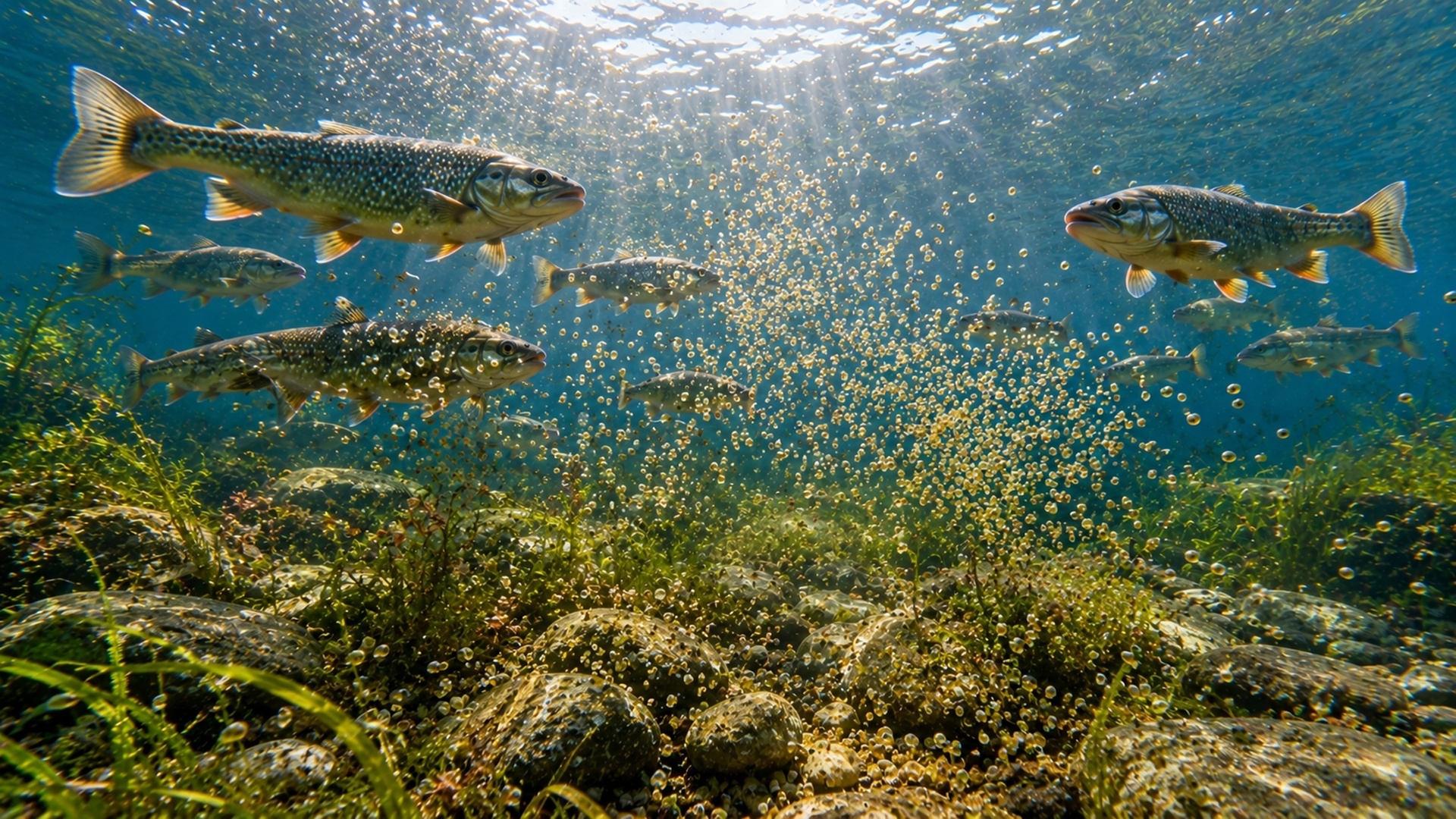
Many fish spawn in open water.
Without a nest.
Without fixed boundaries.
Without visible protection.
And yet reproduction remains possible—
regularly, successfully, and in great numbers.
How can order arise
where everything appears to be left to chance?
⏳ 1. Spawning: Not Chaos, but Timing
At first glance, spawning appears disorderly.
Eggs and sperm are released into the water,
currents scatter them,
and dangers are everywhere.
But this impression is misleading.
Spawning follows clear patterns:
- specific seasons
- precise water temperatures
- suitable light conditions
- often exact times of day
Many species spawn simultaneously.
Thousands of individuals at the same time.
This synchronization is crucial:
- It increases the chances of fertilization
- It overwhelms predators through sheer numbers
Here, order is revealed in the timing,
not in the location.
🔢 2. The Role of Quantity
Many fish species produce enormous numbers of eggs.
This may seem wasteful—
but it is functional.
In open water:
- High losses are taken into account
- Survival is achieved through numbers
Not every egg needs to be protected
when there are enough of them.
This strategy replaces protection with statistics,
not with carelessness.
🛡️ 3. Eggs Are Not Simply “Unprotected”
Fish eggs are by no means passive objects.
They possess:
- protective coverings
- often adhesive mechanisms
- in some cases, camouflage
Some eggs:
- sink deliberately
- drift in a controlled way
- attach themselves to plants or rocks
Even without a nest,
there are small-scale patterns of order
that make survival more likely.
💨 4. Currents as a Means of Transport
What appears to be a danger
is often part of the solution.
Currents:
- distribute eggs
- prevent overcrowding
- open up new habitats
Reproduction makes use of the movement of the water
instead of working against it.
Here, order arises through movement,
not in spite of it.
👶 5. Parental Care – Rare, but Purposeful
Not all fish leave everything to the open water.
Some species display:
- mouthbrooding
- guarding their eggs
- careful selection of spawning sites
Interestingly:
Parental care appears where
it serves a practical purpose.
Not everywhere.
Not as a universal rule.
The same principle applies here:
👉 Effort is invested only where
it brings a benefit.
🐣 6. Independent from the Very First Moment
Many fish larvae are
left to themselves from the very beginning.
No feeding.
No protection.
No instruction.
And yet they possess:
- innate movement patterns
- sensory abilities that function immediately
- instinctive escape responses
Survival does not begin with care,
but with built-in equipment.
⚙️ 7. Why This Strategy Works
Reproduction in open water works
because it:
- is adapted to environmental conditions
- requires no permanent structures
- responds flexibly to change
It is less vulnerable
to local disturbances
than systems tied to one location.
Whatever is lacking
is compensated for by other mechanisms.
🧠 8. A Rational View of Reproduction
In technical systems, the following principle applies:
Not every task requires maximum protection.
Sometimes distribution is more efficient than protection.
The reproduction of many fish follows exactly this principle.
Not everything is preserved.
But enough is.
Here, order is revealed
not in every detail,
but in the outcome.
✝️ 9. The Christian Perspective: Trusting in Order
The Christian perspective emphasizes
that life is not protected in the same way everywhere,
but everywhere it is sustained.
Reproduction without a nest appears risky—
yet it is still embedded
within larger patterns.
Not everything is held onto.
Some things are released.
And yet life continues.
💡 10. What This Form of Reproduction Teaches Us
It teaches us:
- Order can exist without visible safeguards
- Protection is not the only strategy
- Trust can be part of stability
Perhaps it also reminds us
that not everything must be preserved
for a future to emerge.
🌌 Closing Thought
A fish releases life into the water
without holding onto it.
And yet life continues.
Not through control,
but through an order
greater than the individual.
Those who take this form of new beginning seriously
discover even in open water
traces of creation.
