





✉️ FIRST AND SECOND CORINTHIANS
🌍 Lesson 11: Stewardship and Mission
🤝 11.5 Unity
🌐 Giving unites the church in shared love and mission
📖 1. Introduction
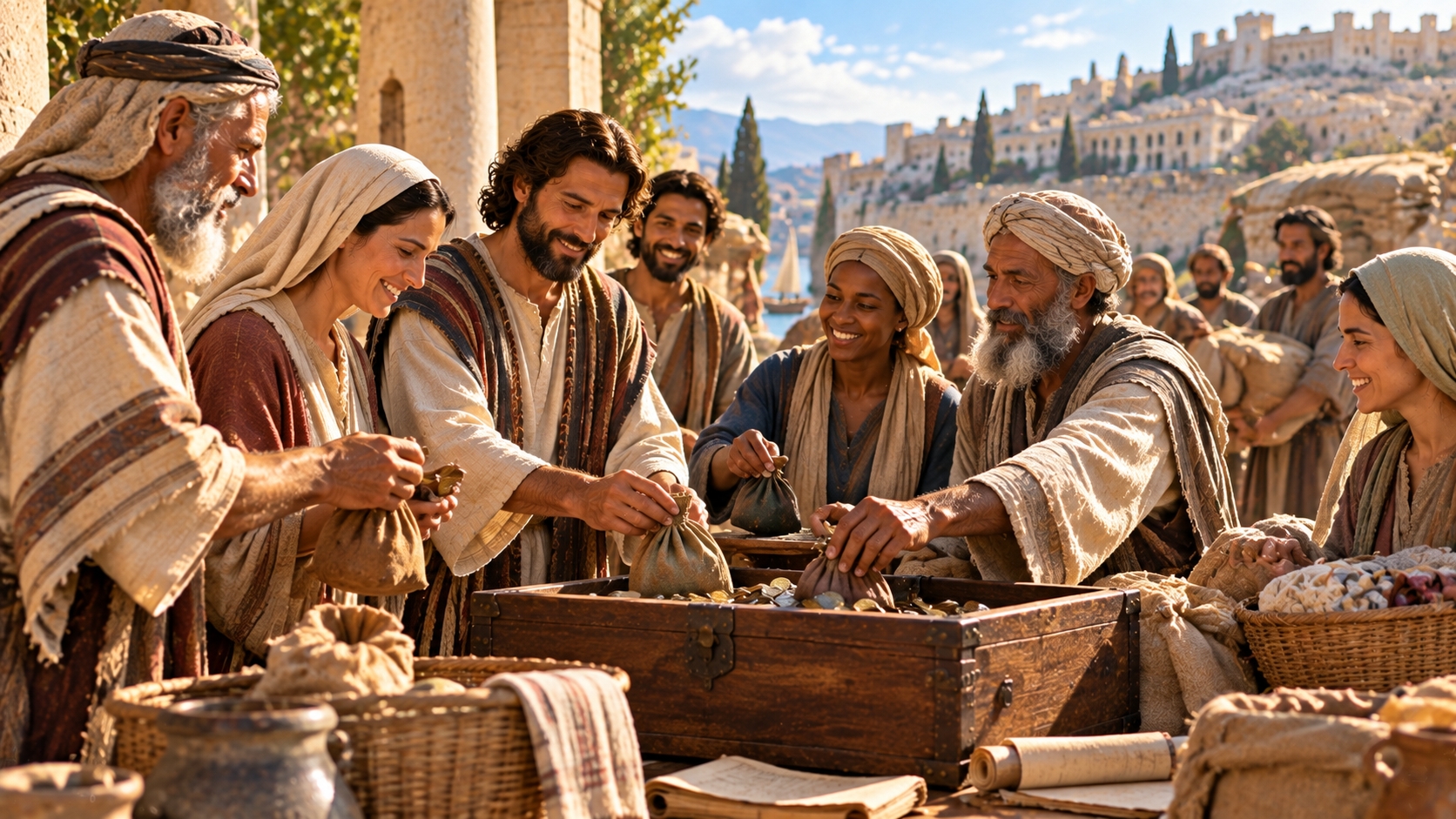
Paul views the collection for the impoverished believers in Judea not merely as financial assistance, but as a spiritual ministry that makes the unity of the church visible. The Christians from the Gentile churches were to recognize that they belonged to the same family of God as the Jewish believers in Jerusalem. What had once been separated by origin, culture, and history was brought together in Christ. Their gift therefore became a sign that the gospel tears down walls and joins people together into one body. Giving thus became a practical expression of love, fellowship, and missionary responsibility. Where Christ is at the center, stewardship becomes an instrument of unity.
📜 2. The Biblical Foundation
Paul made sure that the collection was carried out in an orderly and trustworthy manner and under the authority of the churches:
“And we have sent with him the brother whose praise is in the gospel throughout all the churches.”
2 Corinthians 8:18
He continues:
“And not only that, but who was also chosen of the churches to travel with us with this grace.”
2 Corinthians 8:19
Concerning Titus and the brothers, Paul writes:
“Whether any do enquire of Titus, he is my partner and fellowhelper concerning you: or our brethren be enquired of, they are the messengers of the churches, and the glory of Christ.”
2 Corinthians 8:23
And he calls upon the Corinthians:
“Wherefore shew ye to them, and before the churches, the proof of your love.”
2 Corinthians 8:24
Romans 15 also reveals the unity expressed through the gift:
“For it hath pleased them of Macedonia and Achaia to make a certain contribution for the poor saints which are at Jerusalem.”
Romans 15:26
These texts show that Christian giving is not merely private charity, but fellowship lived out within the body of Christ.
🌍 3. Connection to Our Time
Today as well, God unites His church across countries, languages, cultures, and circumstances of life. When we give for mission, those in need, partner churches, or worldwide projects, we participate in a practical way in the lives of other believers. In doing so, we demonstrate that God’s work is important not only where we live, but wherever people need help, hope, and the gospel. Such giving protects us from narrow, purely local thinking and opens our eyes to the worldwide family of God. At the same time, the handling of gifts requires trust, transparency, and spiritual responsibility so that unity is not damaged by suspicion. Where gifts are given in love, order, and faithfulness, it becomes visible that Christ’s church truly belongs together.
💡 4. Central Message of the Lesson
👉 Christian giving strengthens the unity of the church because it makes love practical, makes fellowship visible, and supports God’s worldwide mission.
✝️ 5. Theological Focus
The theological focus of this lesson is the unity of the body of Christ. Paul is not simply collecting money for a social emergency; through this collection he makes a profound spiritual truth visible: Jews and Gentiles belong in Christ to one new family. The gospel creates a community that is stronger than origin, history, social differences, and former tensions.
The impoverished believers in Jerusalem were Jewish Christians. The churches in Macedonia and Achaia consisted predominantly of Christians from the nations. From a human perspective, distance could easily have existed between them. Yet Paul does not see them as separate groups, but as members of the same body. When one part suffers, another part should help. In this way, the unity created by the gospel becomes practical.
This unity is not based merely on human sympathy, but on Christ. Through His death, Jesus reconciled people to God and at the same time overcame the divisions between human beings. Whoever belongs to Christ also belongs to His brothers and sisters. Christian stewardship, therefore, can never be understood as merely individual. It is always communal and missionary as well.
Paul describes the collection using terms such as ministry, grace, blessing, fellowship, and proof of love. This shows that a gift in the biblical sense is more than a financial transaction. It is a spiritual act. It serves God, helps people, strengthens relationships, and confesses the unity of the church. Money therefore does not become an end in itself, but an instrument of love.
Transparency is especially important. Paul ensures that Titus and other proven brothers administer the gift. They have been appointed by the churches and are described as “messengers of the churches.” In this way, Paul shows that spiritual generosity must be connected with responsible administration. Wherever money is involved, clarity, trust, and accountability are necessary.
This order is itself a ministry to unity. When funds are handled without clarity, mistrust, division, and conflict can arise. Paul wants to prevent a good gift from being damaged by suspicion. Therefore, he acts openly, orderly, and collectively. The gift is not only intended to provide assistance, but also to strengthen trust between the churches.
The collection also shows that mission and unity belong together. A church that thinks only of itself becomes spiritually narrow. A church that sees the needs of others and supports God’s work around the world grows in its experience of belonging together. Mission reminds us that we are part of something greater than our own local situation.
The theological core is this: Christ makes many people into one body, and Christian giving is a visible expression of this unity. Stewardship serves not only provision, but also reconciliation, fellowship, and mission. When the church gives in love, it practically confesses that it belongs together worldwide under one Lord.
🌟 6. Spiritual Deepening
This lesson challenges us not to see our giving merely as a personal decision, but as an expression of our belonging to the body of Christ. When we think about donations, we often first think about amounts, projects, or needs. Paul, however, shows that behind the gift lies a deeper reality: we belong together. The need of another part of the church must not leave us indifferent.
This is especially important in a world strongly shaped by individualism. Many people first ask: How does this affect me personally? What do I gain from it? What can I see directly? The gospel broadens this perspective. In Christ, we learn not to focus only on our own church, our own needs, and our own plans. We learn to see, with the heart of God, brothers and sisters who may live far away.
The collection for Jerusalem was a powerful sign. Gentile Christians helped Jewish Christians. People from different regions, with different backgrounds and experiences, were united through a gift. This shows that unity does not arise through words alone. It becomes visible when love becomes practical.
Today as well, a gift can build bridges. When churches support missionaries, sustain relief projects, help persecuted or impoverished brothers and sisters, or promote worldwide gospel work, they are saying: You are not alone. We belong together. Your need concerns us. God’s mission unites us. This awareness strengthens the worldwide church.
Giving also protects us from spiritual self-centeredness. A church can become so absorbed in its own programs, buildings, concerns, and needs that it loses sight of God’s greater mission. Paul leads the Corinthians out of such narrowness. He reminds them that they are part of a larger movement of God. Their gift represents participation in God’s worldwide mission.
At the same time, Paul shows that unity cannot exist without trust. This is why transparency is so important. Money can be an instrument of love, but it can also become a cause of mistrust and conflict. Paul knew this and therefore acted with great care. He did not want the collection to be burdened by suspicion. Churches need this same wisdom today.
Spiritual administration must be open, responsible, and accountable. This protects the donors, the recipients, and those entrusted with responsibility. It preserves the honor of Christ and strengthens the credibility of mission. When people know that gifts are administered faithfully, they can give with greater joy and confidence.
The unity Paul describes is not merely organizational. It is spiritual. It arises from a shared belonging to Christ. An organization can connect people outwardly, but only Christ can truly make hearts into one family. Therefore, every genuine unity must be rooted in the gospel.
This unity does not simply erase differences, but places them under Christ. Jews and Gentiles remain people with different histories, yet in Christ they are no longer strangers. Rich and poor have different possibilities, but they belong together. The strong and the weak need one another. Those who give and those who receive do not stand in a relationship of superiority and inferiority, but together within the same grace.
This is important because assistance can easily be given from a position of superiority. Paul, however, does not present the gift as an instrument of power. The giving churches should not place themselves above those receiving. Everything happens through grace. The one who gives gives from what he himself has received. The one who receives does not receive as someone inferior, but as a brother or sister in Christ.
In this way, giving becomes humble. It does not say, “We are better.” It says, “God has entrusted something to us so that we may serve.” This attitude preserves unity. Proud giving can humiliate. Loving giving lifts people up. Christian generosity should not create dependence or superiority, but strengthen fellowship.
The collection was also a testimony for future generations. It demonstrated that the gospel has concrete social, spiritual, and communal consequences. The church is not merely a group of people who hold similar beliefs, but a family that accepts responsibility for one another. This truth remains a powerful testimony today.
When we give for worldwide mission, we become aware that God’s work is greater than our own horizon. Perhaps we never see the people who are helped. Perhaps we do not know their names. Perhaps only in eternity will we discover what fruit grew from our gifts. But God sees it. And within the body of Christ, no faithful service is insignificant.
This lesson therefore invites us to live generously and with a deep awareness of community. Our gifts can support preaching, education, health ministry, humanitarian aid, church planting, media mission, and many other ministries. In all of these things, the focus is not merely on projects, but on people who are to come to know Christ and be strengthened.
In the end, Paul leads us back to Christ. He is the head of the church. Under Him, people from every nation, language, and culture become one body. When we give, we are not merely serving a cause, but the Lord who loves His church. Our gift becomes a small but genuine sign of His great reconciling love.
🔧 7. Application in Daily Life
Practical Steps:
- Do not view your church in isolation, but as part of God’s worldwide family.
- Support mission and those in need with the awareness that you are serving brothers and sisters in Christ.
- Give not only for local needs, but also for God’s work beyond your immediate surroundings.
- Pay attention to transparency, trust, and order in the handling of gifts.
- Avoid pride when giving and ingratitude when receiving.
- Pray for the people and churches supported through your gifts.
- Let your stewardship become a sign of unity, love, and mission.
- Regularly ask how your possessions can serve God’s worldwide mission.
❓ 8. Reflection Question
Does my giving reflect the fact that I belong to God’s worldwide family and bear responsibility for God’s mission beyond my own immediate surroundings?
🌟 9. Concluding Thought
Paul shows that Christian giving makes the unity of the church visible. The collection for the impoverished believers in Judea united Jewish and Gentile Christians as one family in Christ. The gift was therefore not merely financial assistance, but an expression of fellowship, love, gratitude, and mission. At the same time, Paul took care to ensure transparent administration so that trust would be strengthened and the honor of Christ preserved. When gifts are given in love and administered responsibly, they can not only relieve need but also unite hearts and churches. Stewardship thus becomes a testimony that Christ has made His worldwide church into one body.
“Wherefore shew ye to them, and before the churches, the proof of your love.”
2 Corinthians 8:24 🤝🌐🙏✨
