
🟦 Introduction
Lesson 5 is about how Christians should use their freedom responsibly. Paul shows that knowledge alone is not enough unless it is accompanied by love. The church in Corinth had to learn that personal rights and freedoms may need to be subordinated to the well-being of others. Through the examples of food offered to idols, self-denial, and Israel’s past, Paul makes clear how dangerous pride and spiritual self-confidence can be. True discipleship does not merely ask, “What am I allowed to do?” but, “What honors God and builds others up?” This lesson invites us to place our entire lives under this guiding principle: “Do everything for the glory of God.”
✉️
✉️ FIRST AND SECOND CORINTHIANS
👑 Lesson 5: All to the Glory of God
🧠 5.1 Knowledge Versus Love
❤️ Knowledge Becomes Spiritually Valuable Only Through Love
📖 1. Introduction
In Corinth, there were Christians who knew a great deal but did not always act lovingly. Regarding food offered to idols, some were convinced that because of their knowledge, they were free to eat anything. They knew that idols were not real gods and that there is only one true God. Yet Paul shows them that correct knowledge can become dangerous when it is used without love. Those who ask only, “What do I know?” or “What am I allowed to do?” can easily overlook a brother or sister with a weak conscience. Therefore, Paul makes it clear: Knowledge alone puffs up, but love builds up.
📜 2. The Biblical Foundation
Paul writes:
“Knowledge puffs up, but love builds up.” 1 Corinthians 8:1
Then he says:
“And if anyone thinks that he knows anything, he knows nothing yet as he ought to know.” 1 Corinthians 8:2
And further:
“But if anyone loves God, this one is known by Him.” 1 Corinthians 8:3
Concerning the one God, Paul writes:
“Therefore concerning the eating of things offered to idols, we know that an idol is nothing in the world, and that there is no other God but one.” 1 Corinthians 8:4
These verses show that true knowledge does not lead to pride, but to love, humility, and consideration.
🌍 3. Connection to Our Time
Even today, knowledge without love can become dangerous. A person may be biblically correct and still act in a hurtful, proud, or inconsiderate way. Conflicts sometimes arise in churches not only because of ignorance, but because truth is used in a cold manner. Some emphasize their freedom, knowledge, or convictions so strongly that they fail to notice how others are being hurt or unsettled. Paul reminds us that spiritual maturity is measured not only by what we know, but by how deeply our knowledge is shaped by love. Truth and love must never be separated.
💡 4. Central Message of the Lesson
👉 Knowledge is spiritually healthy only when it is guided by love and seeks not personal pride, but the building up of others.
✝️ 5. Theological Focus
The central thought of this lesson is the contrast between knowledge that puffs up and love that builds up. Paul does not criticize knowledge itself. Biblical knowledge is important. Christians should know God, His Word, and His will. Yet knowledge becomes dangerous when it is separated from the heart.
In a certain sense, the Corinthians were right. They knew that idols were not real gods. They knew that there is only one God. This knowledge was biblically correct. Yet Paul shows that correct knowledge can be applied wrongly when love is absent.
The problem, therefore, was not the truth that there is only one God. The problem was how that truth was being handled. Some of the “strong” believers in the church made their knowledge the basis of personal freedom without showing consideration for the weak. Their knowledge did not lead to service, but to self-assertion.
Paul says, “Knowledge puffs up.” By this he means knowledge that produces pride. It causes people to think more highly of themselves than they should. Those who think this way use truth to feel superior. That is not spiritual maturity, but spiritual danger.
In contrast, Paul says, “Love builds up.” Love does not ask first: How can I prove my freedom? Instead, it asks: How can I strengthen my brother? How can I protect my sister? How can I contribute to the growth of the church?
The expression “builds up” is important. The church is God’s building. Everything we do should strengthen others in faith. If my knowledge confuses, hurts, or spiritually endangers someone, then I have not used it in the spirit of Christ.
Paul connects knowledge with the knowledge of God. Whoever thinks that they have understood everything has not yet understood how they ought to know. True knowledge remains humble because it recognizes that God is greater than our understanding. The more a person truly knows God, the less arrogant they become.
Then Paul says, “But if anyone loves God, this one is known by Him.” This is a profound statement. The most important thing is not that I boast in my knowledge, but that I live in a genuine relationship with God. To be known by God means to belong to Him and to be loved and accepted by Him.
Paul also draws upon the Jewish confession of faith: There is only one God. Yet in the Bible, this truth is always connected with love. In Deuteronomy 6, the confession of the one God is followed by the command to love God with all one’s heart. Knowledge about God must therefore lead to love for God.
When I love God, I will also respect the people whom God loves. Therefore, true knowledge of God can never remain loveless. Those who truly know God will not merely make correct statements about Him, but will reflect His character.
The theological core is this: Knowledge without love is incomplete. It can even become destructive. Love without truth becomes weak, but truth without love becomes hard. The gospel unites both in Christ.
🌟 6. Spiritual Deepening
This lesson challenges us especially in areas where we feel certain of ourselves. The “strong” believers in Corinth were convinced that they were right. And in a particular sense, they were. Yet people who are convinced that they are right are especially at risk of becoming unloving.
It is possible to hold a correct theological position and still lose the spirit of Christ. A person can defend biblical truth while at the same time crushing others. A person can emphasize freedom while wounding another person’s conscience. Paul says: This is not the way of love.
Spiritual maturity is shown not only by knowing what is permitted. It is shown by voluntarily being considerate. Love is willing to give something up, even if it is permissible in itself, when doing so protects or builds up another person.
This is a very practical principle. In the Christian life, there are many questions where we should ask not only: Is this forbidden? But also: Is it helpful? Does it build up? Does it lead closer to Christ? Could it confuse someone or cause them to stumble?
Paul calls us to a freedom governed by love. Christian freedom is not selfish. It does not say: I am allowed to do this, so I will do it. It asks: How can I live out my freedom in a way that honors Christ and strengthens others?
This is especially important in the church. Different people have different life stories, experiences, questions of conscience, and levels of spiritual maturity. What is not a problem for one person may be a real temptation or source of confusion for another. Love takes such differences seriously.
The weak believers in Corinth apparently still had old associations with idolatry in their consciences. When they saw other Christians eating food offered to idols, they may have thought that idolatry was compatible with faith after all. Therefore, the strong had to learn that their freedom affected others.
Even today, there are areas in which Christians have different sensitivities. These may involve media, lifestyle, clothing, food, leisure activities, music, language, or certain cultural practices. Not every question carries the same importance, but the same principle applies everywhere: Love does not seek only its own advantage.
This lesson also challenges us in the way we handle biblical truth. Truth should not be used as a weapon to shame others. It should serve as a light that leads to Christ. When knowledge makes people more humble, loving, and willing to serve, it is spiritually healthy.
At the same time, love does not mean abandoning truth. Paul does not say that the weak should remain in their mistaken understanding. But he treats them patiently. He does not want them to be wounded by inconsiderate behavior, but to be able to grow in Christ.
Love builds up. This means that love thinks long-term. It asks: How can this person grow in faith? How can their conscience be strengthened? How can they know Christ better? Love is not merely kind, but spiritually responsible.
If knowledge without love can become harmful, then we should also examine our motives. Why do I want to say something? Why do I want to defend my freedom? Do I truly care about truth and building others up, or do I simply want to assert myself?
Being known by God gives us deep peace. We do not need to prove ourselves through knowledge, strength, or freedom. We belong to God. From this security, we can act lovingly without constantly having to defend our rights.
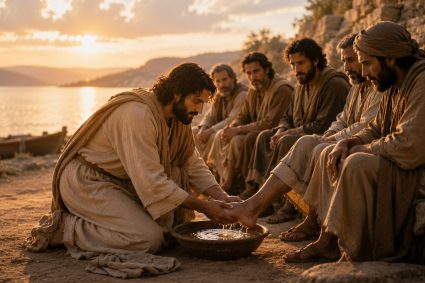
Christ Himself is the highest example of this. He possessed all rights and all knowledge, yet He lived in love and self-sacrifice. He did not seek His own interests, but the salvation of others. Those who follow Him learn to place knowledge in the service of love.
🔧 7. Application in Daily Life
Practical Steps:
- Examine whether your knowledge makes you more humble or more proud.
- Do not ask only, “What am I allowed to do?” but, “What builds others up?”
- Show consideration for people with a weaker or wounded conscience.
- Never defend biblical truth without love and patience.
- Be willing to give up a freedom voluntarily when doing so helps others spiritually.
- Ask God to guard your heart against pride.
- Pay attention to whether your words lead people closer to Christ.
- Learn always to connect knowledge with love, humility, and responsibility.
❓ 8. Reflection Question
Where might I be using my knowledge or freedom more for self-affirmation than for building others up?
🌟 9. Closing Thought
Paul shows that knowledge alone is not enough. It can even become dangerous when it is used without love. The Corinthians knew that there is only one God, yet some had forgotten that this truth should lead them to love and consideration. Spiritual maturity does not ask only about one’s own rights, but about the well-being of others. Knowledge becomes truly spiritually valuable only when it is shaped by God’s love. Those who love God and are known by Him will live out their freedom in a way that honors Christ and builds up the church.
“Knowledge puffs up, but love builds up.” 1 Corinthians 8:1 ✨🧠❤️🙏