🌱 GROWING IN A RELATIONSHIP WITH GOD
💧 Lesson 10: Repentance and Forgiveness
📘 10.5 The Most Expensive Robe
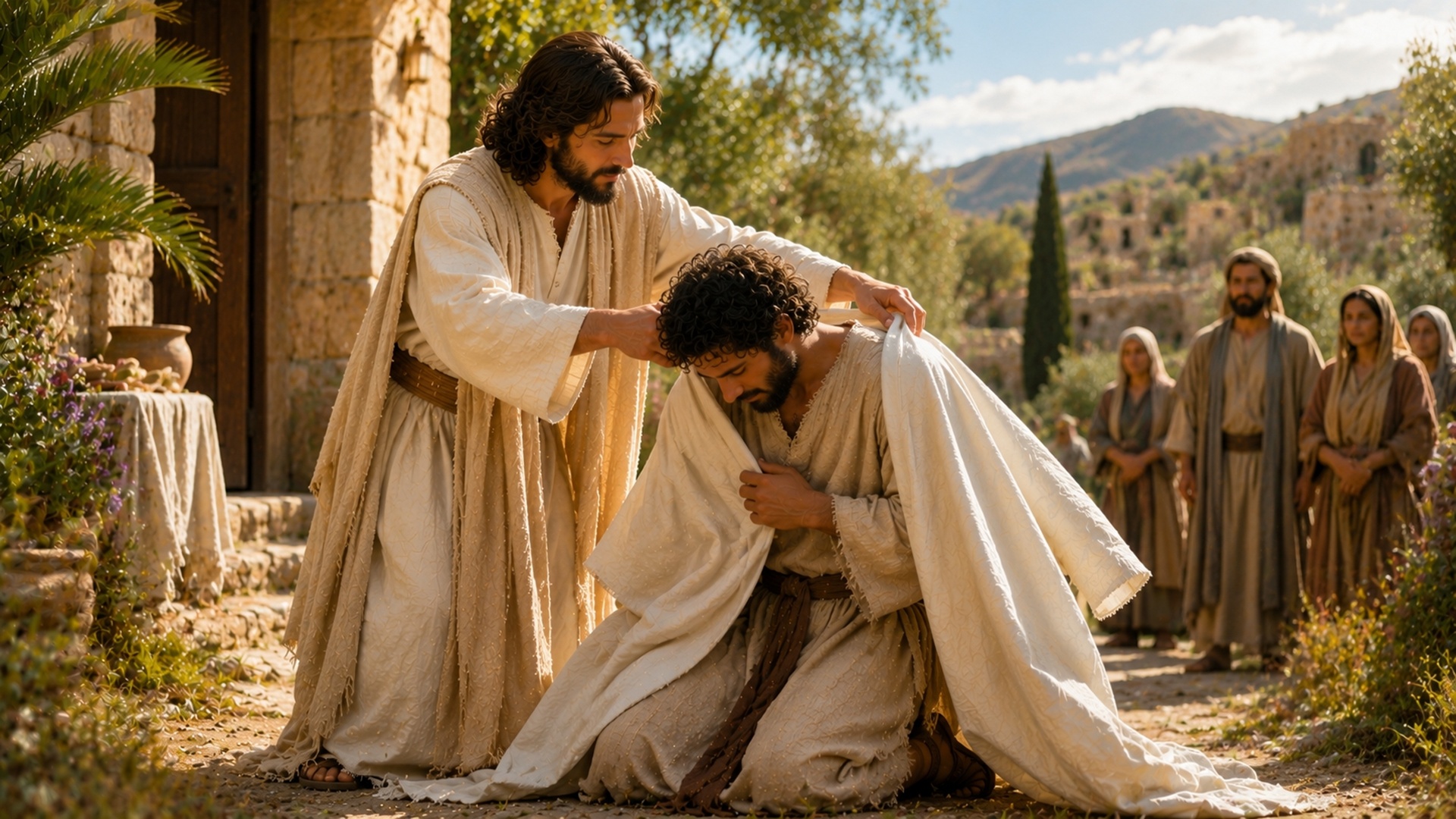
Christ’s righteousness – the only garment that allows us to stand before God
📖 1. Introduction
In today’s world, clothing is often associated with identity, status, and success. People express through their outward appearance who they are or who they want to be. The Bible also uses the image of a garment, but in a much deeper spiritual sense. Before God, it is not our outward appearance that counts, but whether we are clothed with the righteousness of Christ. The lesson shows that no human being can stand before God through personal achievements. Only the garment that Christ gives makes us ready for His kingdom.
📜 2. The Biblical Foundation
In the parable of the royal wedding feast (Matthew 22:1–14), a guest appears without a wedding garment. Although he had been invited, he had not put on the garment that was provided.
Jesus makes clear:
- The invitation is for everyone.
- The garment is offered to everyone.
- But each person must accept it personally.
Other important texts are:
- Zechariah 3:4–5: The filthy garments are removed.
- Isaiah 61:10: The garment of salvation and the robe of righteousness.
- Revelation 19:8: The fine, clean linen of the saints.
- Ephesians 5:27: A church without spot or wrinkle.
All these images point to the righteousness of Christ.
🌍 3. Connection to Today
Even today, many people try to make themselves acceptable before God through their own works.
Some rely on:
- good works,
- religious activities,
- church membership,
- moral behavior.
Others compare themselves with people whom they consider worse.
But God’s standard is not comparison with other human beings, but His perfect holiness.
Before this standard it becomes clear:
no human being possesses the necessary righteousness by their own strength.
That is why everyone needs the same gift:
Christ’s perfect garment.
💡 4. Central Message of the Lesson
👉 Not our own righteousness, but only the righteousness of Christ makes us able to stand before God.
✝️ 5. Theological Focus
The image of the garment runs through the entire history of salvation.
Before the fall, Adam and Eve were clothed with a garment of light. They lived in perfect fellowship with God and knew neither guilt nor shame.
After the fall, everything changed.
For the first time, they noticed their nakedness and tried to cover themselves:
“They sewed fig leaves together and made themselves coverings.”
(Genesis 3:7)
This action symbolizes the human attempt to solve the problem of sin by oneself.
But God did not accept this solution.
Instead, He made garments of animal skins for them.
For this, a sacrifice had to be made.
Already here, the gospel appears for the first time:
- An innocent one dies.
- The guilty are covered.
This principle reaches its climax in Jesus Christ.
His perfect life and His substitutionary death form the true garment of righteousness.
When the Bible speaks of justification, it does not mean that God ignores our sin.
Rather, He credits the believer with the righteousness of Christ.
The sinner appears righteous before God not because of personal achievements, but because of what Christ has done for them.
Therefore, the wedding garment symbolizes:
- forgiveness,
- justification,
- acceptance,
- and the perfect righteousness of Jesus.
The man in the parable was lost because he rejected the garment offered to him.
His problem was not a lack of invitation.
Nor a lack of opportunity.
His problem was his refusal to accept what the king had provided.
🕊️ 6. Spiritual Deepening
The lesson asks a decisive question:
What does it mean in practice to clothe oneself daily with Christ’s righteousness?
First, it means consciously acknowledging every day:
I cannot save myself.
This attitude stands in contrast to natural human pride.
Many people want to contribute something to their salvation.
But the gospel teaches:
- Christ is enough.
- His righteousness is enough.
- His sacrifice is enough.
To clothe oneself daily with Christ’s garment therefore means:
- accepting His forgiveness,
- trusting in His merits,
- seeking His presence,
- and submitting to His guidance.
It also means remaining in a living relationship with Him.
The righteousness of Christ is not only a legal declaration.
It also affects the character.
Whoever remains connected with Christ
is changed by the Holy Spirit.
Their thoughts,
their motives,
and their behavior increasingly begin to reflect Christ.
In this way, the garment of righteousness is not only credited,
but also made visible.
Not as the foundation of salvation,
but as the fruit of salvation.
The greatest danger is,
like the man in the parable, to believe
that one can appear without the garment.
Some trust in:
- knowledge,
- tradition,
- works,
- piety.
But none of these can replace
what Christ alone can give.
Therefore, God’s invitation remains the same today:
Come to Christ.
Accept His garment.
Do not trust in your own righteousness.
🔧 7. Application in Daily Life
Practical steps:
- Begin each day with the awareness of your dependence on Christ.
- Thank God daily for His forgiveness.
- Do not trust in your own achievements.
- Cultivate a close relationship with Jesus through prayer and Bible study.
- Ask the Holy Spirit to make the character of Christ visible in you.
The garment of Christ is put on daily through faith.
❓ 8. Reflection Question
In everyday life, do I trust more in my own spiritual performance or in the perfect righteousness of Jesus?
🌟 9. Closing Thought
In the end, no human being will stand in the kingdom of God because of personal merit. All the redeemed will be there because they accepted the garment Christ offered them.
👉 The most precious garment in the universe was purchased at the cross — and is given to everyone who accepts it by faith. 👗✝️