🗺️ LESSONS OF FAITH FROM JOSHUA
⛪ Lesson 9 : Heirs of the Promise, Prisoners of Hope
📘 9.3 The Challenge of the Land
✨ Receiving Grace, Living Responsibly
🟦 Introduction
The story of Israel is a testimony that God’s gifts are not merely possessions, but callings. The Israelites did not receive the promised land because of their strength or achievements, but solely through God’s grace. Yet this gift also required responsibility, courage, and obedience.
The challenge was not only to receive the land, but to live within the divine promise.
Our salvation mirrors this: we are saved by grace — but true discipleship means growing in that grace, acting, and remaining faithful.
…………………………….. 🗺️ ……………………………..
📖 Bible Study
📜 Bible Text 1 – Joshua 13:1–7
“Joshua was old and advanced in years. The LORD said to him: You are old and advanced in years, and there remains very much land to be possessed.” (Joshua 13:1)
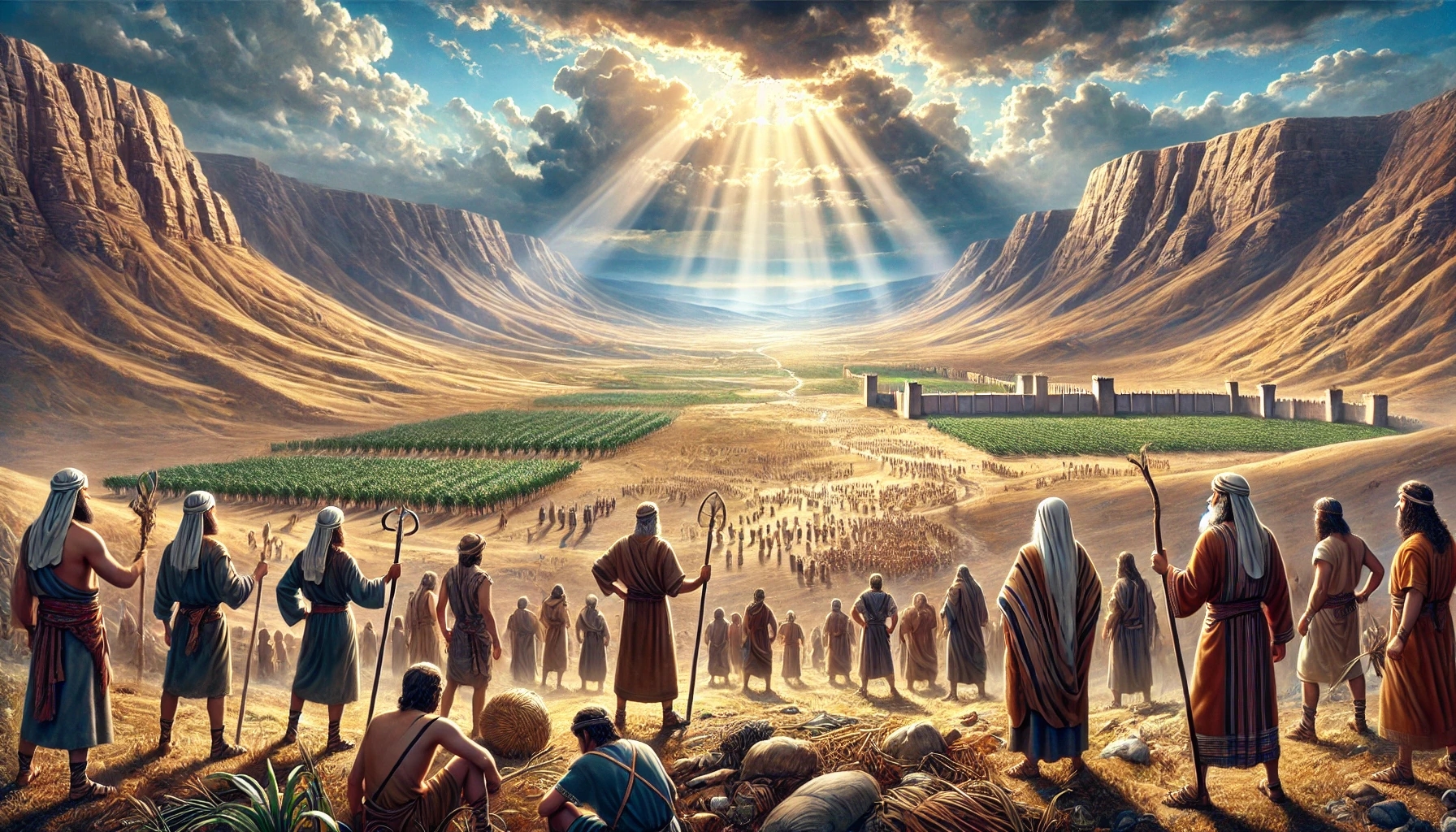
This passage shows that despite a long journey and many victories, Israel had still not taken possession of the entire promised land. God lists the territories that remain — a sign that the promise had been given, but not yet fully realized.
It was a call to further action in faith, even though Joshua was now old. Responsibility shifted to the people.
📜 Bible Text 2 – Philippians 2:12
“…work out your salvation with fear and trembling; not only in my presence but now much more in my absence.”
Paul is not speaking about earning salvation, but about how the redeemed are to take their salvation seriously and live actively in faith. It is about participating in the process of sanctification — in humility and reverence before God.
📜 Bible Text 3 – Hebrews 12:28
“Therefore, since we are receiving a kingdom that cannot be shaken, let us be thankful, and so worship God acceptably with reverence and awe.”
Here the emphasis is that received grace should not lead to passivity but to gratitude expressed in reverent service. The unshakable kingdom is a gift — but one to be lived out with dedication.
…………………………….. 🗺️ ……………………………..
🗣️ Answers to the Questions
🔹 Question 1: What challenges were connected to possessing the land, even though Canaan was a gift from God? (Joshua 13:1–7)
The greatest challenge was that although the land was a divine gift, possessing it did not happen automatically or without effort. Israel had no military superiority. They were former slaves with no military tradition or experience. The fortified cities of Canaan — especially those of the Philistines — were considered unconquerable even by Egypt.
God Himself tells Joshua that “much land remains.”
The challenge, then, was to continue in faith despite age, exhaustion, and uncertainty. The people needed to learn that God’s promises become real only when they are acted upon in trust.
The message for us: grace does not replace our participation — it makes it possible.
🔹 Question 2: In what ways do Christians today face similar challenges regarding taking possession of the promised land? (Philippians 2:12; Hebrews 12:28)
Christians today also live in the tension between received promise and active realization. Through Christ we have already received an unshakable kingdom — salvation, a new identity, hope for the new earth.
But like Israel with the land, we must “take possession” of the new life.
This means shaping our daily life with God — through obedience, prayer, devotion, community, and sanctification. Faith must become concrete: in decisions, lifestyle choices, service, and perseverance.
Philippians 2:12 calls us to live out our salvation “with fear and trembling” — not in fear, but reverence.
Hebrews 12:28 reminds us that true gratitude expresses itself in active, reverent service.
Our challenge today is to stay spiritually awake, faithful, and purposeful in a world full of distraction and self-reliance.
…………………………….. 🗺️ ……………………………..
✨ Spiritual Principles
-
God’s promises require human participation
– Although the land was a gift, Israel still had to take it. Our spiritual life likewise requires active steps of faith. -
Grace is not passive but activating
– God gives the land, but we are responsible to steward it. Grace leads to dedication, not laziness. -
God works despite human limitations
– Joshua was old; Israel was inexperienced. Yet God’s power was enough. Our weaknesses do not disqualify us — they create room for God to work. -
Not all at once — spiritual growth is a process
– The land was taken little by little. Sanctification and spiritual maturity also unfold step by step. -
Responsibility preserves the gift
– Possessing the land depended on obedience. Spiritual blessings remain alive when we maintain them in faithfulness.
…………………………….. 🗺️ ……………………………..
🛠️ Application for Daily Life
-
Where is my “promised land”?
Are there areas in which God has given promises, but I hesitate to “take possession”? Perhaps reconciliation, ministry, or a life change? -
Am I living actively in received grace?
Faith is not only accepting — it is living. Obedience, patience, discipline: these are steps into the land. -
Do I trust God’s strength despite my weakness?
Like Joshua in old age or Israel without an army, I may feel overwhelmed — but God seeks my trust, not perfection. -
What does my spiritual progress look like?
Set goals: regular Bible study, prayer, serving others — these are steps into the promised land.
…………………………….. 🗺️ ……………………………..
🧩 Conclusion
Israel’s story is our story.
The promised land reminds us that grace is a gift that carries responsibility.
God calls us not only to receive — but to live in His will.
Israel’s challenge was not the strength of the enemies but trusting God.
Our challenge today is not conquering cities but following Jesus in a world full of distractions.
God’s promise remains — but obedience makes it visible in our lives.
…………………………….. 🗺️ ……………………………..
💭 Thought of the Day
“God gives the land — but you must step into it.”
The promise alone changes nothing unless it is received in faith and lived in obedience.
Take one step today into the land God wants to show you.
…………………………….. 🗺️ ……………………………..
✍️ Illustration
Between Ruins and Promise
A Path Back into the Light
🟫 Chapter 1: The Calling
Berlin. Concrete, glass, calendars packed with appointments. Lukas Berger, 38, architect, successful — at least on paper. Inside? Empty.
Everything works as planned, yet for months he feels a quiet, constant pressure: “There must be more.”
A letter interrupts his routine: a handwritten envelope from a notary.
The old house of his childhood in the Black Forest, abandoned for years, is scheduled for demolition.
“You are the sole heir. Please respond by the end of the month.”
At first he throws the letter aside.
That night he dreams of his mother’s psalms, the old pear tree in the yard — and a voice whispering: “Lukas, go back.”
✦ ─────────────── ✦ ─────────────── ✦
🟫 Chapter 2: Homecoming
A foggy morning. Lukas drives for hours in silence until he reaches the village he left in anger as a teenager.
The house is a shadow of its former self — damaged roof, cracked windows, weathered walls. He stands before it holding a rusty key.
Inside, everything is dusty yet familiar. A crooked family photo still hangs on the wall.
In the kitchen he finds a Bible — open at Joshua 13. The words hit him like lightning:
“There remains very much land to be possessed.”
✦ ─────────────── ✦ ─────────────── ✦
🟫 Chapter 3: The Inheritance
An old neighbor, Mr. Reuter, recognizes Lukas immediately.
“You look like your father. He was faithful — in everything he did.”
Lukas is silent. He feels like a traitor. He had mocked his family’s faith for years and rejected their values.
But Mr. Reuter says softly:
“Maybe God gave this back to you not to preserve it, but to build on it.”
That evening Lukas reads further. He comes across Philippians 2:12:
“Work out your salvation with fear and trembling.”
It’s not about fear — it’s about responsibility.
✦ ─────────────── ✦ ─────────────── ✦
🟫 Chapter 4: The Decision
That night he dreams of his father.
Standing in front of the house, smiling, waving.
Again he hears the voice: “You must step into it.”
The next morning he calls the notary: “I accept the inheritance.”
But not just that — he decides to renovate the house.
Not as a holiday home, but as a spiritual center.
A place for young people, for conversations about faith, identity, calling.
✦ ─────────────── ✦ ─────────────── ✦
🟫 Chapter 5: The First Wall
The renovation begins.
Lukas works with volunteers from the village — including struggling teenagers.
Every beam he replaces feels like inner restoration.
He battles setbacks, fatigue, self-doubt.
Yet each day he remembers:
“God gave it — but I must fill it with life.”
✦ ─────────────── ✦ ─────────────── ✦
🟫 Chapter 6: Promise in the Dust
Months later, the house stands again. The windows shine in the evening light.
At the small dedication service, Lukas reads Hebrews 12:28:
“Since we are receiving an unshakable kingdom, let us be thankful…”
He looks at the cross on the wall and says:
“I thought I had to be strong to take the land.
But I only had to be willing to be sent.”
🎯 Message of the Story
God gives promises — but they become alive only when we step into them in faith.
Grace is not the finish line; it is the beginning of a journey.
Just as Lukas accepted and restored the old house, God calls you to step into the land before you — with trembling hands, but firm trust.